• 文献检索
  • 文档翻译
  • 深度研究
  • 学术资讯
  • Suppr Zotero 插件Zotero 插件
  • 邀请有礼
  • 套餐&价格
  • 历史记录
应用&插件
Suppr Zotero 插件Zotero 插件浏览器插件Mac 客户端Windows 客户端微信小程序
定价
高级版会员购买积分包购买API积分包
服务
文献检索文档翻译深度研究API 文档MCP 服务
关于我们
关于 Suppr公司介绍联系我们用户协议隐私条款
关注我们

Suppr 超能文献

核心技术专利:CN118964589B侵权必究
粤ICP备2023148730 号-1Suppr @ 2026

文献检索

告别复杂PubMed语法,用中文像聊天一样搜索,搜遍4000万医学文献。AI智能推荐,让科研检索更轻松。

立即免费搜索

文件翻译

保留排版,准确专业,支持PDF/Word/PPT等文件格式,支持 12+语言互译。

免费翻译文档

深度研究

AI帮你快速写综述,25分钟生成高质量综述,智能提取关键信息,辅助科研写作。

立即免费体验

利用应答者驱动抽样研究的数据估算注射吸毒者人数:爱沙尼亚科赫特拉-耶尔韦地区的应用

Using data from respondent-driven sampling studies to estimate the number of people who inject drugs: Application to the Kohtla-Järve region of Estonia.

作者信息

Wu Jiacheng, Crawford Forrest W, Raag Mait, Heimer Robert, Uusküla Anneli

机构信息

Department of Biostatistics, University of Washington, Seattle, WA, United States of America.

Department of Biostatistics, Yale School of Public Health, New Haven, CT, United States of America.

出版信息

PLoS One. 2017 Nov 2;12(11):e0185711. doi: 10.1371/journal.pone.0185711. eCollection 2017.

DOI:10.1371/journal.pone.0185711
PMID:29095866
原文链接:https://pmc.ncbi.nlm.nih.gov/articles/PMC5667832/
Abstract

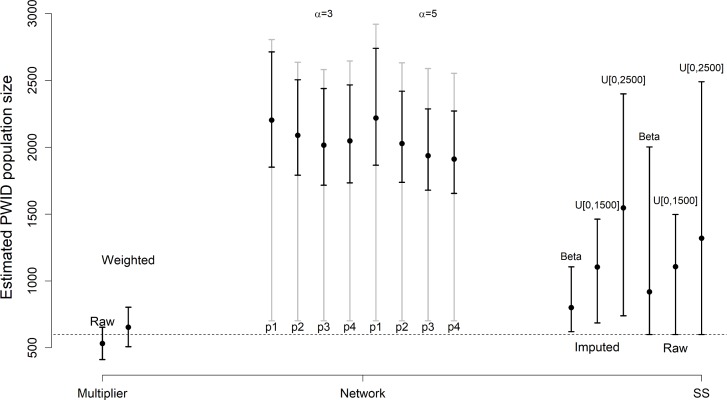
Estimating the size of key risk populations is essential for determining the resources needed to implement effective public health intervention programs. Several standard methods for population size estimation exist, but the statistical and practical assumptions required for their use may not be met when applied to HIV risk groups. We apply three approaches to estimate the number of people who inject drugs (PWID) in the Kohtla-Järve region of Estonia using data from a respondent-driven sampling (RDS) study: the standard "multiplier" estimate gives 654 people (95% CI 509-804), the "successive sampling" method gives estimates between 600 and 2500 people, and a network-based estimate that uses the RDS recruitment chain gives between 700 and 2800 people. We critically assess the strengths and weaknesses of these statistical approaches for estimating the size of hidden or hard-to-reach HIV risk groups.

摘要

估计关键风险人群的规模对于确定实施有效的公共卫生干预项目所需的资源至关重要。存在几种估计人群规模的标准方法,但将其应用于艾滋病毒风险群体时,可能无法满足其使用所需的统计和实际假设。我们运用三种方法,利用应答驱动抽样(RDS)研究的数据,来估计爱沙尼亚科赫特拉-耶尔韦地区注射毒品者(PWID)的人数:标准的“乘数”估计得出654人(95%置信区间509 - 804),“连续抽样”方法得出的估计人数在600至2500人之间,而基于网络的估计(使用RDS招募链)得出的人数在700至2800人之间。我们严格评估了这些统计方法在估计隐藏的或难以接触到的艾滋病毒风险群体规模方面的优缺点。
https://cdn.ncbi.nlm.nih.gov/pmc/blobs/e419/5667832/f80573d20665/pone.0185711.g002.jpg
https://cdn.ncbi.nlm.nih.gov/pmc/blobs/e419/5667832/dbf22d1d235c/pone.0185711.g001.jpg
https://cdn.ncbi.nlm.nih.gov/pmc/blobs/e419/5667832/f80573d20665/pone.0185711.g002.jpg
https://cdn.ncbi.nlm.nih.gov/pmc/blobs/e419/5667832/dbf22d1d235c/pone.0185711.g001.jpg
https://cdn.ncbi.nlm.nih.gov/pmc/blobs/e419/5667832/f80573d20665/pone.0185711.g002.jpg

相似文献

1
Using data from respondent-driven sampling studies to estimate the number of people who inject drugs: Application to the Kohtla-Järve region of Estonia.利用应答者驱动抽样研究的数据估算注射吸毒者人数:爱沙尼亚科赫特拉-耶尔韦地区的应用
PLoS One. 2017 Nov 2;12(11):e0185711. doi: 10.1371/journal.pone.0185711. eCollection 2017.
2
Engagement in HIV care and its correlates among people who inject drugs in St Petersburg, Russian Federation and Kohtla-Järve, Estonia.俄罗斯圣彼得堡和爱沙尼亚科赫特拉-耶尔韦注射吸毒者的艾滋病毒护理参与情况及其相关因素。
Addiction. 2017 Aug;112(8):1421-1431. doi: 10.1111/add.13798. Epub 2017 May 4.
3
Non-fatal overdoses and related risk factors among people who inject drugs in St. Petersburg, Russia and Kohtla-Järve, Estonia.俄罗斯圣彼得堡和爱沙尼亚科赫特拉-耶尔韦注射毒品者中的非致命过量用药及相关风险因素。
BMC Public Health. 2015 Dec 18;15:1255. doi: 10.1186/s12889-015-2604-6.
4
A tale of two cities: stigma and health outcomes among people with HIV who inject drugs in St. Petersburg, Russia and Kohtla-Järve, Estonia.双城故事:俄罗斯圣彼得堡和爱沙尼亚科赫特拉-耶尔韦注射毒品的艾滋病毒感染者的耻辱感与健康状况
Soc Sci Med. 2015 Apr;130:154-61. doi: 10.1016/j.socscimed.2015.02.018. Epub 2015 Feb 16.
5
Differences in risk behaviours and HIV status between primary amphetamines and opioid injectors in Estonia and Russia.爱沙尼亚和俄罗斯原发性苯丙胺类药物和阿片类药物注射使用者的风险行为和艾滋病毒感染状况的差异。
Int J Drug Policy. 2018 Mar;53:96-105. doi: 10.1016/j.drugpo.2017.11.010. Epub 2018 Jan 5.
6
Estimating the number of people who inject drugs using repeated respondent-driven sampling (RDS) in a community-based program: implications for the burden of hepatitis C and HIV infections and harm reduction coverage.利用基于社区的项目中的重复应答者驱动抽样(RDS)估计注射吸毒者人数:对丙型肝炎和 HIV 感染以及减少伤害覆盖范围负担的影响。
AIDS Behav. 2023 Feb;27(2):424-430. doi: 10.1007/s10461-022-03777-4. Epub 2022 Aug 10.
7
Methods to recruit hard-to-reach groups: comparing two chain referral sampling methods of recruiting injecting drug users across nine studies in Russia and Estonia.招募难以接触群体的方法:比较俄罗斯和爱沙尼亚九项研究中两种用于招募注射吸毒者的链式转介抽样方法。
J Urban Health. 2006 Nov;83(6 Suppl):i39-53. doi: 10.1007/s11524-006-9101-2.
8
Estimating the Size of Hidden Populations Using Respondent-driven Sampling Data: Case Examples from Morocco.利用应答驱动抽样数据估计隐性人群规模:摩洛哥的案例
Epidemiology. 2015 Nov;26(6):846-52. doi: 10.1097/EDE.0000000000000362.
9
Hepatitis C bio-behavioural surveys in people who inject drugs-a systematic review of sensitivity to the theoretical assumptions of respondent driven sampling.丙型肝炎病毒在注射吸毒人群中的生物行为学调查——对反应驱动抽样理论假设敏感性的系统评价。
Harm Reduct J. 2017 Jul 11;14(1):44. doi: 10.1186/s12954-017-0172-z.
10
Sampling Males Who Inject Drugs in Haiphong, Vietnam: Comparison of Time-Location and Respondent-Driven Sampling Methods.越南海防市注射吸毒男性的抽样:时间地点抽样法与应答者驱动抽样法的比较
J Urban Health. 2015 Aug;92(4):744-57. doi: 10.1007/s11524-015-9966-z.

引用本文的文献

1
Prevalence of HCV among people who inject drugs in Brussels-a respondent-driven sampling survey.布鲁塞尔注射吸毒人群中丙型肝炎病毒的流行情况-一项应答驱动的抽样调查。
Harm Reduct J. 2020 Feb 21;17(1):11. doi: 10.1186/s12954-020-00358-3.
2
Population Size Estimations Among Hidden Populations Using Respondent-Driven Sampling Surveys: Case Studies From Armenia.利用应答驱动抽样调查对隐性人群进行人口规模估计:来自亚美尼亚的案例研究
JMIR Public Health Surveill. 2019 Mar 14;5(1):e12034. doi: 10.2196/12034.
3
Maximizing respondent-driven sampling field procedures in the recruitment of sexual minorities for health research.

本文引用的文献

1
Hidden population size estimation from respondent-driven sampling: a network approach.基于应答者驱动抽样的隐藏人口规模估计:一种网络方法。
J Am Stat Assoc. 2018;113(522):755-766. doi: 10.1080/01621459.2017.1285775. Epub 2018 Mar 6.
2
Theoretical and Empirical Comparisons of Methods to Estimate the Size of Hard-to-Reach Populations: A Systematic Review.估计难以接触人群规模方法的理论与实证比较:一项系统综述
AIDS Behav. 2017 Jul;21(7):2188-2206. doi: 10.1007/s10461-017-1678-9.
3
People living with HIV in Estonia: engagement in HIV care in 2013.
在为健康研究招募性少数群体时最大化应答驱动抽样现场程序。
SAGE Open Med. 2019 Feb 17;7:2050312119829983. doi: 10.1177/2050312119829983. eCollection 2019.
爱沙尼亚的艾滋病病毒感染者:2013年的艾滋病护理参与情况。
Euro Surveill. 2016 Oct 27;21(43). doi: 10.2807/1560-7917.ES.2016.21.43.30380.
4
Diagnostics for Respondent-driven Sampling.应答驱动抽样的诊断方法。
J R Stat Soc Ser A Stat Soc. 2015 Jan;178(1):241-269. doi: 10.1111/rssa.12059. Epub 2014 May 1.
5
Estimated Number of People Who Inject Drugs in San Francisco, 2005, 2009, and 2012.2005年、2009年及2012年旧金山注射吸毒者估计人数。
AIDS Behav. 2016 Dec;20(12):2914-2921. doi: 10.1007/s10461-015-1268-7.
6
Estimating hidden population size using Respondent-Driven Sampling data.使用应答驱动抽样数据估计隐藏人口规模。
Electron J Stat. 2014;8(1):1491-1521. doi: 10.1214/14-EJS923.
7
Using Capture-Recapture Methods to Estimate the Population of People Who Inject Drugs in Washington, DC.使用捕获-再捕获方法估算华盛顿特区注射毒品者的人数。
AIDS Behav. 2016 Feb;20(2):363-8. doi: 10.1007/s10461-015-1085-z.
8
Critique and lessons learned from using multiple methods to estimate population size of men who have sex with men in Ghana.对在加纳使用多种方法估计男男性行为者人口规模的批判及经验教训
AIDS Behav. 2015 Feb;19 Suppl 1:S16-23. doi: 10.1007/s10461-014-0943-4.
9
A tale of two cities: stigma and health outcomes among people with HIV who inject drugs in St. Petersburg, Russia and Kohtla-Järve, Estonia.双城故事:俄罗斯圣彼得堡和爱沙尼亚科赫特拉-耶尔韦注射毒品的艾滋病毒感染者的耻辱感与健康状况
Soc Sci Med. 2015 Apr;130:154-61. doi: 10.1016/j.socscimed.2015.02.018. Epub 2015 Feb 16.
10
Estimating the size of populations at high risk for HIV using respondent-driven sampling data.利用应答者驱动抽样数据估算艾滋病病毒高风险人群规模。
Biometrics. 2015 Mar;71(1):258-266. doi: 10.1111/biom.12255. Epub 2015 Jan 13.