Institute of Experimental Virology, TWINCORE, Centre for Experimental and Clinical Infection Research, a Joint Venture between the Medical School Hannover (MHH) and the Helmholtz Centre for Infection Research (HZI), 30625 Hannover, Germany.
German Centre for Infection Research (DZIF), Partner Site Hannover-Braunschweig, 38124 Braunschweig, Germany.
Cells. 2019 Mar 12;8(3):233. doi: 10.3390/cells8030233.
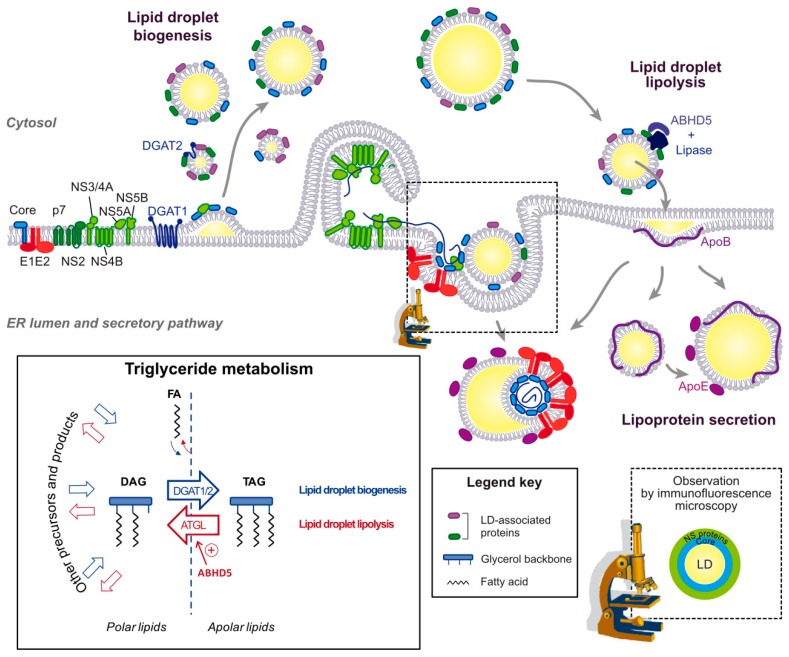
The replication cycle of the liver-tropic hepatitis C virus (HCV) is tightly connected to the host lipid metabolism, during the virus entry, replication, assembly and egress stages, but also while the virus circulates in the bloodstream. This interplay coins viral particle properties, governs viral cell tropism, and facilitates immune evasion. This review summarizes our knowledge of these interactions focusing on the late steps of the virus replication cycle. It builds on our understanding of the cell biology of lipid droplets and the biosynthesis of liver lipoproteins and attempts to explain how HCV hijacks these organelles and pathways to assemble its lipo-viro-particles. In particular, this review describes (i) the mechanisms of viral protein translocation to and from the lipid droplet surface and the orchestration of an interface between replication and assembly complexes, (ii) the importance of the triglyceride mobilization from the lipid droplets for HCV assembly, (iii) the interplay between HCV and the lipoprotein synthesis pathway including the role played by apolipoproteins in virion assembly, and finally (iv) the consequences of these complex virus⁻host interactions on the virion composition and its biophysical properties. The wealth of data accumulated in the past years on the role of the lipid metabolism in HCV assembly and its imprint on the virion properties will guide vaccine design efforts and reinforce our understanding of the hepatic lipid metabolism in health and disease.
肝嗜性丙型肝炎病毒 (HCV) 的复制周期与宿主脂质代谢紧密相关,贯穿于病毒进入、复制、组装和出芽等各个阶段,也存在于病毒在血液中循环时。这种相互作用影响病毒粒子的特性、决定病毒的细胞嗜性,并促进免疫逃逸。本文综述了这些相互作用的最新知识,重点关注病毒复制周期的后期步骤。它以我们对脂滴的细胞生物学和肝脏脂蛋白生物合成的理解为基础,试图解释 HCV 如何劫持这些细胞器和途径来组装其脂质病毒颗粒。具体而言,本文描述了 (i) 病毒蛋白向和从脂滴表面的易位机制,以及复制和组装复合物之间接口的协调,(ii) 从脂滴中动员甘油三酯对 HCV 组装的重要性,(iii) HCV 与脂蛋白合成途径的相互作用,包括载脂蛋白在病毒组装中的作用,最后 (iv) 这些复杂的病毒-宿主相互作用对病毒粒子组成及其物理性质的影响。过去几年积累的大量关于脂质代谢在 HCV 组装中的作用及其对病毒粒子特性的影响的数据将指导疫苗设计工作,并加深我们对健康和疾病状态下肝脏脂质代谢的理解。