Institut Jacques Monod, CNRS, UMR 7592, Université Paris Diderot, Sorbonne Paris Cité, 75013 Paris, France.
Université Paris-Sud, Université Paris-Saclay, 91405 Orsay, France.
Biomolecules. 2018 Jul 5;8(3):45. doi: 10.3390/biom8030045.
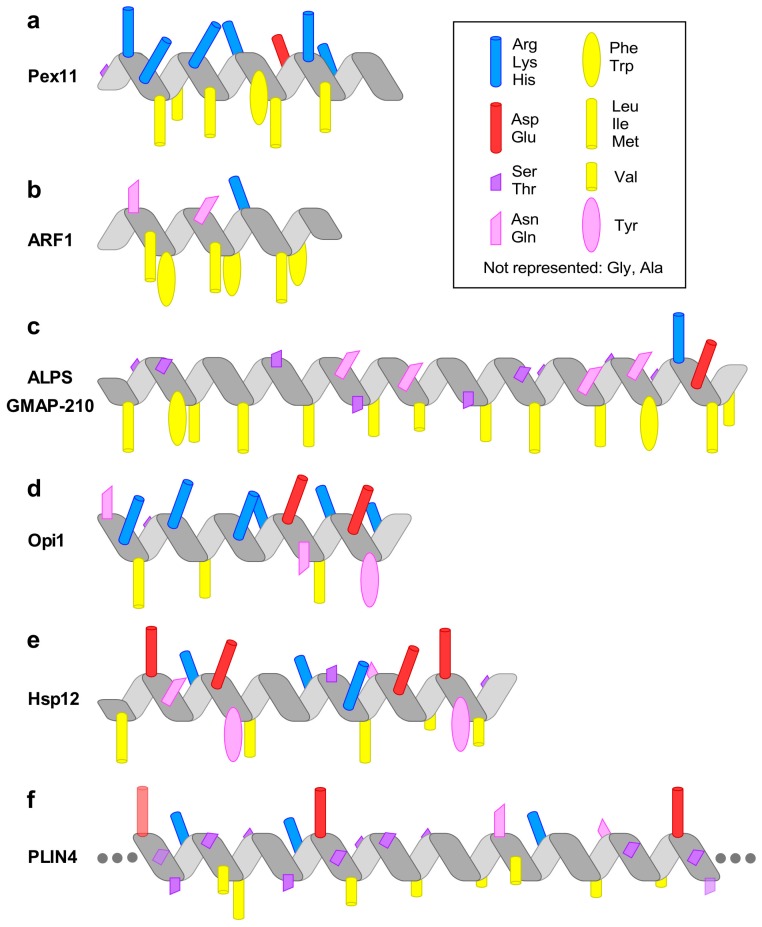
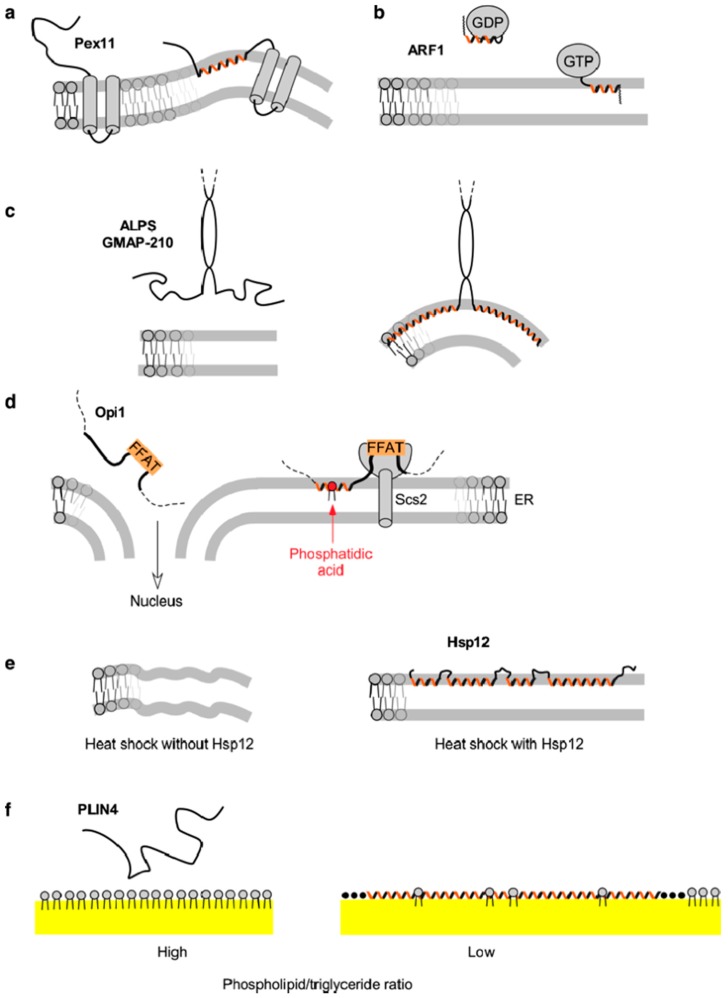
Amphipathic helices (AHs), a secondary feature found in many proteins, are defined by their structure and by the segregation of hydrophobic and polar residues between two faces of the helix. This segregation allows AHs to adsorb at polar⁻apolar interfaces such as the lipid surfaces of cellular organelles. Using various examples, we discuss here how variations within this general scheme impart membrane-interacting AHs with different interfacial properties. Among the key parameters are: (i) the size of hydrophobic residues and their density per helical turn; (ii) the nature, the charge, and the distribution of polar residues; and (iii) the length of the AH. Depending on how these parameters are tuned, AHs can deform lipid bilayers, sense membrane curvature, recognize specific lipids, coat lipid droplets, or protect membranes from stress. Via these diverse mechanisms, AHs play important roles in many cellular processes.
两亲性螺旋(AHs)是许多蛋白质中存在的二级结构特征,其定义为结构特征以及疏水性和极性残基在螺旋的两个面上的分隔。这种分隔允许 AHs 在极性-非极性界面(如细胞细胞器的脂质表面)上吸附。在这里,我们将通过各种示例讨论这种一般方案中的变化如何赋予具有不同界面特性的膜相互作用 AHs。关键参数包括:(i)疏水性残基的大小及其每螺旋圈的密度;(ii)极性残基的性质、电荷和分布;以及(iii)AH 的长度。根据这些参数的调整方式,AHs 可以使脂质双层变形、感知膜曲率、识别特定脂质、包裹脂滴或保护膜免受压力。通过这些不同的机制,AHs 在许多细胞过程中发挥重要作用。