Department of Emergency Medicine, Second Affiliated Hospital, School of Medicine & Institute of Emergency Medicine, Zhejiang University, No 88, Jiefang Rd, Hangzhou, China.
Yuhang Branch of The Second Affiliated Hospital of Zhenjiang University, No.369 Yingbin Road, Yuhang District, Hangzhou, 311100, Zhenjiang Province, China.
Crit Care. 2019 Mar 14;23(1):91. doi: 10.1186/s13054-019-2362-4.
The aim of this study was to evaluate the effects and safety of vasopressin receptor agonists in patients with septic shock.
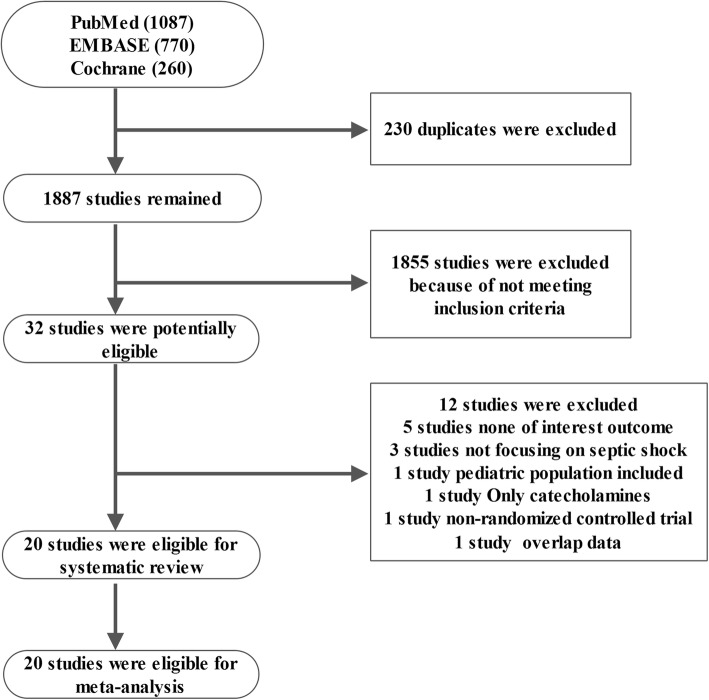
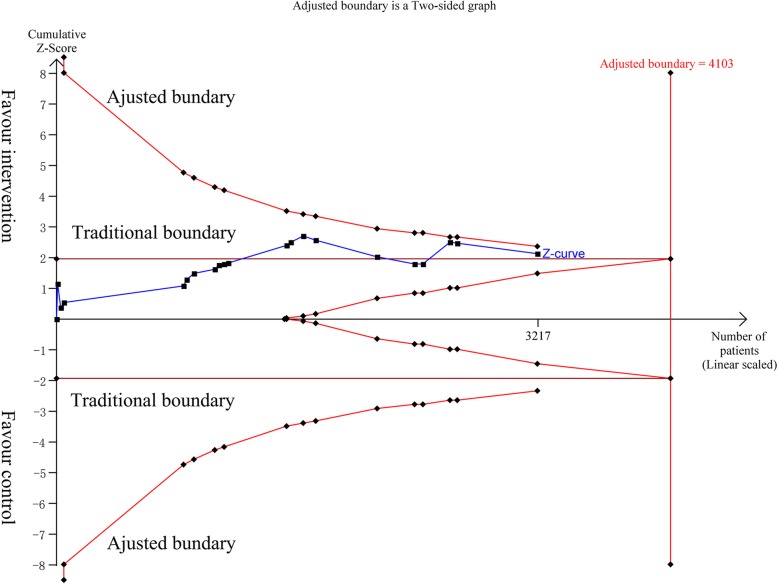
PubMed, EMBASE, and Cochrane library were searched for randomized controlled trials evaluating the effects of vasopressin receptor agonists in septic shock patients. Two reviewers performed literature selection, data extraction, and quality evaluation independently. The primary outcome was mortality. And secondary outcomes included intensive care unit (ICU) length of stay, duration of mechanical ventilation, and incidence of adverse events. In addition, a trial sequential analysis (TSA) was performed.
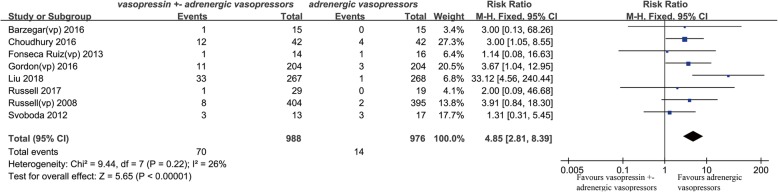
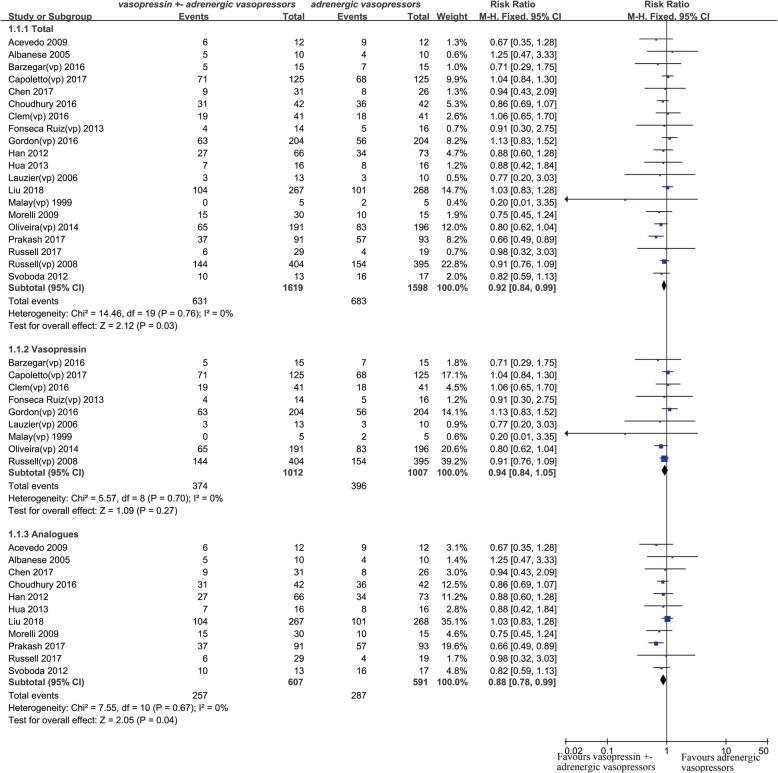
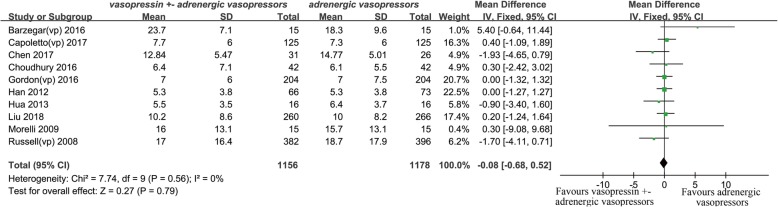
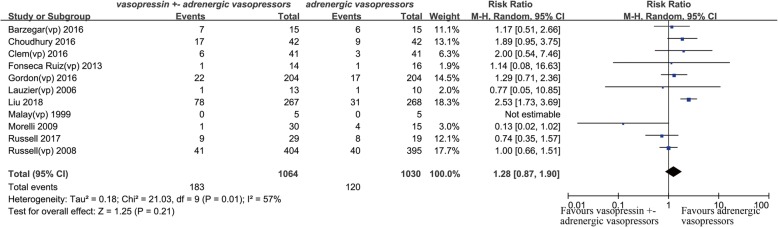
Twenty studies were eligible for meta-analysis. The results showed vasopressin receptor agonists use was associated with reduced mortality (relative risk (RR) 0.92; 95% confidence interval (CI) 0.84 to 0.99; I = 0%). Nevertheless, they had no significant effects on ICU length of stay (mean deviation (MD) - 0.08, 95% CI, - 0.68 to 0.52, I = 0%) and duration of mechanical ventilation (MD - 0.58, 95% CI - 1.47 to 0.31, I = 57%). Additionally, there was no significant difference in total adverse events between two groups (RR 1.28, 95% CI 0.87 to 1.90, I = 57%), but vasopressin receptor agonists administration could significantly increase the risk of digital ischemia (RR 4.85, 95% CI 2.81 to 8.39, I = 26%). Finally, there was no statistical difference of cardiovascular events (RR 0.91, 95% CI 0.53 to 1.57, I = 1%), arrhythmia (0.77, 95% CI 0.48 to 1.23, I = 23%), mesenteric ischemia (0.83, 95% CI 0.44 to 1.55, I = 0%), diarrhea (2.47, 95% CI 0.77 to 7.96, I = 49%), cerebrovascular events (1.36, 95% CI 0.18 to 10.54, I = 0%), and hyponatremia (1.47, 95% CI 0.84 to 2.55, I = 0%) between two groups. Egger's test showed there was no significant publication bias among studies (P = 0.36).
The use of vasopressin might result in reduced mortality in patients with septic shock. An increased risk of digital ischemia must be taken into account.
本研究旨在评估血管加压素受体激动剂在脓毒性休克患者中的疗效和安全性。
检索 PubMed、EMBASE 和 Cochrane 图书馆中评估血管加压素受体激动剂在脓毒性休克患者中的疗效的随机对照试验。两名评审员独立进行文献筛选、数据提取和质量评估。主要结局为死亡率。次要结局包括重症监护病房(ICU)住院时间、机械通气时间和不良事件发生率。此外,还进行了试验序贯分析(TSA)。
有 20 项研究符合荟萃分析的条件。结果表明,血管加压素受体激动剂的使用与死亡率降低相关(相对风险(RR)0.92;95%置信区间(CI)0.84 至 0.99;I = 0%)。然而,它们对 ICU 住院时间(平均差值(MD)-0.08,95%CI,-0.68 至 0.52,I = 0%)和机械通气时间(MD -0.58,95%CI -1.47 至 0.31,I = 57%)没有显著影响。此外,两组之间的总不良事件发生率无显著差异(RR 1.28,95%CI 0.87 至 1.90,I = 57%),但血管加压素受体激动剂的使用可显著增加手指缺血的风险(RR 4.85,95%CI 2.81 至 8.39,I = 26%)。最后,心血管事件(RR 0.91,95%CI 0.53 至 1.57,I = 1%)、心律失常(RR 0.77,95%CI 0.48 至 1.23,I = 23%)、肠系膜缺血(RR 0.83,95%CI 0.44 至 1.55,I = 0%)、腹泻(RR 2.47,95%CI 0.77 至 7.96,I = 49%)、脑血管事件(RR 1.36,95%CI 0.18 至 10.54,I = 0%)和低钠血症(RR 1.47,95%CI 0.84 至 2.55,I = 0%)发生率两组间无统计学差异。Egger 检验显示研究间无显著发表偏倚(P = 0.36)。
血管加压素的使用可能降低脓毒性休克患者的死亡率。但必须考虑到手指缺血的风险增加。