Department of Agricultural Microbiology, Faculty of Agricultural Sciences, Aligarh Muslim University, Aligarh, 202002, India.
Sci Rep. 2019 Mar 14;9(1):4547. doi: 10.1038/s41598-019-40864-4.
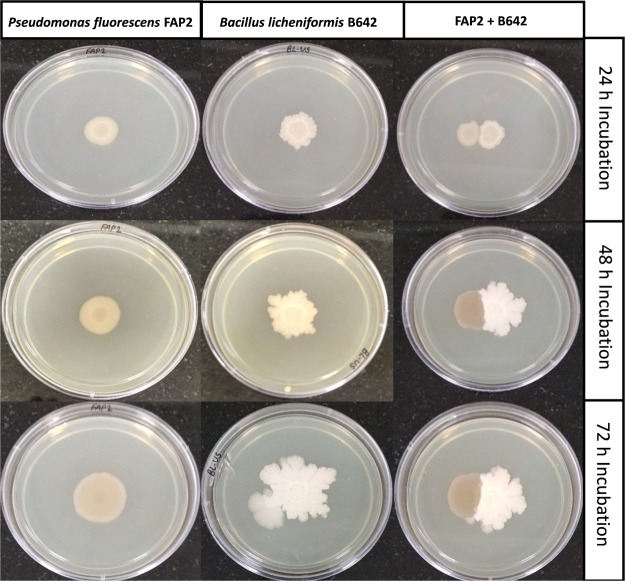
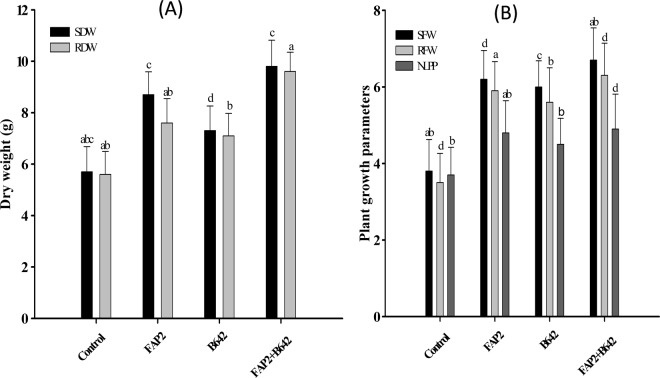
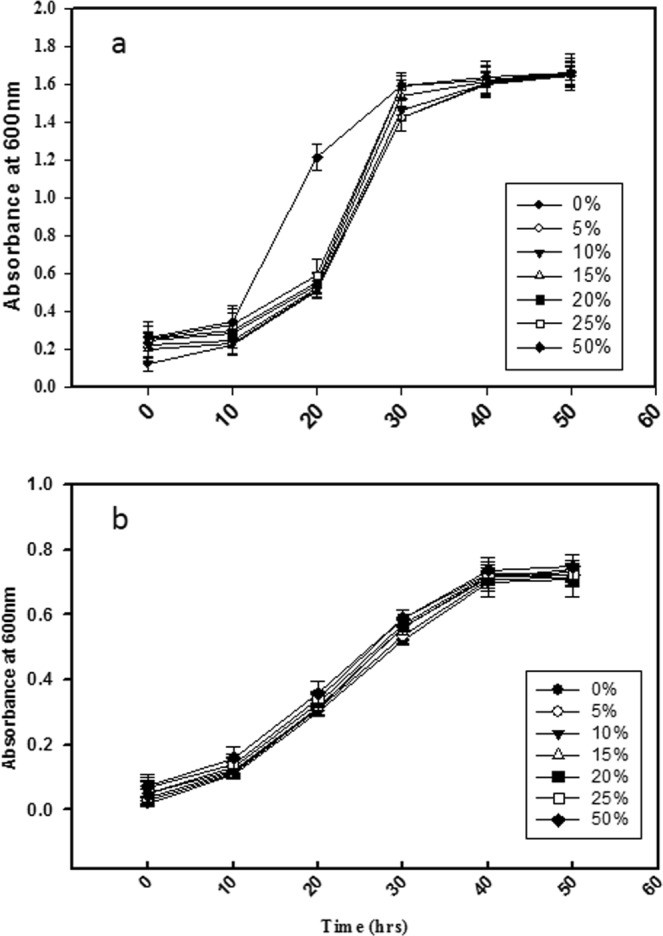
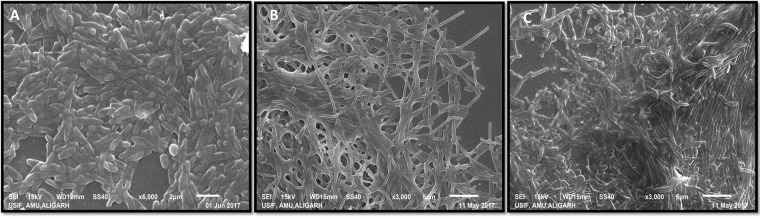
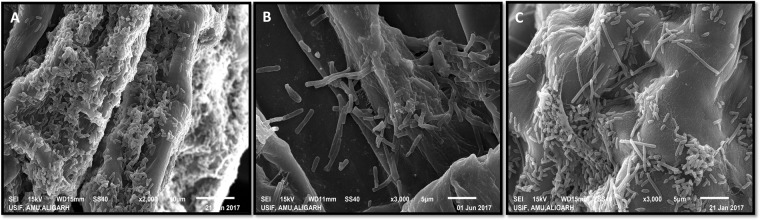
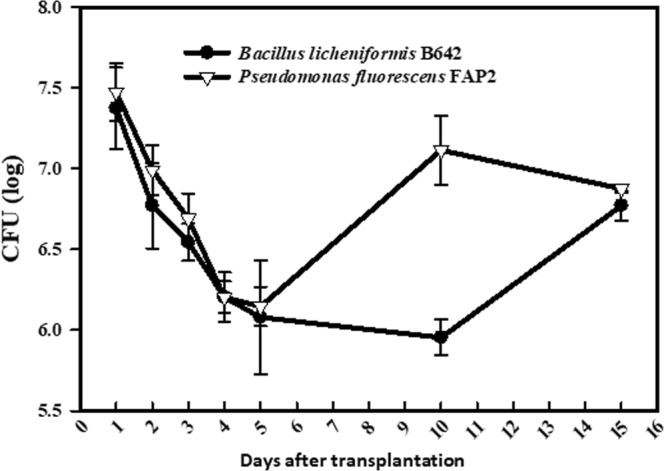
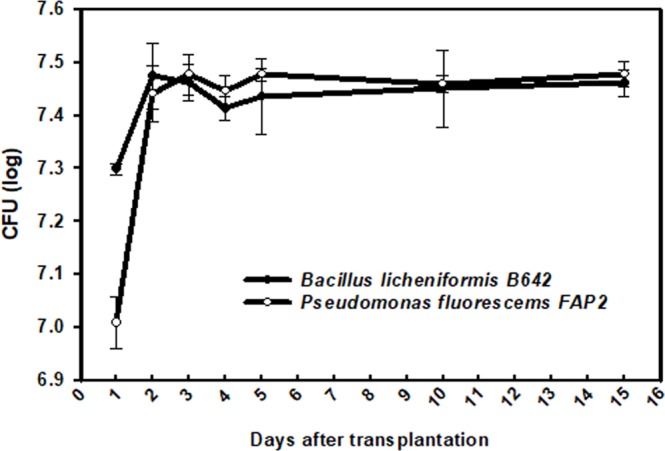
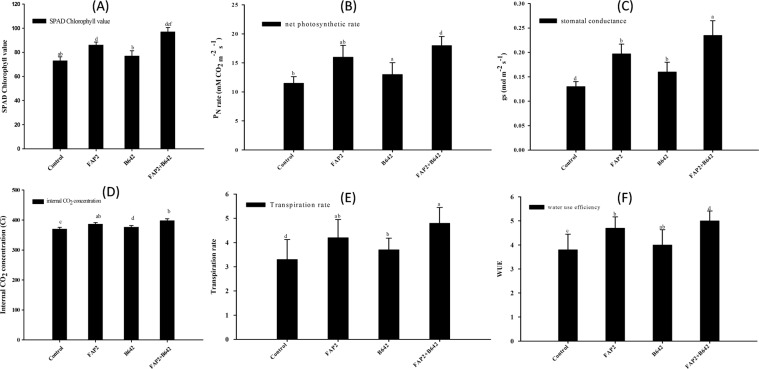
Compatible interaction between commonly used plant growth promoting rhizobacteria (PGPR) in biofilm mode in vitro and in the rhizosphere is expected to provide better understanding for the development of effective consortium. With the above hypothesis, the present study evaluated two characterized PGPR (Pseudomonas fluorescens FAP2 and Bacillus licheniformis B642) for their biofilm-related functions using standard protocols. The interaction between the FAP2 and B642 in planktonic mode was studied by plate spot/overlay method and competitive growth assessment. Biofilm development on a microtitre plate and a glass surface was studied by standard methods. Biofilm formation was characterized by SEM. Rhizosphere and rhizoplane colonization of wheat seedlings by both isolates individually and by co-inoculation was studied by determining CFU/g of soil/root samples. Biofilm development on the root surface was further analyzed by SEM. Both isolates demonstrated multiple plant growth promoting (PGP) traits (production of IAA, siderophore, and ammonia; phosphate solubilization) and biofilm-related functions such as production of EPS, alginate, cell surface hydrophobicity and swarming motility. Both strains formed strong biofilms on a glass cover slip in vitro. Interaction between the two strains under the planktonic mode revealed no antagonism in terms of growth inhibition and competitive growth kinetics. Similarly, FAP2 and B642 strains formed a mixed biofilm on a glass cover slip as well as on seedling roots. Wheat rhizosphere and rhizoplane were colonized by both isolates as evidenced from their viable counts in single and co-inoculation. The effect of single and co inoculation revealed the significant enhancement of vegetative growth and photosynthetic parameters such as chlorophyll content, transpiration rate (E), internal CO concentration (Ci), stomatal conductance (g), and net photosynthetic rate (P) and leaf water potential (LWP) as compared to uninoculated control. Indigenous Pseudomonas fluorescens FAP2 strain and Bacillus licheniformis B642 are compatible PGPR in both planktonic and biofilm modes of growth and threfore could be developed effective consortium of PGPR. Further indepth investigation is required to understand molecular mechanism of the interaction in biofilm mode of growth under natural condition.
在体外生物膜模式下,常用植物促生根际细菌(PGPR)之间的相容相互作用预计将为开发有效的联合体提供更好的理解。基于上述假设,本研究使用标准方案评估了两种经过表征的 PGPR(荧光假单胞菌 FAP2 和地衣芽孢杆菌 B642)的生物膜相关功能。通过平板点/覆盖法和竞争生长评估研究了 FAP2 和 B642 在浮游模式下的相互作用。通过标准方法研究了微量滴定板和玻璃表面上的生物膜发展。通过 SEM 表征生物膜形成。通过确定土壤/根样本中的 CFU/g 来研究两种分离株单独和共同接种时对小麦幼苗根际和根面的定殖。通过 SEM 进一步分析根表面的生物膜发展。两种分离株均表现出多种植物生长促进(PGP)特性(产生 IAA、铁载体和氨;磷酸盐溶解)和生物膜相关功能,如 EPS、海藻酸盐、细胞表面疏水性和群集运动的产生。两种菌株在体外玻璃盖玻片上均形成了强生物膜。在浮游模式下,两种菌株之间的相互作用在生长抑制和竞争生长动力学方面没有表现出拮抗作用。同样,FAP2 和 B642 菌株在玻璃盖玻片以及幼苗根上形成了混合生物膜。从单接种和共接种的活菌计数中可以看出,两种分离株都定殖在小麦根际和根面。与未接种对照相比,单接种和共接种的效果显著提高了营养生长和光合参数,如叶绿素含量、蒸腾速率(E)、内部 CO 浓度(Ci)、气孔导度(g)、净光合速率(P)和叶片水势(LWP)。土著荧光假单胞菌 FAP2 菌株和地衣芽孢杆菌 B642 是在浮游和生物膜生长模式下均相容的 PGPR,因此可以开发有效的 PGPR 联合体。需要进一步深入研究以了解自然条件下生物膜生长模式下相互作用的分子机制。