Zhang Xiaochen, Gong Qin
Department of Biomedical Engineering, School of Medicine, Tsinghua University, Beijing, China.
Research Center of Biomedical Engineering, Graduate School at Shenzhen, Tsinghua University, Shenzhen, China.
Front Neurosci. 2019 Feb 26;13:130. doi: 10.3389/fnins.2019.00130. eCollection 2019.
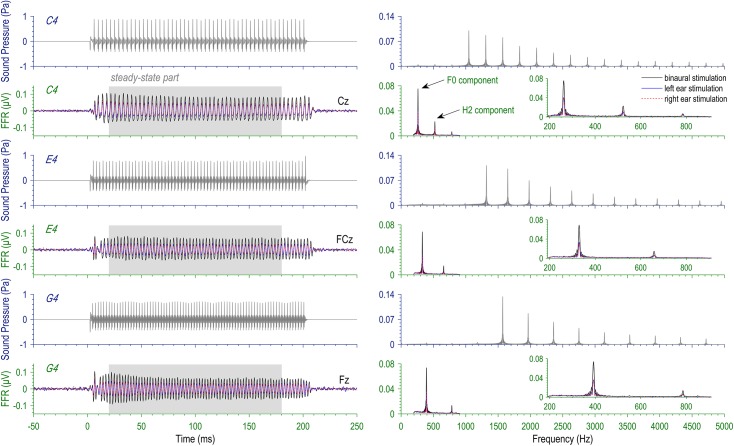
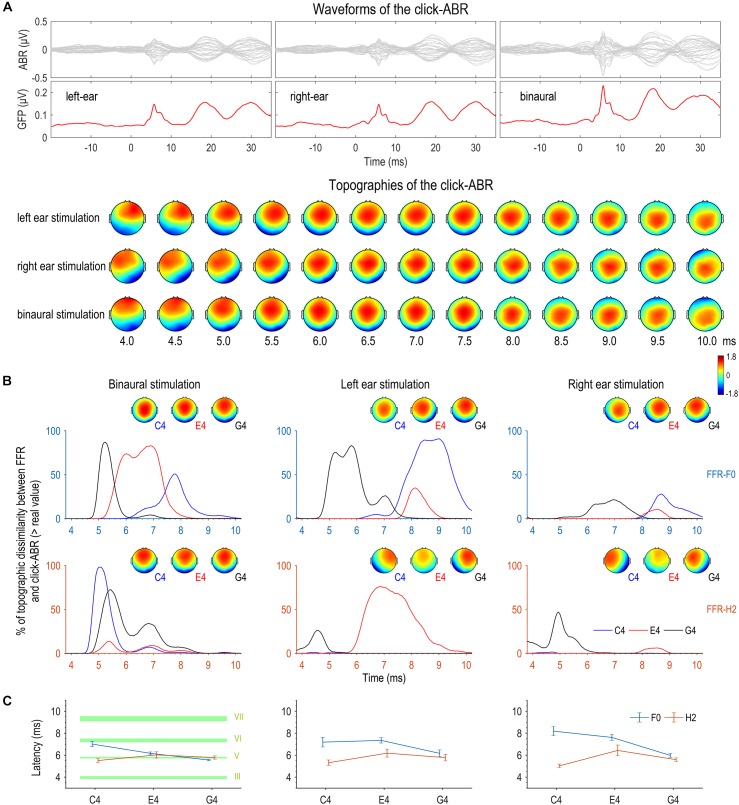
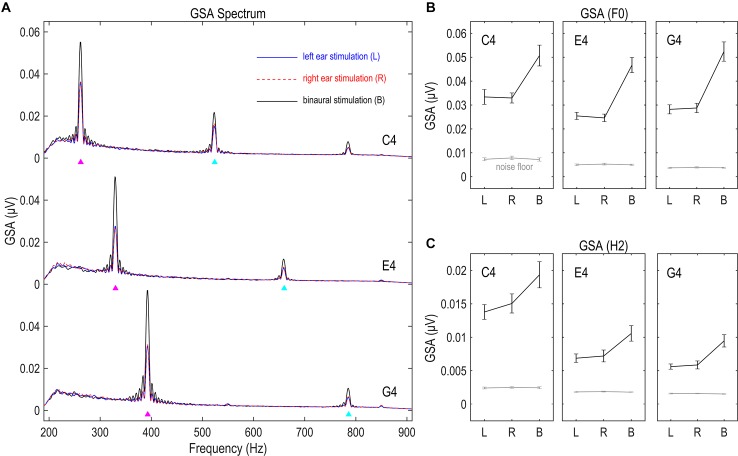
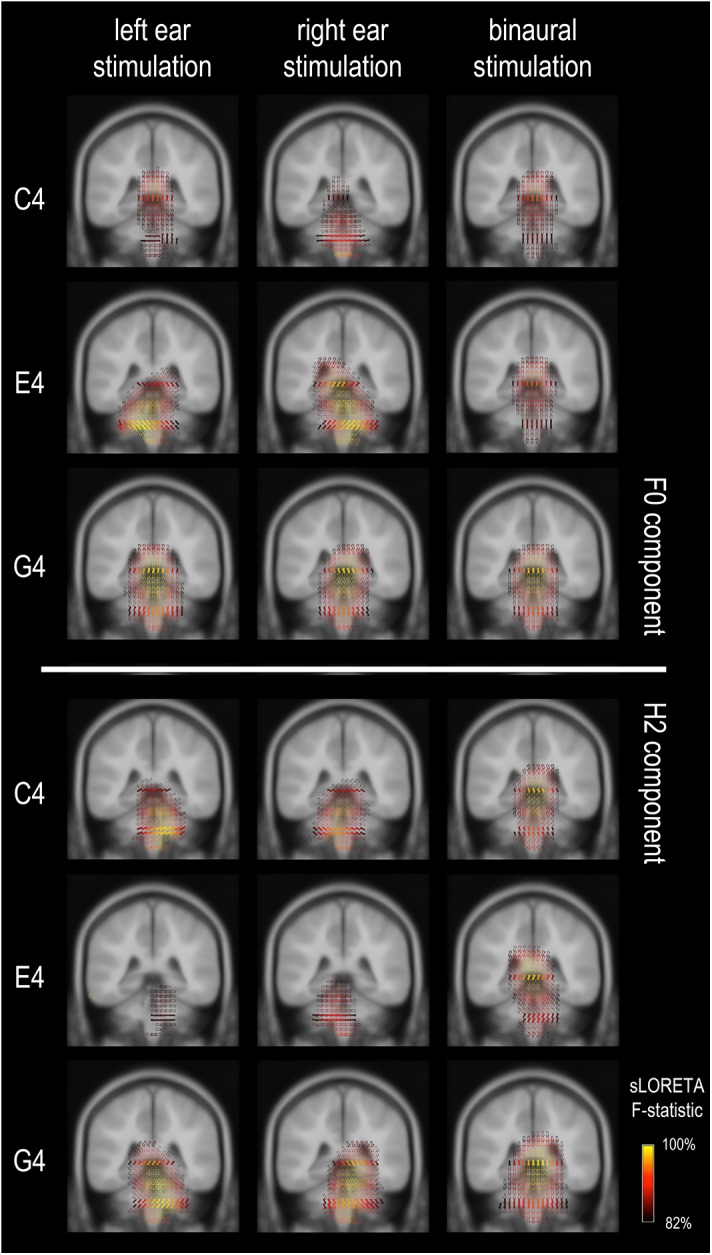
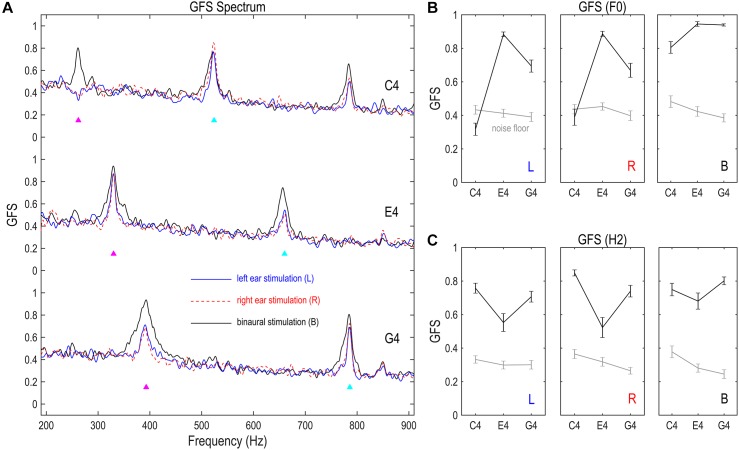
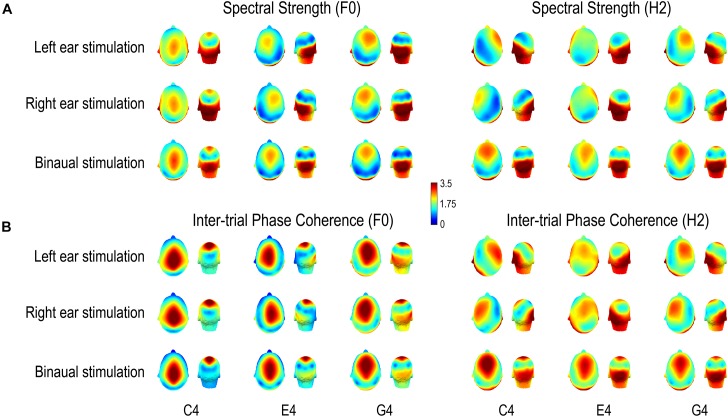
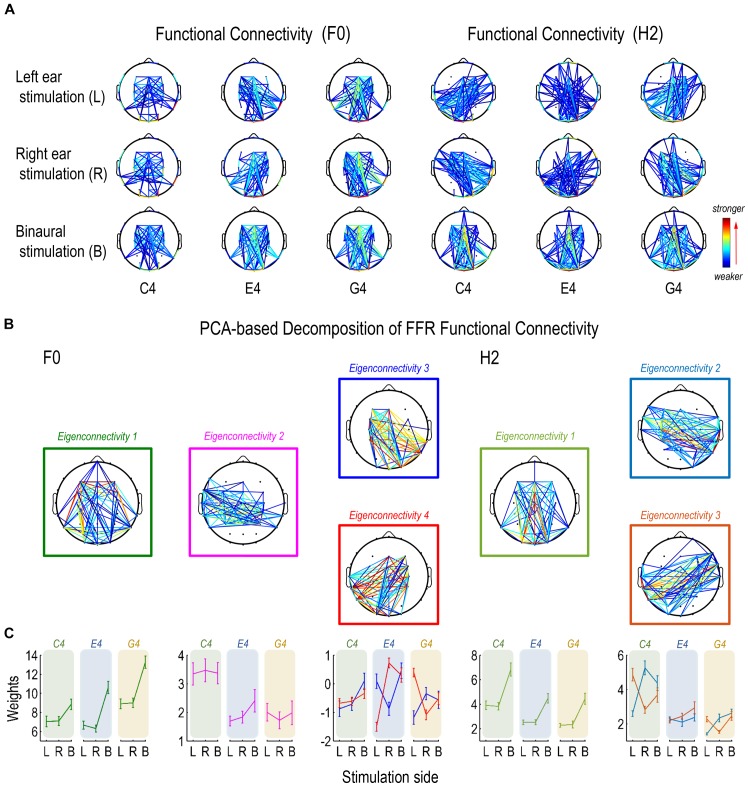
The neural generators of the frequency-following response (FFR), a neural response widely used to study the human auditory system, remain unclear. There is evidence that the balance between cortical and subcortical contributions to the FFR varies with stimulus frequency. In this study, we tried to clarify whether this variation extended to subcortical nuclei at higher stimulus frequencies where cortical sources were inactive. We evoked FFRs, in 17 human listeners with normal hearing (9 female), with three complex tones with missing-fundamentals corresponding to musical tones C4 (262 Hz), E4 (330 Hz), and G4 (393 Hz) presented to left, right, or both ears. Source imaging results confirmed the dominance of subcortical activity underlying both fundamental frequency (F0) and second harmonic (H2) components of the FFR. Importantly, several FFR features (spatial complexity, scalp distributions of spectral strength and inter-trial phase coherence, and functional connectivity patterns) varied systematically with stimulus F0, suggesting an unfixed source configuration. We speculated that the variation of FFR source configuration with stimulus frequency resulted from changing relative contributions of subcortical nuclei. Supportively, topographic comparison between the FFR and the auditory brainstem response (ABR) evoked by clicks revealed that the topography of the F0 component resembled that of the click-ABR at an earlier latency when stimulus F0 was higher and that the topography of the H2 component resembled that of the click-ABR at a nearly fixed latency regardless of stimulus F0, particularly for binaurally evoked FFRs. Possible generation sites of the FFR and implications for future studies were discussed.
频率跟随反应(FFR)是一种广泛用于研究人类听觉系统的神经反应,其神经发生器尚不清楚。有证据表明,皮质和皮质下对FFR的贡献之间的平衡随刺激频率而变化。在本研究中,我们试图阐明这种变化是否扩展到更高刺激频率下皮质源不活跃时的皮质下核。我们对17名听力正常的人类受试者(9名女性)进行测试,向其左耳、右耳或双耳呈现三种对应于音乐音调C4(262 Hz)、E4(330 Hz)和G4(393 Hz)的缺基复音来诱发FFR。源成像结果证实了FFR的基频(F0)和二次谐波(H2)成分背后皮质下活动的主导地位。重要的是,几个FFR特征(空间复杂性、频谱强度的头皮分布和试验间相位相干性以及功能连接模式)随刺激F0系统地变化,表明源配置不固定。我们推测FFR源配置随刺激频率的变化是由皮质下核相对贡献的变化引起的。支持这一推测的是,FFR与点击诱发的听觉脑干反应(ABR)之间的地形比较表明,当刺激F0较高时,F0成分的地形在较早潜伏期类似于点击ABR的地形,而H2成分的地形在几乎固定的潜伏期类似于点击ABR的地形,与刺激F0无关,特别是对于双耳诱发的FFR。文中讨论了FFR可能的产生部位以及对未来研究的启示。