Sanchez-Arcos Carlos, Kai Marco, Svatoš Aleš, Gershenzon Jonathan, Kunert Grit
Department of Biochemistry, Max-Planck Institute for Chemical Ecology, Jena, Germany.
Research Group Mass Spectrometry/Proteomics, Max-Planck Institute for Chemical Ecology, Jena, Germany.
Front Plant Sci. 2019 Feb 28;10:188. doi: 10.3389/fpls.2019.00188. eCollection 2019.
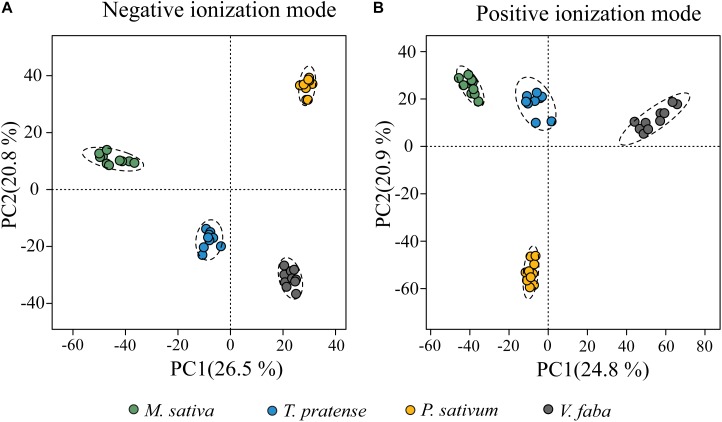
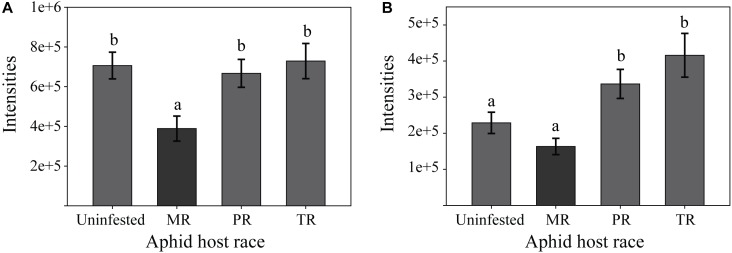
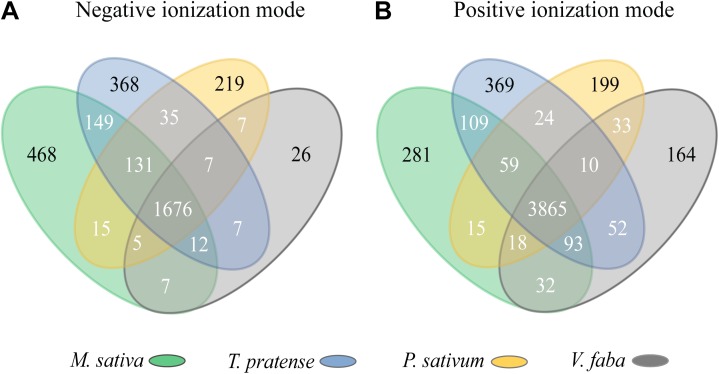
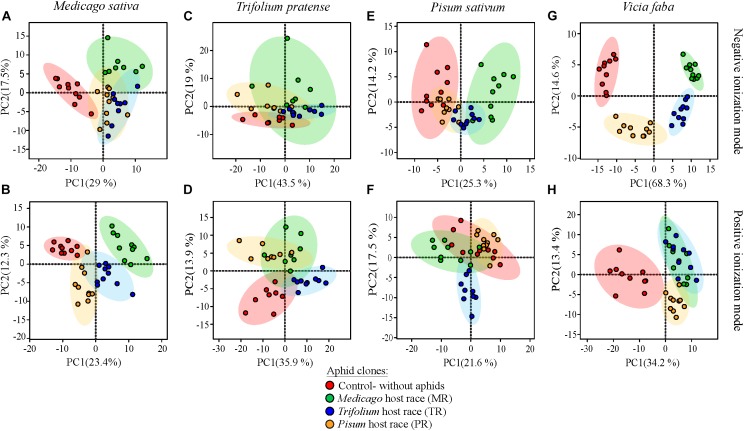
The pea aphid (), a phloem-sucking insect, has undergone a rapid radiation together with the domestication and anthropogenic range expansion of several of its legume host plants. This insect species is a complex of at least 15 genetically different host races that can all develop on the universal host plant . However, each host race is specialized on a particular plant species, such as , , or , which makes it an attractive model insect to study ecological speciation. Previous work revealed that pea aphid host plants produce a specific phytohormone profile depending on the host plant - host race combination. Native aphid races induce lower defense hormone levels in their host plant than non-native pea aphid races. Whether these changes in hormone levels also lead to changes in other metabolites is still unknown. We used a mass spectrometry-based untargeted metabolomic approach to identify plant chemical compounds that vary among different host plant-host race combinations and might therefore, be involved in pea aphid host race specialization. We found significant differences among the metabolic fingerprints of the four legume species studied prior to aphid infestation, which correlated with aphid performance. After infestation, the metabolic profiles of and plants infested with their respective native aphid host race were consistently different from profiles after infestation with non-native host races and from uninfested control plants. The metabolic profiles of plants infested with their native aphid host race were also different from plants infested with non-native host races, but not different from uninfested control plants. The compounds responsible for these differences were putatively identified as flavonoids, saponins, non-proteinogenic amino acids and peptides among others. As members of these compound classes are known for their activity against insects and aphids in particular, they may be responsible for the differential performance of host races on native vs. non-native host plants. We conclude that the untargeted metabolomic approach is suitable to identify candidate compounds involved in the specificity of pea aphid - host plant interactions.
豌豆蚜是一种吸食韧皮部的昆虫,它与几种豆科寄主植物的驯化及人为范围扩张一同经历了快速的辐射演化。这种昆虫物种是一个由至少15个基因不同的寄主族组成的复合体,它们都能在通用寄主植物上发育。然而,每个寄主族都专门适应一种特定的植物物种,比如苜蓿、三叶草或豌豆,这使其成为研究生态物种形成的一个有吸引力的模式昆虫。先前的研究表明,豌豆蚜的寄主植物会根据寄主植物 - 寄主族组合产生特定的植物激素谱。本地蚜虫族在其寄主植物中诱导产生的防御激素水平低于非本地豌豆蚜族。这些激素水平的变化是否也会导致其他代谢物的变化仍然未知。我们采用基于质谱的非靶向代谢组学方法来鉴定在不同寄主植物 - 寄主族组合中存在差异的植物化合物,这些化合物可能参与了豌豆蚜寄主族的特化过程。我们发现,在蚜虫侵染之前,所研究的四种豆科植物的代谢指纹存在显著差异,这与蚜虫的表现相关。侵染后,被其各自本地蚜虫寄主族侵染后的苜蓿和三叶草植物的代谢谱与被非本地寄主族侵染后的代谢谱以及未侵染的对照植物的代谢谱始终不同。被其本地蚜虫寄主族侵染后的豌豆植物的代谢谱也与被非本地寄主族侵染后的植物不同,但与未侵染的对照植物没有差异。造成这些差异的化合物被推测为黄酮类化合物、皂苷、非蛋白质氨基酸和肽等。由于这些化合物类别的成员尤其以其对昆虫和蚜虫的活性而闻名,它们可能是导致寄主族在本地与非本地寄主植物上表现差异的原因。我们得出结论,非靶向代谢组学方法适用于鉴定参与豌豆蚜 - 寄主植物相互作用特异性的候选化合物。