Murray Nicholas G, Fernandez Eileen, Salvatore Anthony P, Reed-Jones Rebecca J
School of Health and Kinesiology, College of Health Sciences, Georgia Southern University, Georgia, United States.
Speech Language Pathology Program, College of Health Sciences, University of Texas at El Paso, Texas, United States.
J Clin Transl Res. 2016 Dec 12;2(4):123-128. eCollection 2017 Jan 4.
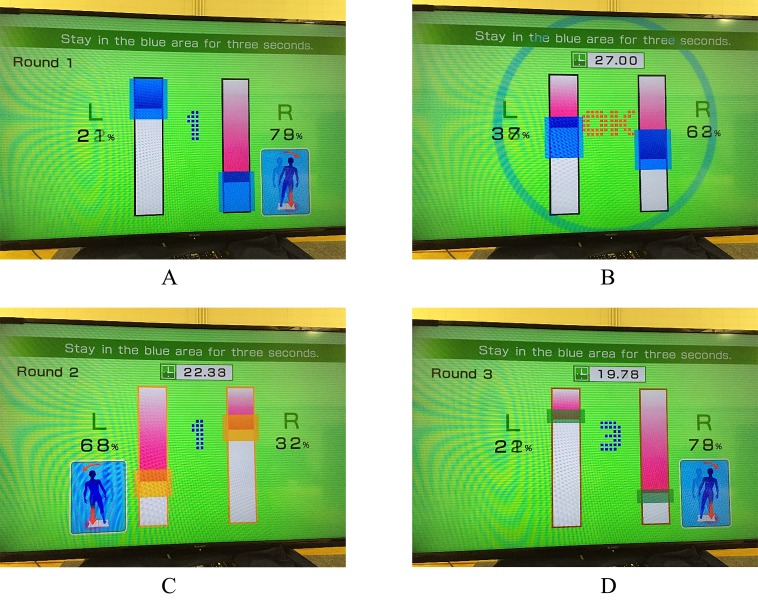
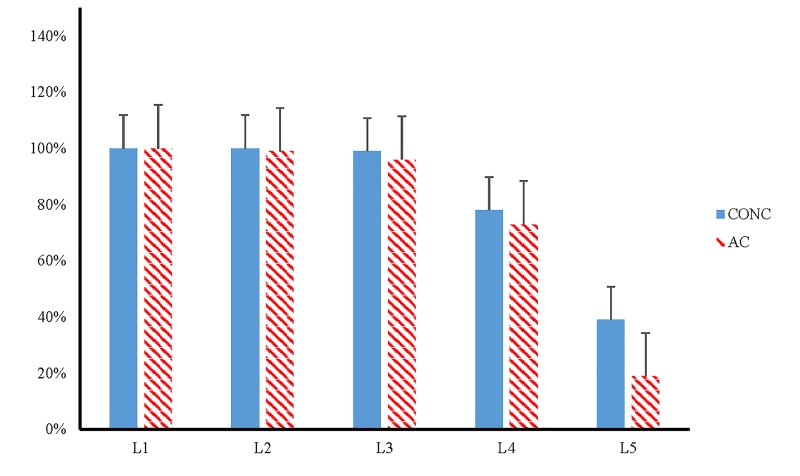
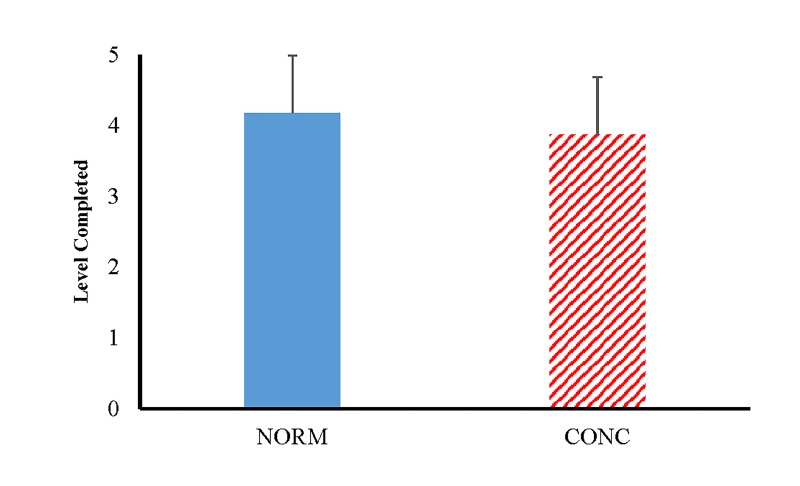
To evaluate the Wii Basic Balance Test (WBBT), as a tool for detecting postural instability in athletes with concussions. Seventy-nine healthy physically active controls (NORM) (mean age 21.23 ± 1.78), and fifty-six athletes with concussions (CONC) (mean age 19.39 ± 2.145) participated in this study. All participants performed the Wii Basic Balance Test, which requires the participants to shift weight mediolaterally to maintain a red bar within a blue area denoted on the screen for three seconds during set levels of difficulty. CONC were included in the study within 24-48 hours of the initial concussion injury. Seven one-way ANOVAs assessed differences for each (1) Mean total number of WBBT Levels completed (TL), (2) Mean total seconds to complete all WBBT Level (TT), (3) Time to complete Level 1 (LI), (4) Time to complete Level 2 (L2), (5) Time to complete Level 3 (L3), (6) Time to complete Level 4 (L4), (7) Time to complete Level 5 (L5). CONC completed significantly fewer Levels of the WBBT (p=0.032) when compared to NORM. Athletes with Concussions took a significantly longer time to complete LI (p=0.002) when compared to CONC. Post-hoc Chi-Square analysis determined a significantly greater (p=0.015) proportion (39%) of CONC successfully completed WBBT L5 when compared to the proportion (19%) of CONC. Follow up ROC curves revealed an Sn = 0.392 and an Sp = 0.821 for TL with a cutoff value of 4 levels, Sn=0.875 and an Sp = 0.253 for LI with a cutoff value of 4.4 seconds, and Sn = 0.804 and an Sp = 0.392 for those who successfully completed the WBBT L5. WBBT could be a low cost object method of assessing postural instability within 24-48 hours post-concussion. This data could provide health providers with an alternative method to measure the presence of postural instability post-concussion injury.
评估Wii基本平衡测试(WBBT)作为检测脑震荡运动员姿势不稳的工具。79名健康的体育活动对照组(NORM)(平均年龄21.23±1.78)和56名脑震荡运动员(CONC)(平均年龄19.39±2.145)参与了本研究。所有参与者都进行了Wii基本平衡测试,该测试要求参与者在设定的难度水平下,左右移动体重以将屏幕上蓝色区域内的红色条保持三秒。CONC在初次脑震荡损伤后的24 - 48小时内被纳入研究。七个单因素方差分析评估了以下各项的差异:(1)完成的WBBT级别总数平均值(TL),(2)完成所有WBBT级别的总秒数平均值(TT),(3)完成第1级别的时间(LI),(4)完成第2级别的时间(L2),(5)完成第3级别的时间(L3),(6)完成第4级别的时间(L4),(7)完成第5级别的时间(L5)。与NORM相比,CONC完成的WBBT级别显著更少(p = 0.032)。与CONC相比,脑震荡运动员完成LI的时间显著更长(p = 0.002)。事后卡方分析确定,与CONC的比例(19%)相比,CONC成功完成WBBT L5的比例(39%)显著更高(p = 0.015)。后续的ROC曲线显示,TL的Sn = 0.392,Sp = 0.821,临界值为4级;LI的Sn = 0.875,Sp = 0.253,临界值为4.4秒;成功完成WBBT L5者的Sn = 0.804,Sp = 0.392。WBBT可能是一种低成本的客观方法,用于评估脑震荡后24 - 48小时内的姿势不稳。这些数据可为医疗服务提供者提供一种测量脑震荡损伤后姿势不稳情况的替代方法。