Ramachandran Anup, Visschers Ruben G J, Duan Luqi, Akakpo Jephte Y, Jaeschke Hartmut
Department of Pharmacology, Toxicology & Therapeutics, University of Kansas Medical Center, Kansas City, KS, United States.
J Clin Transl Res. 2018 May 28;4(1):75-100. doi: 10.18053/jctres.04.201801.005.
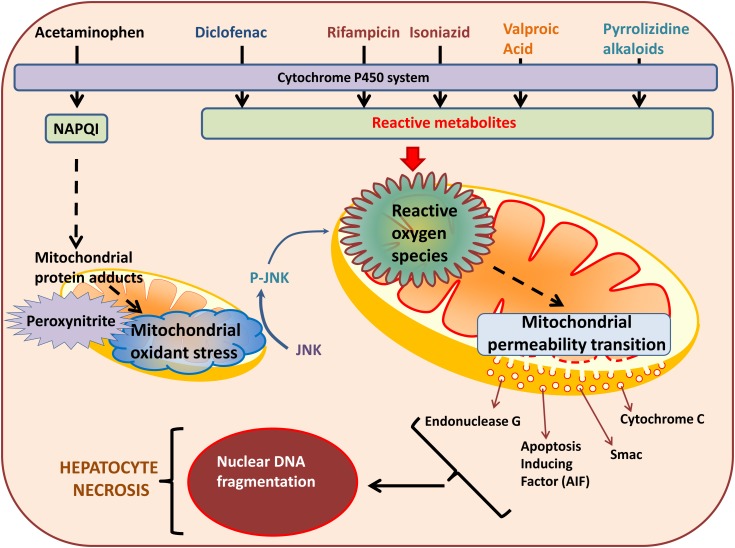
Mitochondria are critical cellular organelles for energy generation and are now also recognized as playing important roles in cellular signaling. Their central role in energy metabolism, as well as their high abundance in hepatocytes, make them important targets for drug-induced hepatotoxicity. This review summarizes the current mechanistic understanding of the role of mitochondria in drug-induced hepatotoxicity caused by acetaminophen, diclofenac, anti-tuberculosis drugs such as rifampin and isoniazid, anti-epileptic drugs such as valproic acid and constituents of herbal supplements such as pyrrolizidine alkaloids. The utilization of circulating mitochondrial-specific biomarkers in understanding mechanisms of toxicity in humans will also be examined. In summary, it is well-established that mitochondria are central to acetaminophen-induced cell death. However, the most promising areas for clinically useful therapeutic interventions after acetaminophen toxicity may involve the promotion of adaptive responses and repair processes including mitophagy and mitochondrial biogenesis, In contrast, the limited understanding of the role of mitochondria in various aspects of hepatotoxicity by most other drugs and herbs requires more detailed mechanistic investigations in both animals and humans. Development of clinically relevant animal models and more translational studies using mechanistic biomarkers are critical for progress in this area. This review focuses on the role of mitochondrial dysfunction in liver injury mechanisms of clinically important drugs like acetaminophen, diclofenac, rifampicin, isoniazid, amiodarone and others. A better understanding ofthe mechanisms in animal models and their translation to patients will be critical for the identification of new therapeutic targets.
线粒体是细胞中产生能量的关键细胞器,如今也被认为在细胞信号传导中发挥着重要作用。它们在能量代谢中的核心作用,以及在肝细胞中的高丰度,使其成为药物性肝毒性的重要靶点。本综述总结了目前对线粒体在对乙酰氨基酚、双氯芬酸、利福平和异烟肼等抗结核药物、丙戊酸等抗癫痫药物以及吡咯里西啶生物碱等草药补充剂成分所致药物性肝毒性中作用的机制性认识。还将探讨利用循环线粒体特异性生物标志物来理解人类中毒机制的情况。总之,线粒体在对乙酰氨基酚诱导的细胞死亡中起核心作用已得到充分证实。然而,对乙酰氨基酚中毒后临床上有用的治疗干预最有前景的领域可能涉及促进适应性反应和修复过程,包括线粒体自噬和线粒体生物发生。相比之下,对于大多数其他药物和草药在肝毒性各个方面中线粒体作用的了解有限,需要在动物和人类中进行更详细的机制研究。开发临床相关的动物模型以及使用机制性生物标志物进行更多的转化研究对于该领域的进展至关重要。本综述重点关注线粒体功能障碍在对乙酰氨基酚、双氯芬酸、利福平、异烟肼、胺碘酮等临床重要药物肝损伤机制中的作用。更好地理解动物模型中的机制及其向患者的转化对于确定新的治疗靶点至关重要。