Terry Mary Beth, Liao Yuyan, Kast Karin, Antoniou Antonis C, McDonald Jasmine A, Mooij Thea M, Engel Christoph, Nogues Catherine, Buecher Bruno, Mari Véronique, Moretta-Serra Jessica, Gladieff Laurence, Luporsi Elisabeth, Barrowdale Daniel, Frost Debra, Henderson Alex, Brewer Carole, Evans D Gareth, Eccles Diana, Cook Jackie, Ong Kai-Ren, Izatt Louise, Ahmed Munaza, Morrison Patrick J, Dommering Charlotte J, Oosterwijk Jan C, Ausems Margreet G E M, Kriege Mieke, Buys Saundra S, Andrulis Irene L, John Esther M, Daly Mary, Friedlander Michael, McLachlan Sue Anne, Osorio Ana, Caldes Trinidad, Jakubowska Anna, Simard Jacques, Singer Christian F, Tan Yen, Olah Edith, Navratilova Marie, Foretova Lenka, Gerdes Anne-Marie, Roos-Blom Marie-José, Arver Brita, Olsson Håkan, Schmutzler Rita K, Hopper John L, van Leeuwen Flora E, Goldgar David, Milne Roger L, Easton Douglas F, Rookus Matti A, Andrieu Nadine
JNCI Cancer Spectr. 2018 Dec;2(4):pky078. doi: 10.1093/jncics/pky078. Epub 2019 Mar 8.
Full-term pregnancy (FTP) is associated with a reduced breast cancer (BC) risk over time, but women are at increased BC risk in the immediate years following an FTP. No large prospective studies, however, have examined whether the number and timing of pregnancies are associated with BC risk for and mutation carriers.
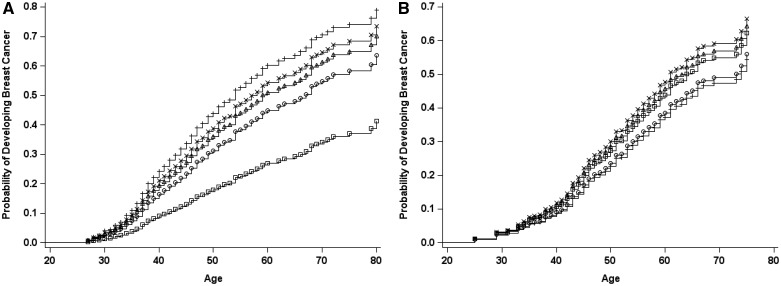
Using weighted and time-varying Cox proportional hazards models, we investigated whether reproductive events are associated with BC risk for mutation carriers using a retrospective cohort (5707 and 3525 mutation carriers) and a prospective cohort (2276 and 1610 mutation carriers), separately for each cohort and the combined prospective and retrospective cohort.
For mutation carriers, there was no overall association with parity compared with nulliparity (combined hazard ratio [HR] = 0.99, 95% confidence interval [CI] = 0.83 to 1.18). Relative to being uniparous, an increased number of FTPs was associated with decreased BC risk (HR = 0.79, 95% CI = 0.69 to 0.91; HR = 0.70, 95% CI = 0.59 to 0.82; HR = 0.50, 95% CI = 0.40 to 0.63, for 2, 3, and ≥4 FTPs, respectively, < .0001) and increasing duration of breastfeeding was associated with decreased BC risk (combined cohort = .0003). Relative to being nulliparous, uniparous mutation carriers were at increased BC risk in the prospective analysis (prospective hazard ration [HR] = 1.69, 95% CI = 1.09 to 2.62). For mutation carriers, being parous was associated with a 30% increase in BC risk (HR = 1.33, 95% CI = 1.05 to 1.69), and there was no apparent decrease in risk associated with multiparity except for having at least 4 FTPs vs. 1 FTP (HR = 0.72, 95% CI = 0.54 to 0.98).
These findings suggest differential associations with parity between and mutation carriers with higher risk for uniparous carriers and parous carriers.
随着时间推移,足月妊娠(FTP)与乳腺癌(BC)风险降低相关,但女性在足月妊娠后的头几年患乳腺癌的风险会增加。然而,尚无大型前瞻性研究探讨妊娠次数和时间与携带BRCA1和BRCA2突变者的乳腺癌风险是否相关。
我们使用加权和时变Cox比例风险模型,分别对一个回顾性队列(5707名BRCA1和3525名BRCA2突变携带者)和一个前瞻性队列(2276名BRCA1和1610名BRCA2突变携带者),以及前瞻性和回顾性队列合并后的队列进行研究,以调查生殖事件与携带BRCA1和BRCA2突变者的乳腺癌风险是否相关。
对于携带BRCA1突变者,与未生育相比,总体上生育情况与乳腺癌风险无关联(合并风险比[HR]=0.99,95%置信区间[CI]=0.83至1.18)。相对于生育一胎,足月妊娠次数增加与乳腺癌风险降低相关(对于2次、3次和≥4次足月妊娠,HR分别为0.79,95%CI=0.69至0.91;HR=0.70,95%CI=0.59至0.82;HR=0.50,95%CI=0.40至0.63,P<0.0001),且母乳喂养持续时间增加与乳腺癌风险降低相关(合并队列P=0.0003)。在前瞻性分析中,相对于未生育,生育一胎的携带BRCA1突变者患乳腺癌的风险增加(前瞻性风险比[HR]=1.69,95%CI=1.09至2.62)。对于携带BRCA2突变者,生育与乳腺癌风险增加30%相关(HR=1.33,95%CI=1.05至1.69),除了至少有4次足月妊娠与1次足月妊娠相比(HR=0.72,95%CI=0.54至0.98)外,多胎生育与风险降低无明显关联。
这些发现表明,携带BRCA1和BRCA2突变者在生育情况与乳腺癌风险的关联上存在差异,生育一胎的携带BRCA1突变者以及生育的携带BRCA2突变者风险更高。