Department of Hematology-Oncology, National University Cancer Institute, Singapore, Singapore.
Cancer Science Institute, National University of Singapore, Singapore, Singapore.
PLoS One. 2019 Mar 15;14(3):e0213746. doi: 10.1371/journal.pone.0213746. eCollection 2019.
Due to historically low uptake of genetic testing, the mutational spectrum of Asians with Hereditary Breast Cancer (HBC) is not well understood. This study sought to understand the incidence and spectrum of germline mutations in Asian patients with suspected HBC in a clinic setting.
1056 patients with suspected HBC were seen in our Cancer (CA) Genetics Clinic from 2000-2017, of which 460 underwent genetic testing.
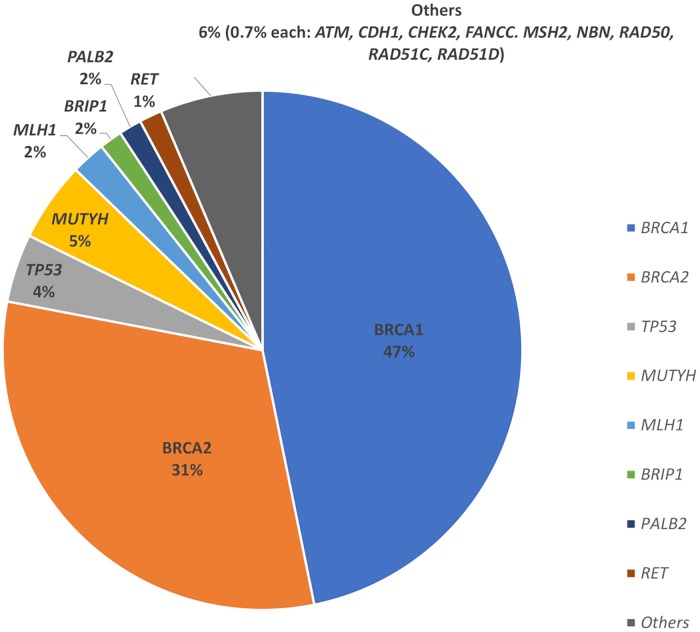
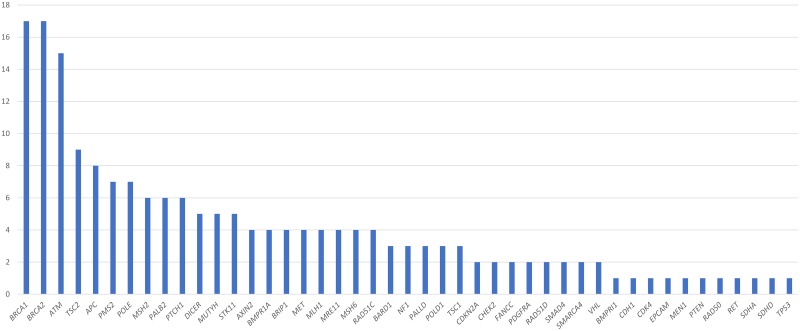
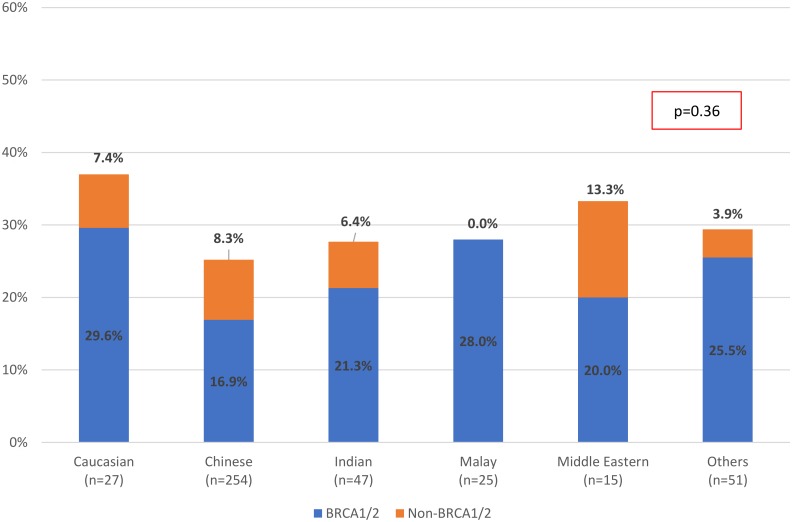
Of 460 probands tested, 93% were female, 61% Chinese, 90% had prior CA, with 19% (77/414) having ≥2 primary CA. Median age at CA-diagnosis was 43y (17-83); 70% had Breast CA (BC) and 25% Ovarian CA (OC). 34% had young-onset BC, 8% bilateral BC, and 4% BC/OC. Majority had family history of BC (53%) or OC (20%). 57% underwent multigene testing (14-49 genes), 34% targeted testing, and 8% predictive testing. 30% were found to have a pathogenic mutation: 80% in BRCA1/2 (8 novel mutations noted). Of 33 non-BRCA1/2 pathogenic mutations detected, 61% were in 11 BC genes while 39% were in non-BC genes suggestive of alternative CA syndromes. Testing beyond BRCA1/2 impacted management for 15.9% (22/138) of carriers, but extensive testing identified variants of uncertain significance (VUS) in up to 44.5% of probands. Restricting multigene panel testing to a guideline-based 20-gene panel including Lynch Syndrome genes was found to be most optimal, detecting 94.6% of mutation carriers while reducing VUS rate to 21.5%.
Evolution of CA Genetics testing strategy to a multigene approach facilitated detection of pathogenic mutations in non-BRCA1/2 genes and aided management. Guideline-based panel testing is feasible and can be offered in Asians with suspected HBC.
由于遗传检测的接受度历来较低,亚洲遗传性乳腺癌(HBC)患者的突变谱尚不清楚。本研究旨在了解诊所环境中疑似 HBC 的亚洲患者的种系突变发生率和谱。
2000 年至 2017 年,我们的癌症(CA)遗传诊所共接诊了 1056 名疑似 HBC 患者,其中 460 名接受了基因检测。
在接受检测的 460 名先证者中,93%为女性,61%为中国人,90%有既往 CA,19%(77/414)有≥2 个原发性 CA。CA 诊断时的中位年龄为 43 岁(17-83);70%为乳腺癌(BC),25%为卵巢癌(OC)。34%为早发性 BC,8%为双侧 BC,4%为 BC/OC。大多数有乳腺癌(53%)或卵巢癌(20%)家族史。57%进行了多基因检测(14-49 个基因),34%进行了靶向检测,8%进行了预测性检测。30%发现致病性突变:80%在 BRCA1/2(注意到 8 个新突变)。在检测到的 33 个非 BRCA1/2 致病性突变中,61%在 11 个 BC 基因中,39%在非 BC 基因中提示存在其他 CA 综合征。BRCA1/2 以外的检测对 15.9%(22/138)的携带者的管理产生了影响,但广泛检测发现高达 44.5%的先证者存在意义不明的变异(VUS)。发现将多基因检测方案限制在包括 Lynch 综合征基因的基于指南的 20 基因检测方案最具优势,检测到 94.6%的突变携带者,同时将 VUS 率降低至 21.5%。
CA 遗传检测策略向多基因方法的演变促进了非 BRCA1/2 基因中致病性突变的检测,并有助于管理。基于指南的面板检测是可行的,可提供给疑似 HBC 的亚洲人。