The Laboratory of Virology and Infectious Disease, The Rockefeller University, New York, NY, United States.
The Laboratory of Virology and Infectious Disease, The Rockefeller University, New York, NY, United States.
Curr Opin Virol. 2019 Apr;35:27-34. doi: 10.1016/j.coviro.2019.02.008. Epub 2019 Mar 12.
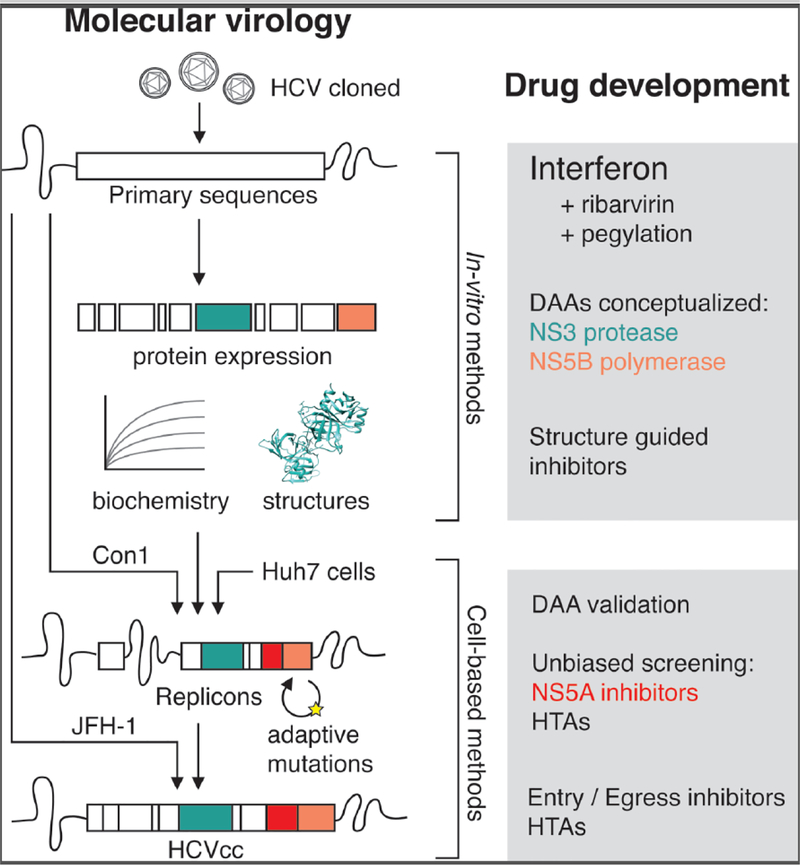
"What I cannot create, I do not understand." Richard Feynman may have championed reasoning from first principles in his famous blackboard missive, but he could just as well have been referring to the plight of a molecular virologist. What cannot be grown in a controlled laboratory setting, we cannot fully understand. The story of the laboratory domestication of hepatitis C virus (HCV) is now a classic example of virologists applying all manner of inventive skill to create cell-based models of infection in order to clarify prospective drug targets. In this review, we highlight key successes and failures that were instructive in achieving cell-based models for HCV studies and drug development. We also emphasize the lessons learned from the ∼40 year saga that may be applicable to viruses yet unknown and uncultured.
“我不能创造的东西,我就无法理解。”理查德·费曼(Richard Feynman)在他著名的黑板便条中可能倡导了从第一原理进行推理,但他也可能指的是分子病毒学家的困境。在可控的实验室环境中无法生长的东西,我们就无法完全理解。丙型肝炎病毒(HCV)的实验室驯化故事现在是病毒学家应用各种创造性技能来创建基于细胞的感染模型以阐明潜在药物靶点的经典范例。在这篇综述中,我们强调了在建立基于细胞的 HCV 研究和药物开发模型方面具有启发性的关键成功和失败。我们还强调了从这个约 40 年的传奇故事中吸取的经验教训,这些经验教训可能适用于未知和未培养的病毒。