Department of Neurology, Weill Cornell Medicine, New York, New York.
Department of Neurological Surgery, Weill Cornell Brain and Spine Institute, Weill Cornell Medicine, New York, New York.
Neurosurgery. 2020 Feb 1;86(2):221-230. doi: 10.1093/neuros/nyz046.
Hypertonic saline (HTS) and mannitol are effective in reducing intracranial pressure (ICP) after severe traumatic brain injury (TBI). However, their simultaneous effect on the cerebral perfusion pressure (CPP) and ICP has not been studied rigorously.
To determine the difference in effects of HTS and mannitol on the combined burden of high ICP and low CPP in patients with severe TBI.
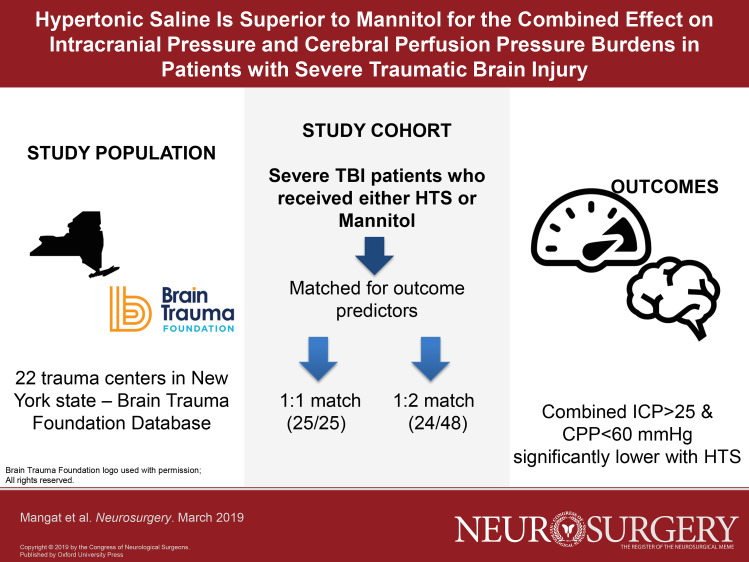
We performed a case-control study using prospectively collected data from the New York State TBI-trac® database (Brain Trauma Foundation, New York, New York). Patients who received only 1 hyperosmotic agent, either mannitol or HTS for raised ICP, were included. Patients in the 2 groups were matched (1:1 and 1:2) for factors associated with 2-wk mortality: age, Glasgow Coma Scale score, pupillary reactivity, hypotension, abnormal computed tomography scans, and craniotomy. Primary endpoint was the combined burden of ICPhigh (> 25 mm Hg) and CPPlow (< 60 mm Hg).
There were 25 matched pairs for 1:1 comparison and 24 HTS patients matched to 48 mannitol patients in 1:2 comparisons. Cumulative median osmolar doses in the 2 groups were similar. In patients treated with HTS compared to mannitol, total number of days (0.6 ± 0.8 vs 2.4 ± 2.3 d, P < .01), percentage of days with (8.8 ± 10.6 vs 28.1 ± 26.9%, P < .01), and the total duration of ICPhigh + CPPlow (11.12 ± 14.11 vs 30.56 ± 31.89 h, P = .01) were significantly lower. These results were replicated in the 1:2 match comparisons.
HTS bolus therapy appears to be superior to mannitol in reduction of the combined burden of intracranial hypertension and associated hypoperfusion in severe TBI patients.
高渗盐水(HTS)和甘露醇在治疗严重创伤性脑损伤(TBI)后可有效降低颅内压(ICP)。然而,它们对脑灌注压(CPP)和 ICP 的同时影响尚未得到严格研究。
确定 HTS 和甘露醇对严重 TBI 患者高 ICP 和低 CPP 联合负担的影响差异。
我们使用来自纽约州 TBI-trac®数据库(脑外伤基金会,纽约州,纽约)前瞻性收集的数据进行病例对照研究。仅接受 1 种高渗剂(甘露醇或 HTS)治疗升高 ICP 的患者被纳入。2 组患者根据与 2 周死亡率相关的因素进行匹配(1:1 和 1:2):年龄、格拉斯哥昏迷评分、瞳孔反应、低血压、异常计算机断层扫描和开颅术。主要终点是 ICP 高(>25mmHg)和 CPP 低(<60mmHg)的联合负担。
1:1 比较有 25 对匹配,1:2 比较有 24 例 HTS 患者匹配 48 例甘露醇患者。2 组累积渗透压剂量相似。与甘露醇相比,接受 HTS 治疗的患者总天数(0.6±0.8 vs 2.4±2.3 d,P<.01)、有(8.8±10.6 vs 28.1±26.9%,P<.01)天数百分比和 ICP 高+CPP 低的总持续时间(11.12±14.11 vs 30.56±31.89 h,P=.01)明显更低。这些结果在 1:2 匹配比较中得到了复制。
HTS 推注疗法在降低严重 TBI 患者颅内高压和相关低灌注的联合负担方面似乎优于甘露醇。