Mucha Anna, Wierzbicki Heliodor, Kamiński Stanisław, Oleński Kamil, Hering Dorota
Department of Genetics, University of Environmental and Life Sciences, Kożuchowska 7, 51-613, Wroclaw, Poland.
Department of Animal Genetics, University of Warmia and Mazury, Oczapowskiego 5, 10-718, Olsztyn, Poland.
J Appl Genet. 2019 May;60(2):179-186. doi: 10.1007/s13353-019-00489-9. Epub 2019 Mar 15.
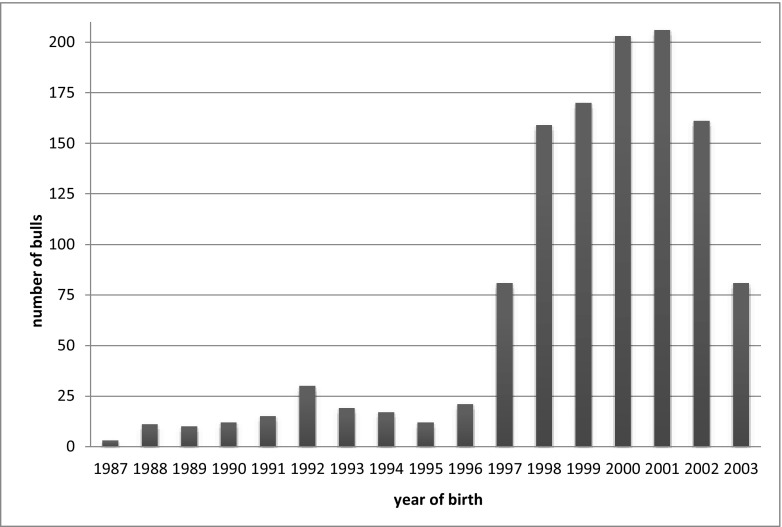
The aim of this study was to predict the genomic breeding value (DGV) of production, selected conformation and reproductive traits, and somatic cell score of dairy cattle in Poland using high-frequency marker haplotypes. The dataset consisted of phenotypic, genotypic, and pedigree data of 1216 Polish Holstein-Friesian bulls. The genotypic data consisted of 54,000 single-nucleotide polymorphisms (SNPs). The data were divided into two subsets: a test dataset (n = 1064) and a validation dataset (n = 152). Genotypic data were selected using three criteria: the percentage of missing genotypes, minor allele frequency, and linkage disequilibrium. The purpose of the data selection was to identify blocks of SNPs that were then used for the construction of haplotypes. Only haplotypes with a frequency higher than 25% were selected. DGV was predicted using four variants of a linear model with random haplotype effects and deregressed breeding values as the response variables. The accuracy of genomic prediction was checked by comparing DGVs with estimated breeding values (EBVs) using two methods: Pearson's correlations and the regression of EBV on DGV. The use of high-frequency haplotypes showed a tendency to underestimate DGVs. None of the models tested was clearly superior with regard to the traits studied. DGVs of production and conformation traits as well as somatic cell score (medium or high heritability traits) were more accurate than those estimated for fertility traits (low heritability traits).
本研究的目的是利用高频标记单倍型预测波兰奶牛的生产、选定体型和繁殖性状的基因组育种值(DGV)以及体细胞评分。数据集包括1216头波兰荷斯坦-弗里生公牛的表型、基因型和系谱数据。基因型数据由54000个单核苷酸多态性(SNP)组成。数据被分为两个子集:一个测试数据集(n = 1064)和一个验证数据集(n = 152)。使用三个标准选择基因型数据:缺失基因型的百分比、次要等位基因频率和连锁不平衡。数据选择的目的是识别SNP块,然后用于构建单倍型。只选择频率高于25%的单倍型。使用具有随机单倍型效应和去回归育种值作为响应变量的线性模型的四个变体预测DGV。通过使用两种方法将DGV与估计育种值(EBV)进行比较来检查基因组预测的准确性:皮尔逊相关性和EBV对DGV的回归。使用高频单倍型显示出低估DGV的趋势。在所研究的性状方面,没有一个测试模型明显更优。生产和体型性状以及体细胞评分(中或高遗传力性状)的DGV比繁殖性状(低遗传力性状)的估计值更准确。