From the Department of Radiology, Hainan Branch of Chinese People's Liberation Army General Hospital, Sanya, Hainan, China (F.Z.).
Biomedical Imaging Research Institute, Cedars-Sinai Medical Center, Los Angeles, CA (F.Z., Z.F., B.Z., Z.D., D.D., D.S.B., D.L., Y.X.).
Stroke. 2019 Apr;50(4):859-866. doi: 10.1161/STROKEAHA.118.023273.
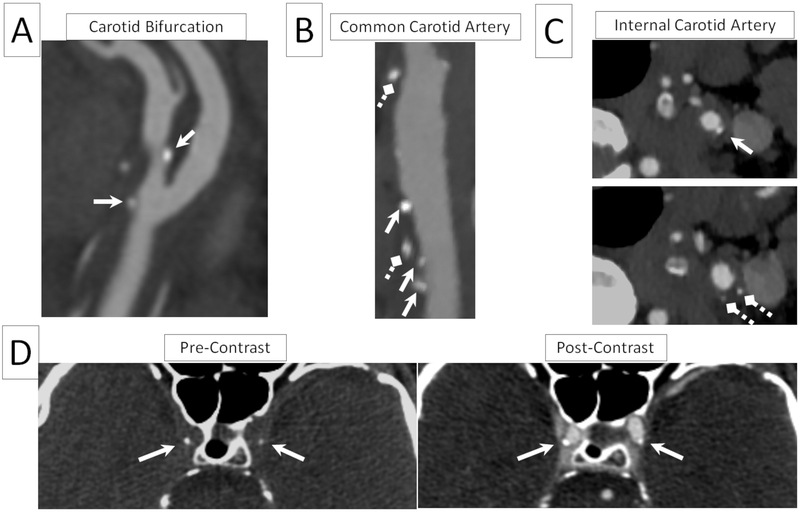
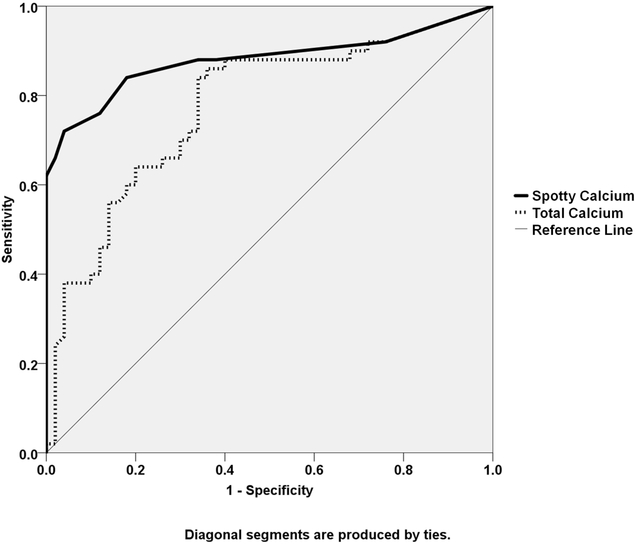
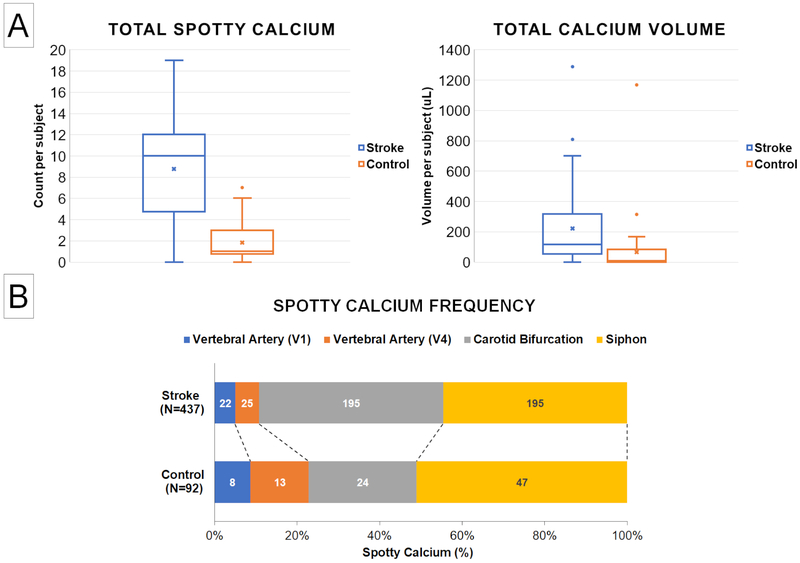
Background and Purpose- Cervicocerebral vascular calcification on computed tomography angiography is a known sign of advanced atherosclerosis. However, the clinical significance of calcification pattern remains unclear. In this study, we aimed to investigate the potential association between spotty calcium and acute ischemic stroke. Methods- This study included patients with first-time nonlacunar ischemic stroke (N=50) confirmed by brain magnetic resonance imaging or nonenhanced head computed tomography, as well as control subjects with asymptomatic carotid atherosclerosis (N=50) confirmed by carotid ultrasonography. Subjects in both groups underwent contrast-enhanced cervicocerebral computed tomography angiography within a week after the initial imaging examination. Spotty calcification was evaluated at 11 arterial segments commonly affected by atherosclerosis along the carotid and vertebrobasilar circulation. Statistical analysis was performed comparing the frequency and spatial pattern of spotty calcification between the 2 groups. Results- Spotty calcification in the Stroke group was markedly more prevalent than that in the Control group (total SC count: 8.74±4.96 versus 1.84±1.82, P<0.001). The odds ratio (95% CI) for stroke was 2.49 (1.55-4.00) for spotty calcification at bilateral carotid bifurcation, 1.52 (1.13-2.04) at carotid siphon, and 1.98 (1.45-2.69) at all evaluated locations. A total number of 3 spotty calcifications were determined as the optimal cutoff threshold for increased risk of stroke. Spotty calcium showed significantly greater area under the receiver operating characteristics curve than total calcium volume irrespective of size (0.88 versus 0.77). Within the Stroke group, ipsilateral lateral side showed significantly more spotty calcium than the contralateral side (5.18±3.05 versus 3.56±2.67, P<0.001). Conclusions- Nonlacunar ischemia stroke was associated with markedly increased incidence of spotty calcification with a distinct spatial pattern on cervicocerebral computed tomography compared with subclinical atherosclerosis, suggesting the potential role of spotty calcification for improving the risk stratification for ischemic stroke.
背景与目的- 计算机断层血管造影(CTA)显示的颈脑血管钙化是动脉粥样硬化进展的已知标志。然而,钙化模式的临床意义尚不清楚。本研究旨在探讨点状钙与急性缺血性卒中之间的潜在关联。方法- 本研究纳入了经脑磁共振成像或非增强头部 CT 证实的首次非腔隙性缺血性卒中(N=50)患者,以及经颈动脉超声证实的无症状颈动脉粥样硬化(N=50)的对照组患者。两组患者均在首次影像学检查后一周内行颈脑血管 CTA 增强检查。在颈动脉和椎基底动脉循环的 11 个常受动脉粥样硬化影响的动脉段评估点状钙化。对两组间点状钙化的频率和空间分布进行统计分析。结果- 卒中组的点状钙化明显比对照组更常见(总 SC 计数:8.74±4.96 对 1.84±1.82,P<0.001)。点状钙化双侧颈动脉分叉处、颈动脉虹吸处和所有评估部位的卒中比值比(95%可信区间)分别为 2.49(1.55-4.00)、1.52(1.13-2.04)和 1.98(1.45-2.69)。点状钙化 3 个被确定为卒中风险增加的最佳截断阈值。无论大小,点状钙的曲线下面积均明显大于总钙体积(0.88 对 0.77)。在卒中组中,同侧外侧比对侧侧显示出明显更多的点状钙化(5.18±3.05 对 3.56±2.67,P<0.001)。结论- 与亚临床动脉粥样硬化相比,非腔隙性缺血性卒中与颈脑血管 CTA 上点状钙化明显增加且具有明显的空间模式相关,表明点状钙化可能有助于改善缺血性卒中的风险分层。