Guo Changlei, Zhang Junbiao, Zhang Peiyong, Si Aoyang, Zhang Zhenling, Zhao Liangping, Lv Fenghua, Zhao Guoan
Department of Cardiology, The First Affiliated Hospital Xinxiang Medical University, Weihui 452100, Henan, China,
Drug Des Devel Ther. 2019 Feb 26;13:767-774. doi: 10.2147/DDDT.S179101. eCollection 2019.
Ginkgolide B (GB) is a terpene lactone component found in , which has a protective role on ischemia reperfusion (I/R) injury. This study was aimed at exploring the protective mechanism of GB on the myocardial I/R.
Myocardial I/R model was established on Sprague Dawley rats. The levels of cardiac troponin I, cardiac troponin T, lactic dehydrogenase, and myoglobin were determined by a 200FR NEO automatic biochemical analyzer. Histological examination was performed through HE and terminal deoxynucleotidyl transferase-mediated dUTP nick end-labeling staining. The expression levels of p-PERK, p-IRE1α, ATF6, p-AKT, and mTOR were detected by Western blot.
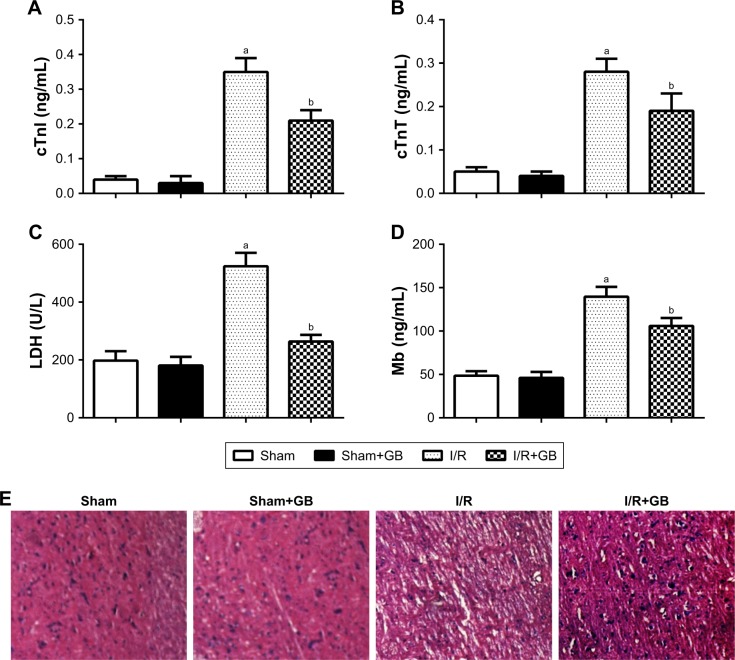
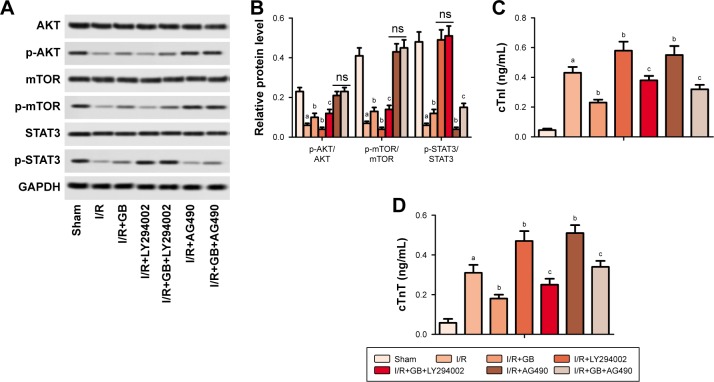
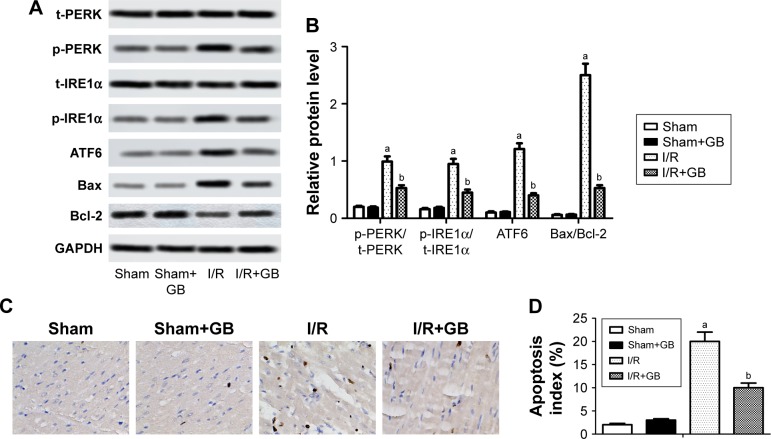
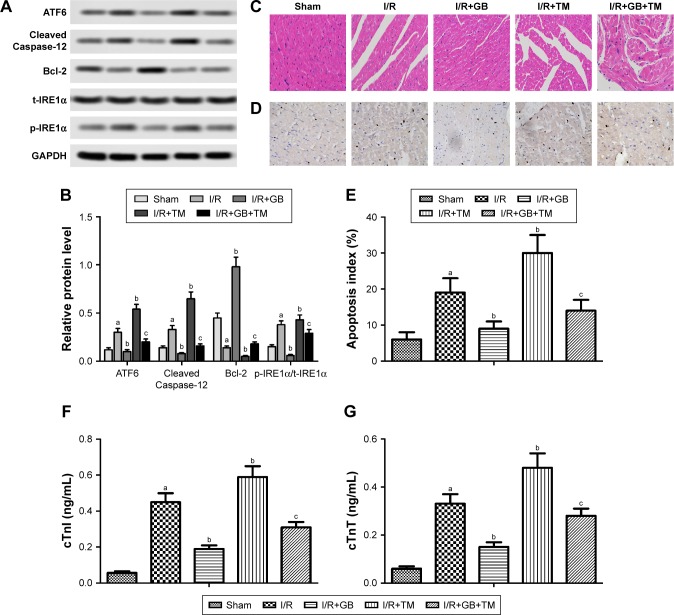
The results exhibited that GB treatment suppressed the high levels of cardiac troponin I, cardiac troponin T, lactic dehydrogenase, and myoglobin and ameliorated the damaged and irregularly arranged myocardial cells induced by I/R injury significantly, indicating that GB could ameliorate myocardial I/R injury. Moreover, the high expression levels of endoplasmic reticulum (ER) stress key proteins caused by I/R injury were suppressed significantly by GB treatment, including p-PERK, p-IRE1α, and ATF6. GB treatment also decreased the number of apoptotic cells compared with I/R group. In addition, activation of ER stress by Tunicamycin treatment could counteract the protective effects of GB on I/R injury, suggesting that GB ameliorated myocardial I/R injury through inhibition of ER stress-induced apoptosis. Finally, the decreased p-AKT and p-mTOR expressions caused by I/R injury were upregulated by GB and inhibition of PI3K/AKT/mTOR pathway by LY294002 abolished the protective effects of GB on I/R injury, indicating that GB activated PI3K/AKT/mTOR pathway during I/R injury.
GB protected against myocardial I/R injury through inhibiting ER stress-induced apoptosis via PI3K/AKT/mTOR signaling pathway.
银杏内酯B(GB)是银杏中发现的一种萜类内酯成分,对缺血再灌注(I/R)损伤具有保护作用。本研究旨在探讨GB对心肌I/R的保护机制。
在Sprague Dawley大鼠上建立心肌I/R模型。采用200FR NEO自动生化分析仪测定心肌肌钙蛋白I、心肌肌钙蛋白T、乳酸脱氢酶和肌红蛋白水平。通过苏木精-伊红(HE)染色和末端脱氧核苷酸转移酶介导的dUTP缺口末端标记(TUNEL)染色进行组织学检查。采用蛋白质免疫印迹法检测磷酸化蛋白激酶样内质网激酶(p-PERK)、磷酸化肌醇需求酶1α(p-IRE1α)、活化转录因子6(ATF6)、磷酸化蛋白激酶B(p-AKT)和哺乳动物雷帕霉素靶蛋白(mTOR)的表达水平。
结果显示,GB治疗可抑制心肌肌钙蛋白I、心肌肌钙蛋白T、乳酸脱氢酶和肌红蛋白的高水平表达,并显著改善I/R损伤诱导的心肌细胞损伤和排列紊乱,表明GB可改善心肌I/R损伤。此外,GB治疗可显著抑制I/R损伤引起的内质网(ER)应激关键蛋白的高表达,包括p-PERK、p-IRE1α和ATF6。与I/R组相比,GB治疗还减少了凋亡细胞的数量。此外,衣霉素处理激活ER应激可抵消GB对I/R损伤的保护作用,提示GB通过抑制ER应激诱导的凋亡改善心肌I/R损伤。最后,GB上调了I/R损伤引起的p-AKT和p-mTOR表达降低,而LY294002抑制磷脂酰肌醇-3激酶(PI3K)/蛋白激酶B(AKT)/哺乳动物雷帕霉素靶蛋白(mTOR)信号通路消除了GB对I/R损伤的保护作用,表明GB在I/R损伤期间激活了PI3K/AKT/mTOR信号通路。
GB通过PI3K/AKT/mTOR信号通路抑制ER应激诱导的凋亡,从而保护心肌免受I/R损伤。