Centre for Crop Systems Analysis, Department of Plant Sciences, Wageningen University & Research, AK Wageningen, The Netherlands.
International Rice Research Institute, Metro Manila, Philippines.
J Exp Bot. 2019 Apr 29;70(9):2575-2586. doi: 10.1093/jxb/erz120.
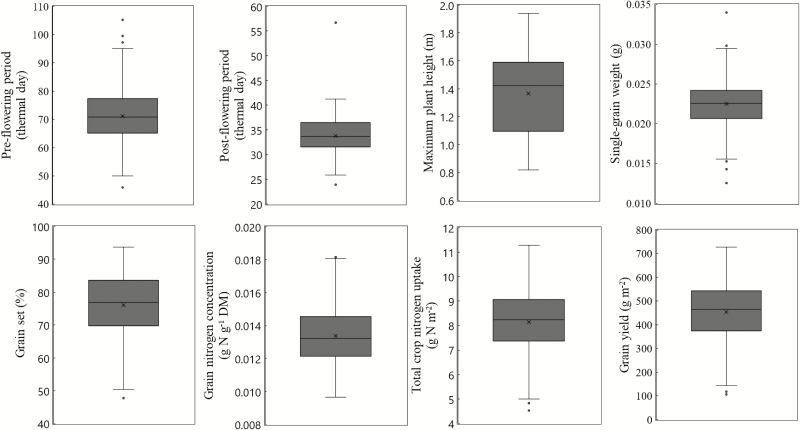
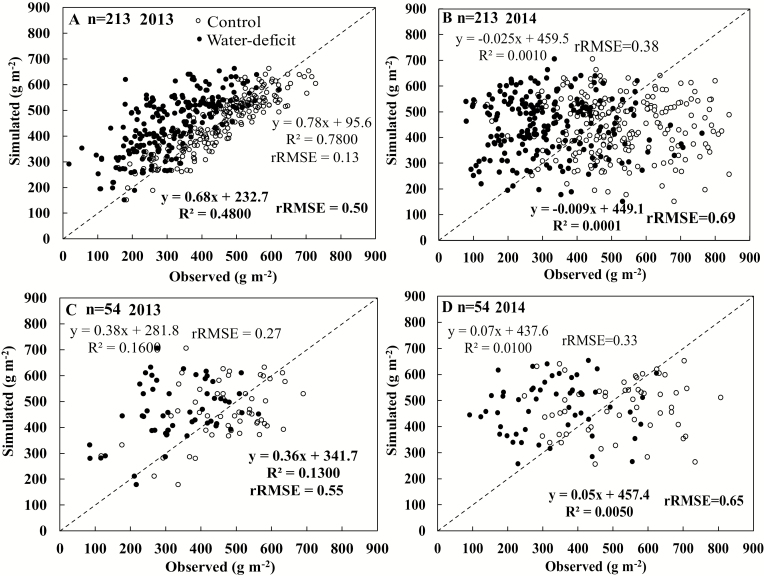
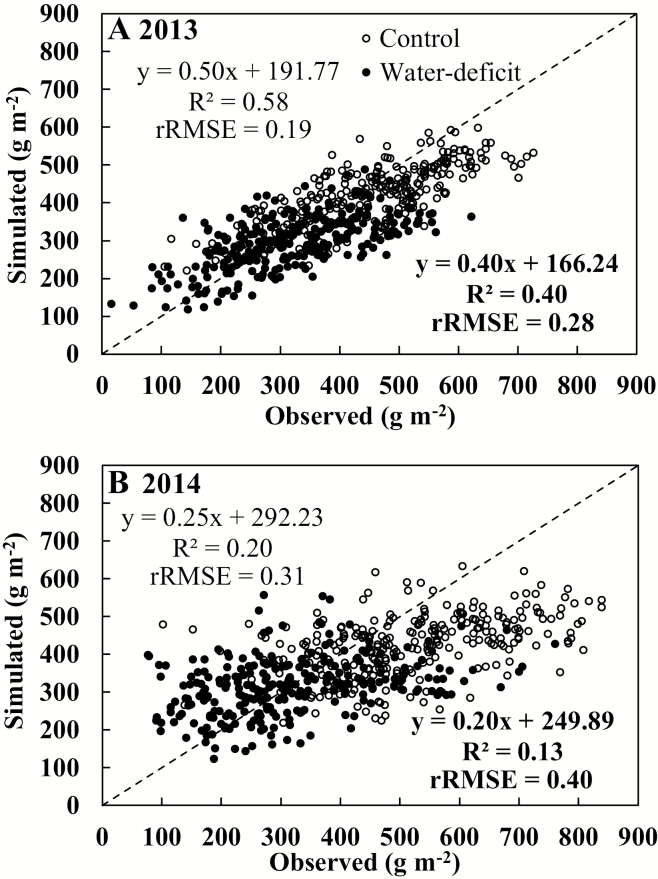
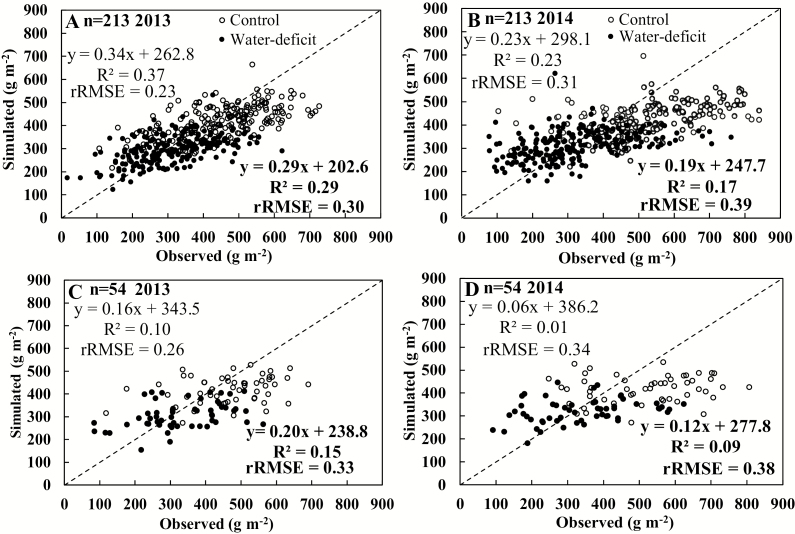
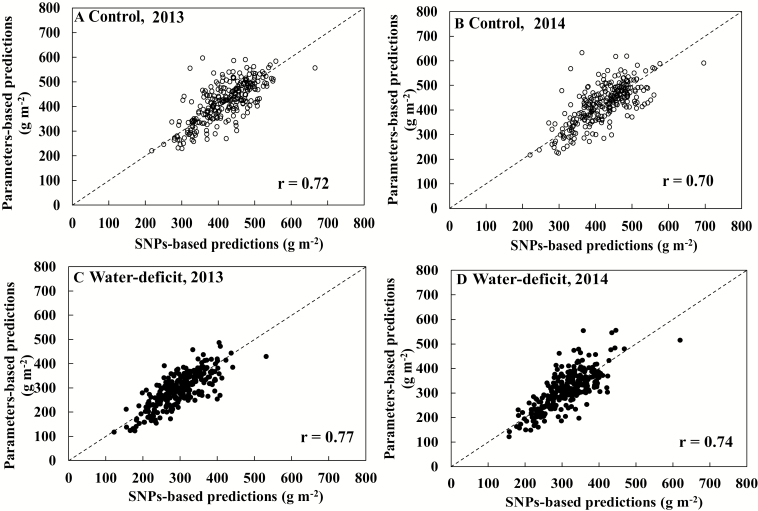
We explored the use of the eco-physiological crop model GECROS to identify markers for improved rice yield under well-watered (control) and water deficit conditions. Eight model parameters were measured from the control in one season for 267 indica genotypes. The model accounted for 58% of yield variation among genotypes under control and 40% under water deficit conditions. Using 213 randomly selected genotypes as the training set, 90 single nucleotide polymorphism (SNP) loci were identified using a genome-wide association study (GWAS), explaining 42-77% of crop model parameter variation. SNP-based parameter values estimated from the additive loci effects were fed into the model. For the training set, the SNP-based model accounted for 37% (control) and 29% (water deficit) of yield variation, less than the 78% explained by a statistical genomic prediction (GP) model for the control treatment. Both models failed in predicting yields of the 54 testing genotypes. However, compared with the GP model, the SNP-based crop model was advantageous when simulating yields under either control or water stress conditions in an independent season. Crop model sensitivity analysis ranked the SNP loci for their relative importance in accounting for yield variation, and the rank differed greatly between control and water deficit environments. Crop models have the potential to use single-environment information for predicting phenotypes under different environments.
我们探索了生态生理作物模型 GECROS 的应用,以确定在充分供水(对照)和缺水条件下提高水稻产量的标记。在一个季节中,从对照条件下测量了 267 个籼稻基因型的 8 个模型参数。该模型解释了对照条件下基因型间产量变异的 58%,缺水条件下产量变异的 40%。使用 213 个随机选择的基因型作为训练集,通过全基因组关联研究(GWAS)鉴定了 90 个单核苷酸多态性(SNP)位点,解释了作物模型参数变异的 42-77%。从加性位点效应估计的 SNP 基参数值被输入到模型中。对于训练集,SNP 基模型解释了 37%(对照)和 29%(缺水)的产量变异,低于对照处理的统计基因组预测(GP)模型解释的 78%。两个模型都未能预测 54 个测试基因型的产量。然而,与 GP 模型相比,SNP 基作物模型在独立季节模拟对照或胁迫条件下的产量时具有优势。作物模型敏感性分析对 SNP 位点在解释产量变异方面的相对重要性进行了排序,且在对照和缺水环境下的排序差异很大。作物模型有可能利用单环境信息预测不同环境下的表型。