National Institute of Parasitic Diseases, Chinese Center for Disease Control and Prevention, Shanghai, Shanghai, People's Republic of China.
WHO Collaborating Centre for Malaria, Schistosomiasis and Filariasis, Key Laboratory of Parasite and Vector Biology, Ministry of Health, Shanghai, People's Republic of China.
PLoS One. 2019 Mar 18;14(3):e0213686. doi: 10.1371/journal.pone.0213686. eCollection 2019.
Malaria reduction and future elimination in China is made more difficult by the importation of cases from neighboring endemic countries, particularly Myanmar, Laos, and Vietnam, and increased travel to Africa by Chinese nationals. The increasing prevalence of artemisinin resistant parasites across Southeast Asia highlights the importance of monitoring the parasite importation into China. Artemisinin resistance in the Mekong region is associated with variants of genes encoding the K13 kelch domain protein (pf13k), found in specific genetic backgrounds, including certain alleles of genes encoding the chloroquine resistance transporter (pfcrt) and multidrug resistance transporter PgH1 (pfmdr1).
In this study we investigated the prevalence of drug resistance markers in 72 P. falciparum samples from uncomplicated malaria infections in Tengchong and Yingjiang, counties on the Yunnan-Myanmar border. Variants of pf13k, pfcrt and pfmdr1 are described.
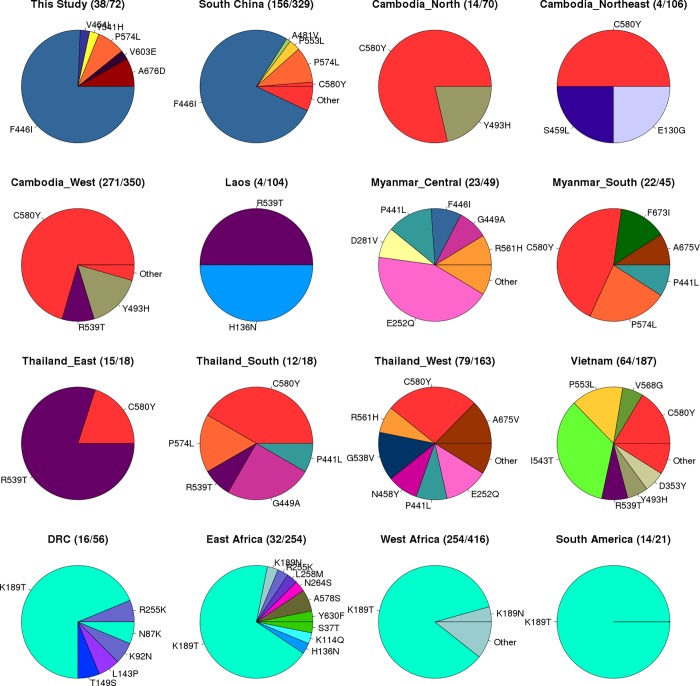
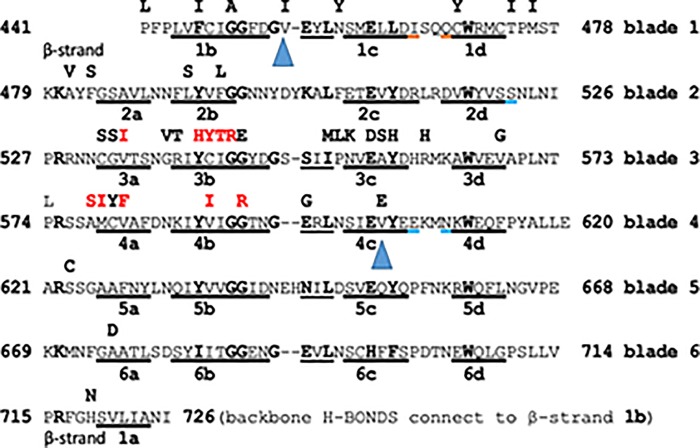
Almost all parasites harboured chloroquine-resistant alleles of pfcrt, whereas pfmdr1 was more diverse. Major mutations in the K13 propeller domain associated with artemisinin resistance in the Mekong region (C580Y, R539T and Y493H) were absent, but F446I and two previously undescribed mutations (V603E and V454I) were identified. Protein structural modelling was carried out in silico on each of these K13 variants, based on recently published crystal structures for the K13 propeller domain. Whereas F446I was predicted to elicit a moderate destabilisation of the propeller structure, the V603E substitution is likely to lead to relatively high protein instability. We plotted these stability estimates, and those for all previously described variants, against published values for in vivo parasitaemia half-life, and found that quadratic regression generates a useful predictive algorithm.
This study provides a baseline of P. falciparum resistance-associated mutations prevalent at the China-Myanmar border. We also show that protein modelling can be used to generate testable predictions as to the impact of pfk13 mutations on in vivo (and potentially in vitro) artemisinin susceptibility.
中国疟疾的减少和未来的消除因来自邻国缅甸、老挝和越南的病例输入以及中国公民前往非洲旅行的增加而变得更加困难。东南亚青蒿素耐药寄生虫的流行率不断上升,突显了监测寄生虫输入中国的重要性。湄公河流域的青蒿素耐药性与 K13 kelch 结构域蛋白(pf13k)基因编码的变异有关,这些变异存在于特定的遗传背景中,包括氯喹耐药转运蛋白(pfcrt)和多药耐药转运蛋白 PgH1(pfmdr1)的某些基因编码的特定等位基因。
在这项研究中,我们调查了来自云南省与缅甸接壤的腾冲县和盈江县的 72 例无并发症疟疾感染中恶性疟原虫样本的耐药标志物的流行率。描述了 pf13k、pfcrt 和 pfmdr1 的变异。
几乎所有寄生虫都携带氯喹耐药的 pfcrt 等位基因,而 pfmdr1 则更为多样化。与湄公河流域青蒿素耐药相关的 K13 螺旋桨结构域的主要突变(C580Y、R539T 和 Y493H)不存在,但鉴定出 F446I 和两个以前未描述的突变(V603E 和 V454I)。根据最近发表的 K13 螺旋桨结构域晶体结构,对每个 K13 变体进行了计算机模拟的蛋白质结构建模。虽然预测 F446I 会导致螺旋桨结构适度失稳,但 V603E 取代可能导致相对较高的蛋白质不稳定性。我们绘制了这些稳定性估计值,以及所有以前描述的变体的估计值,与已发表的体内寄生虫半衰期值相对比,发现二次回归生成了一个有用的预测算法。
本研究提供了中国-缅甸边境恶性疟原虫耐药相关突变的基线情况。我们还表明,蛋白质建模可用于生成关于 pfk13 突变对体内(和可能在体外)青蒿素敏感性的可测试预测。