Department of Preventive Medicine, Northwestern University Feinberg School of Medicine, Chicago, Illinois, United States of America.
Rush Institute for Healthy Aging, Rush University, Chicago, Illinois, United States of America.
PLoS One. 2019 Mar 18;14(3):e0213948. doi: 10.1371/journal.pone.0213948. eCollection 2019.
Age-related cognitive decline is a well-known phenomenon after age 65 but little is known about earlier changes and prior studies are based on relatively small samples. We investigated the impact of age on cognitive decline in the largest population sample to date including young to old adults.
Between 100,352 and 468,534 participants aged 38-73 years from UK Biobank completed at least one of seven self-administered cognitive functioning tests: prospective memory (PM), pairs matching (Pairs), fluid intelligence (FI), reaction time (RT), symbol digit substitution, trail making A and B. Up to 26,005 participants completed at least one of two follow-up assessments of PM, Pairs, FI and RT. Multivariable regression models examined the association between age (<45[reference], 45-49, 50-54, 55-59, 60-64, 65+) and cognition scores at baseline. Mixed models estimated the impact of age on cognitive decline over follow-up (~5.1 years).
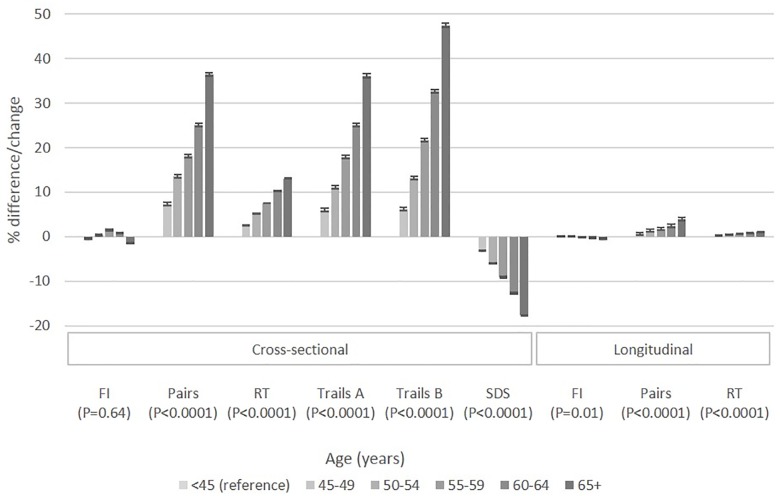
FI was higher between ages 50 and 64 and lower at 65+ compared to <45 at baseline. Performance on all other baseline tests was lower with older age: with increasing age category, difference in test scores ranged from 2.5 to 7.8%(P<0.0001). Compared to <45 at baseline, RT and Pairs performance declined faster across all older age cohorts (3.0 and 1.2% change, respectively, with increasing age category, P<0.0001). Cross-sectional results yielded 8 to 12-fold higher differences in RT and Pairs with age compared to longitudinal results.
Our findings suggest that declines in cognitive abilities <65 are small. The cross-sectional differences in cognition scores for middle to older adult years may be due in part to age cohort effects.
65 岁以后认知能力下降是一种众所周知的现象,但对于更早的变化知之甚少,先前的研究基于相对较小的样本。我们调查了年龄对迄今为止最大的人群样本中认知能力下降的影响,包括从年轻到老年的成年人。
英国生物库(UK Biobank)的 38-73 岁参与者中,有 100352 至 468534 人至少完成了七项自我管理认知功能测试中的一项:前瞻性记忆(PM)、配对匹配(Pairs)、流体智力(FI)、反应时间(RT)、符号数字替代、轨迹运动 A 和 B。多达 26005 名参与者至少完成了 PM、Pairs、FI 和 RT 的两次随访评估中的一项。多变量回归模型检查了年龄(<45[参考]、45-49、50-54、55-59、60-64、65+)与基线时认知评分之间的关系。混合模型估计了随访期间(约 5.1 年)年龄对认知衰退的影响。
FI 在 50 至 64 岁之间较高,而 65 岁以上则低于<45 岁。随着年龄的增加,所有其他基线测试的表现都降低了:随着年龄组的增加,测试分数的差异范围从 2.5%到 7.8%(P<0.0001)。与<45 岁相比,RT 和 Pairs 的表现随着年龄的增长在所有年龄组中都更快地下降(分别为 3.0%和 1.2%的变化,随着年龄组的增加,P<0.0001)。横断面结果显示,与纵向结果相比,RT 和 Pairs 的年龄差异高 8 至 12 倍。
我们的研究结果表明,65 岁以下的认知能力下降很小。中年至老年认知能力评分的横断面差异可能部分归因于年龄组效应。