White Brandy, Huh Ian, Brooks Cory L
Department of Chemistry, California State University Fresno, 2555 E San Ramon Ave, Fresno, CA, 93740, USA.
BMC Res Notes. 2019 Mar 19;12(1):154. doi: 10.1186/s13104-019-4197-0.
To determine the X-ray structure and biophysical properties of a Camelid VH isolated from a naïve phage display library.
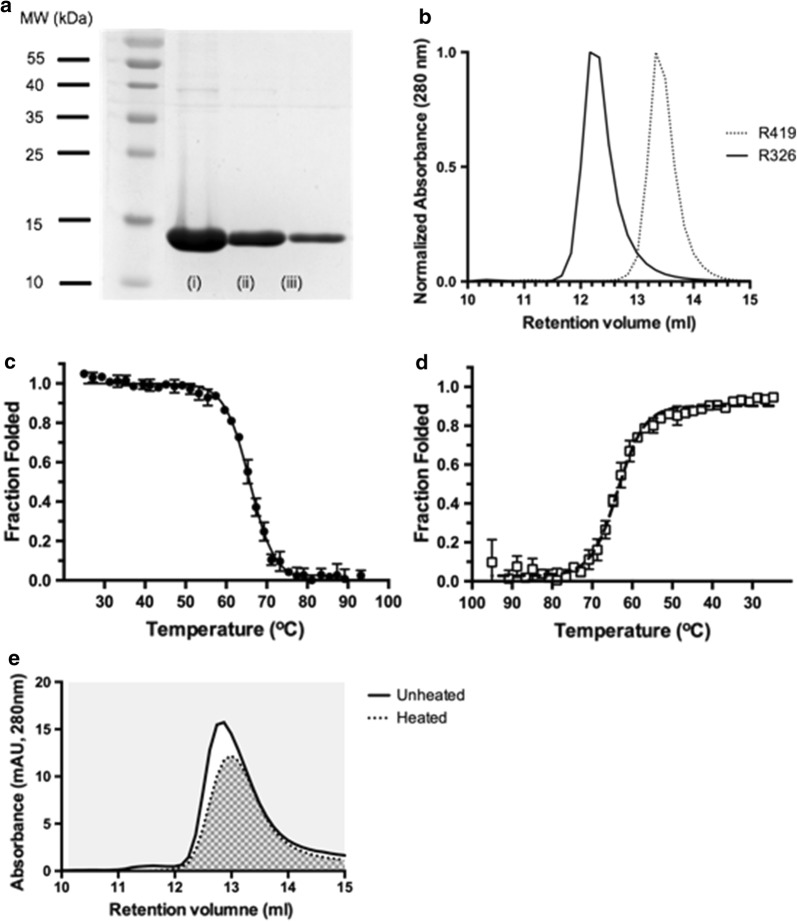
Single domain antibodies (VH) derived from the unique immune system of the Camelidae family have gained traction as useful tools for biotechnology as well as a source of potentially novel therapeutics. Here we report the structure and biophysical characterization of a VH originally isolated from a naïve camelid phage display library. VH R419 has a melting temperate of 66 °C and was found to be a monomer in solution. The protein crystallized in space group P622 and the structure was solved by molecular replacement to a resolution of 1.5 Å. The structure revealed a flat paratope with CDR loops that could be classified into existing canonical loop structures. A combination of high expression yield, stability and rapid crystallization might make R419 into a candidate scaffold for CDR grafting and homology modeling.
确定从天然噬菌体展示文库中分离得到的骆驼科动物重链可变区(VH)的X射线结构和生物物理特性。
源自骆驼科独特免疫系统的单域抗体(VH)作为生物技术的有用工具以及潜在新型治疗药物的来源已受到关注。在此,我们报告了最初从天然骆驼科噬菌体展示文库中分离得到的VH的结构和生物物理特性。VH R419的解链温度为66°C,在溶液中为单体。该蛋白在空间群P622中结晶,通过分子置换法解析其结构,分辨率达到1.5Å。该结构显示出一个平坦的互补决定区(CDR)环组成的抗原结合部位,这些CDR环可归类为现有的典型环结构。高表达产量、稳定性和快速结晶的综合特性可能使R419成为用于CDR嫁接和同源建模的候选支架。