a Human Health Therapeutics Research Centre , National Research Council Canada , Ottawa , Ontario , Canada.
b School of Environmental Sciences , University of Guelph , Guelph , Ontario , Canada.
MAbs. 2018 Aug/Sep;10(6):815-826. doi: 10.1080/19420862.2018.1489633. Epub 2018 Aug 15.
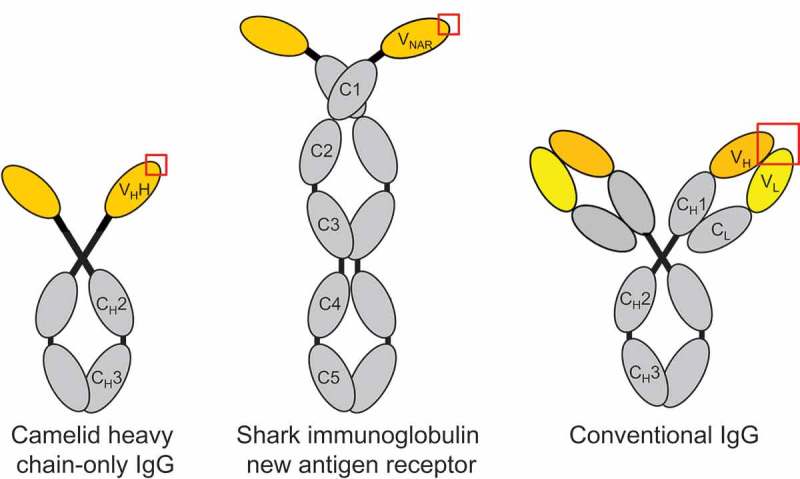
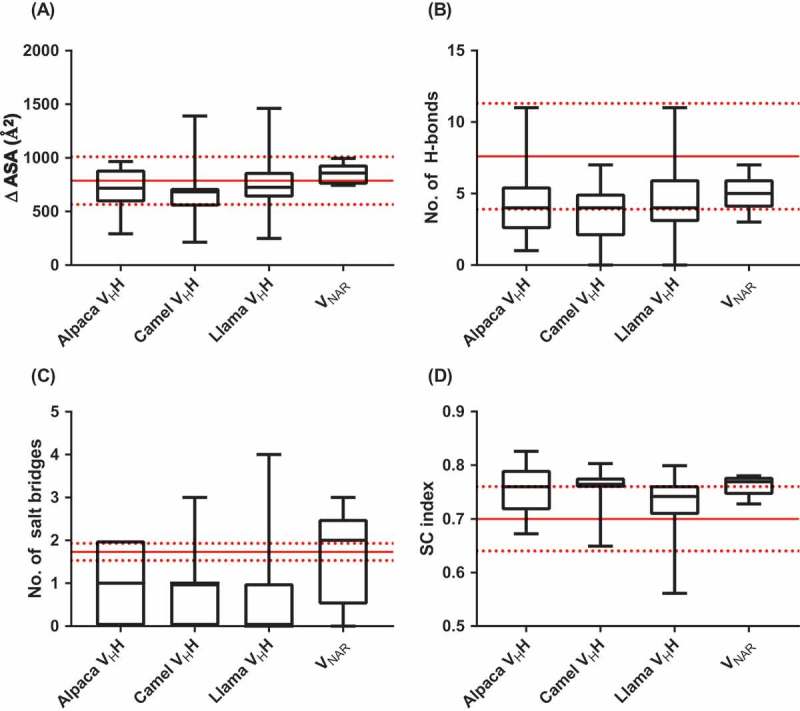
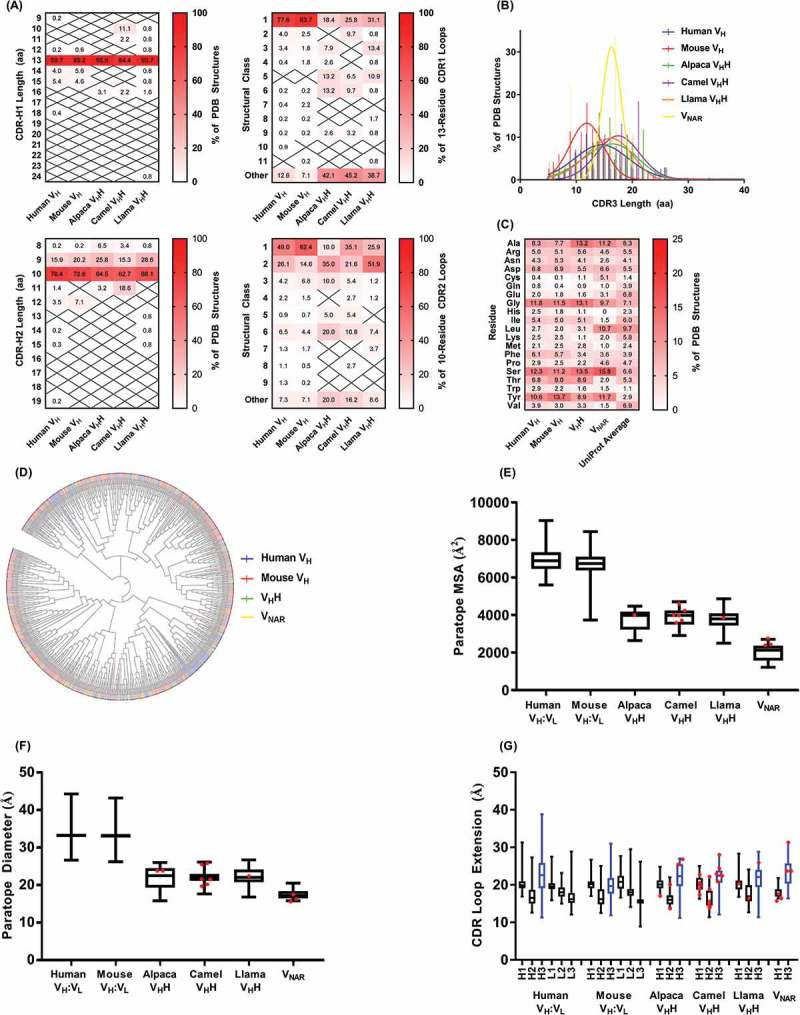
Single-domain antibodies (sdAbs), the autonomous variable domains of heavy chain-only antibodies produced naturally by camelid ungulates and cartilaginous fishes, have evolved to bind antigen using only three complementarity-determining region (CDR) loops rather than the six present in conventional V:V antibodies. It has been suggested, based on limited evidence, that sdAbs may adopt paratope structures that predispose them to preferential recognition of recessed protein epitopes, but poor or non-recognition of protuberant epitopes and small molecules. Here, we comprehensively surveyed the evidence in support of this hypothesis. We found some support for a global structural difference in the paratope shapes of sdAbs compared with those of conventional antibodies: sdAb paratopes have smaller molecular surface areas and diameters, more commonly have non-canonical CDR1 and CDR2 structures, and have elongated CDR3 length distributions, but have similar amino acid compositions and are no more extended (interatomic distance measured from CDR base to tip) than conventional antibody paratopes. Comparison of X-ray crystal structures of sdAbs and conventional antibodies in complex with cognate antigens showed that sdAbs and conventional antibodies bury similar solvent-exposed surface areas on proteins and form similar types of non-covalent interactions, although these are more concentrated in the compact sdAb paratope. Thus, sdAbs likely have privileged access to distinct antigenic regions on proteins, but only owing to their small molecular size and not to general differences in molecular recognition mechanism. The evidence surrounding the purported inability of sdAbs to bind small molecules was less clear. The available data provide a structural framework for understanding the evolutionary emergence and function of autonomous heavy chain-only antibodies.
单域抗体(sdAb)是由骆驼科和软骨鱼类天然产生的重链抗体的独立可变区,它仅使用三个互补决定区(CDR)环而不是传统 V:V 抗体中的六个来进化以结合抗原。基于有限的证据,有人提出 sdAb 可能采用表位结构,使它们更容易优先识别隐蔽的蛋白质表位,但对突出的表位和小分子的识别能力较差或无法识别。在这里,我们全面调查了支持该假说的证据。我们发现一些证据支持 sdAb 与传统抗体的表位形状存在整体结构差异:sdAb 表位的分子表面积和直径较小,CDR1 和 CDR2 结构更常见非典型结构,CDR3 长度分布更长,但氨基酸组成相似,与传统抗体表位相比,并不更伸展(从 CDR 基到尖端测量的原子间距离)。与同源抗原结合的 sdAb 和传统抗体的 X 射线晶体结构比较表明,sdAb 和传统抗体在蛋白质上埋藏相似的溶剂暴露表面积,并形成相似类型的非共价相互作用,尽管这些相互作用在紧凑的 sdAb 表位中更为集中。因此,sdAb 可能优先进入蛋白质上独特的抗原区域,但这仅仅是由于其较小的分子大小,而不是由于分子识别机制的一般差异。围绕 sdAb 据称不能结合小分子的说法的证据不太清楚。现有数据为理解自主重链抗体的进化出现和功能提供了结构框架。