Bielefeld University, School of Public Health, Department of Prevention and Health Promotion, Universitätsstraße 25, Bielefeld, 33615, Germany.
University of Hildesheim, Institute of Psychology, Universitätsplatz 1, Hildesheim, 31142, Germany.
BMC Psychol. 2019 Mar 19;7(1):17. doi: 10.1186/s40359-019-0291-2.
Informed choice is of ethical and practical importance in mammography screening. To assess the level to which decisions regarding such screening are informed is thus imperative, but no specific instrument has been available to measure informed choice in the German mammography screening programme. The aims of this study were to develop the Informed Choice in Mammography Screening Questionnaire (IMQ) and to find first evidence for the factor structure, reliability and validity of its different components.
The IMQ was sent to 17.349 women aged 50 in Westphalia-Lippe, Germany. The instrument has been developed after consideration of (1) the results of qualitative interviews on decision making in the mammography screening programme, (2) relevant literature on other informed choice instruments and (3) a qualitative study on influencing factors. The IMQ comprises 3 scales (attitude, norms, and barriers), 1 index (knowledge) and singular items covering intention to participate and sociodemographic variables. To assess the psychometric properties of the components of the IMQ, confirmatory factor and item response theory analyses were conducted. Additionally, reliability, validity and item statistics were assessed.
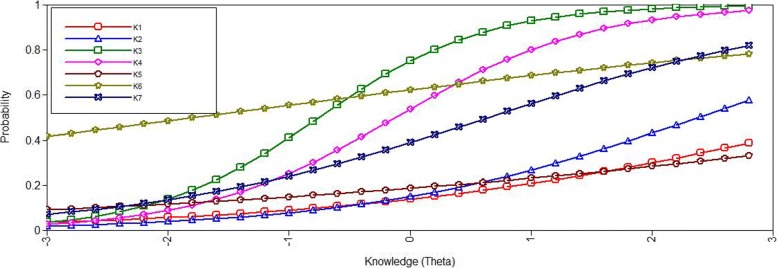
5.847 questionnaires were returned (response rate 33.7%). For attitude, the confirmatory factor analysis supported a one-factor structure. For norms, the model fit was not acceptable. Reliability levels were good with a Cronbach's α of.793 for attitude (4 items) and.795 for norms (5 items). For barriers, 9 items were deleted because of low discrimination indices; 6 items remained. The hypothesised assumption-subscale and the importance-subscale were confirmed, but these subscales showed poor reliabilities with Cronbach's α=.525 (4 items) and.583 (2 items). For the knowledge index, item response theory analysis showed that 6 out of 7 items were suitable. Hypotheses concerning the correlations between the different components were confirmed, which supported their convergent and divergent validity.
The results of this study demonstrated that the IMQ is a multidimensional instrument. Further development of the barriers and norms scales is necessary. The IMQ can be utilised to assess the level of informed choices as well as influencing factors.
在乳腺 X 线筛查中,知情选择具有伦理和实践意义。因此,评估此类筛查决策的知情程度是至关重要的,但在德国乳腺 X 线筛查计划中,尚无专门的工具来衡量知情选择。本研究旨在开发乳腺 X 线筛查知情选择问卷(IMQ),并首次对其不同组成部分的结构因素、信度和效度进行验证。
IMQ 被发送给德国威斯特伐利亚-利珀的 17349 名 50 岁女性。该工具是在考虑(1)关于乳腺 X 线筛查计划中决策制定的定性访谈结果、(2)关于其他知情选择工具的相关文献以及(3)关于影响因素的定性研究的基础上开发的。IMQ 包括 3 个量表(态度、规范和障碍)、1 个指数(知识)和涵盖参与意向和社会人口学变量的单项条目。为了评估 IMQ 各组成部分的心理测量特性,进行了验证性因子分析和项目反应理论分析。此外,还评估了可靠性、有效性和项目统计数据。
共收回 5847 份问卷(回复率 33.7%)。对于态度,验证性因子分析支持单因素结构。对于规范,模型拟合不可接受。态度(4 项)和规范(5 项)的可靠性水平良好,Cronbach's α 值分别为 0.793 和 0.795。对于障碍,由于区分度指数较低,删除了 9 个项目;保留了 6 个项目。假设-子量表和重要性-子量表得到了验证,但这些子量表的可靠性较差,Cronbach's α 值分别为 0.525(4 项)和 0.583(2 项)。对于知识指数,项目反应理论分析表明,7 个项目中有 6 个是合适的。对不同组成部分之间相关性的假设得到了验证,支持了它们的收敛和发散有效性。
本研究结果表明,IMQ 是一个多维工具。需要进一步开发障碍和规范量表。IMQ 可用于评估知情选择水平以及影响因素。