Neonatal Brain Research Group, Irish Centre for Fetal and Neonatal Translational Research (INFANT), University College Cork, Cork, Ireland.
Department of Paediatrics and Child Health, University College Cork, Cork, Ireland.
Sci Rep. 2019 Mar 19;9(1):4859. doi: 10.1038/s41598-019-41227-9.
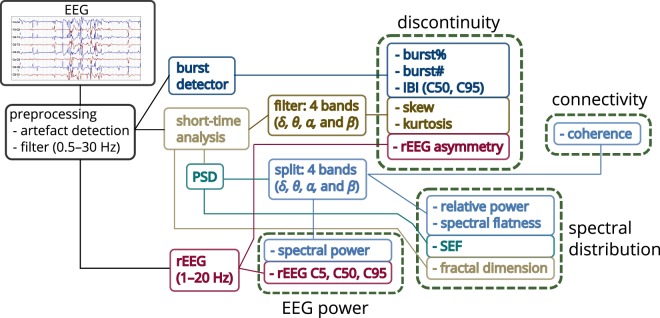
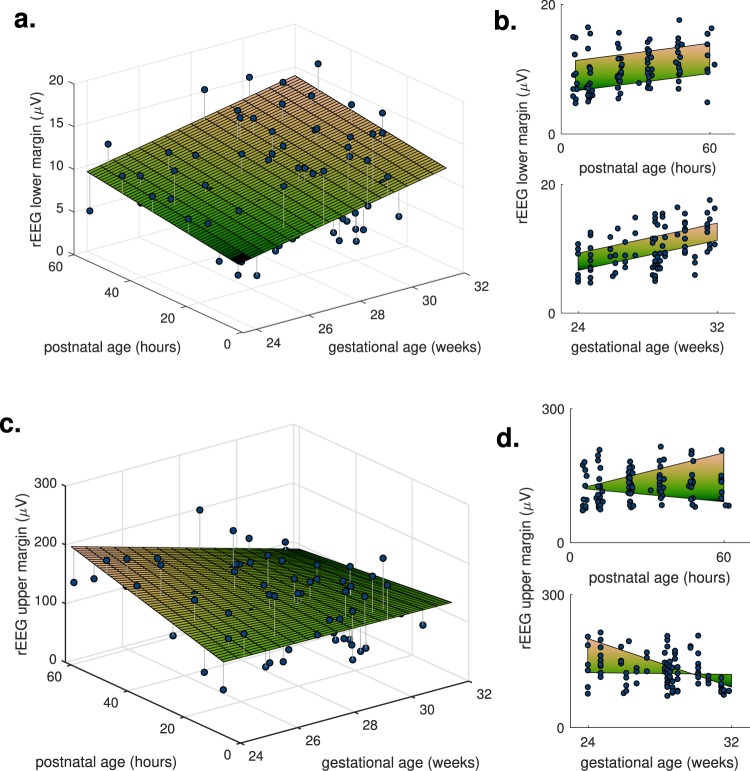
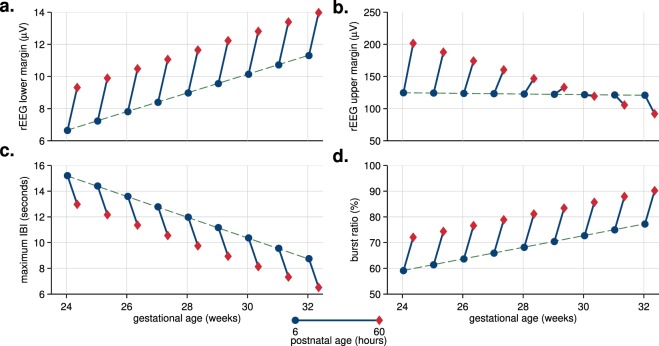
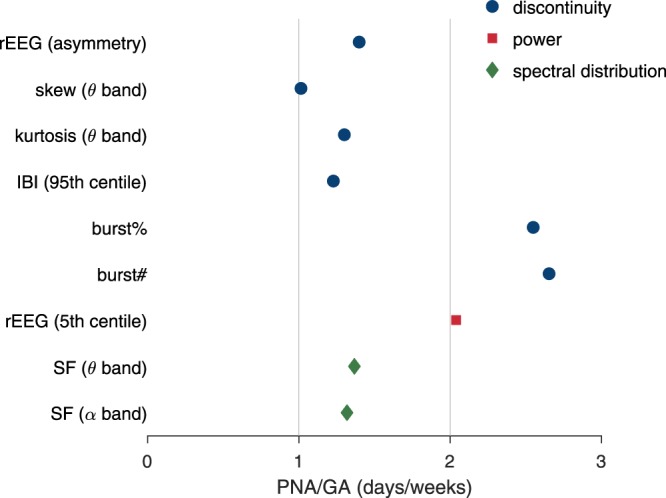
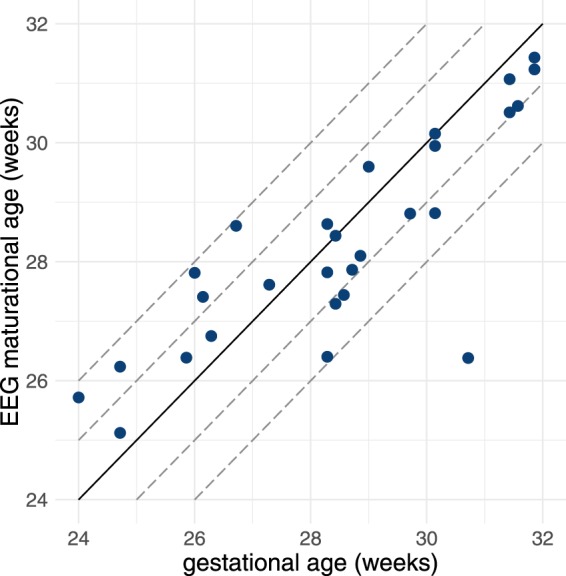
For the premature newborn, little is known about changes in brain activity during transition to extra-uterine life. We aim to quantify these changes in relation to the longer-term maturation of the developing brain. We analysed EEG for up to 72 hours after birth from 28 infants born <32 weeks of gestation. These infants had favourable neurodevelopment at 2 years of age and were without significant neurological compromise at time of EEG monitoring. Quantitative EEG was generated using features representing EEG power, discontinuity, spectral distribution, and inter-hemispheric connectivity. We found rapid changes in cortical activity over the 3 days distinct from slower changes associated with gestational age: for many features, evolution over 1 day after birth is equivalent to approximately 1 to 2.5 weeks of maturation. Considerable changes in the EEG immediately after birth implies that postnatal adaption significantly influences cerebral activity for early preterm infants. Postnatal age, in addition to gestational age, should be considered when analysing preterm EEG within the first few days after birth.
对于早产儿,人们对于其向宫外生活过渡期间大脑活动的变化知之甚少。我们旨在定量分析这些变化与发育中大脑的长期成熟之间的关系。我们分析了 28 名胎龄<32 周出生的婴儿出生后长达 72 小时的脑电图。这些婴儿在 2 岁时神经发育良好,在进行脑电图监测时没有明显的神经功能障碍。使用代表脑电图功率、不连续性、频谱分布和半球间连通性的特征生成定量脑电图。我们发现,皮质活动在 3 天内发生了快速变化,与与胎龄相关的较慢变化明显不同:对于许多特征,出生后 1 天的演变相当于大约 1 到 2.5 周的成熟。出生后立即出现的脑电图显著变化意味着,对于早期早产儿来说,产后适应会显著影响大脑活动。在出生后最初几天内分析早产儿脑电图时,除胎龄外,还应考虑产后年龄。