Mikkelsen Lonnie, Johnson Mark, Wisniewska Danuta Maria, van Neer Abbo, Siebert Ursula, Madsen Peter Teglberg, Teilmann Jonas
Department of Bioscience Aarhus University Roskilde Denmark.
Sea Mammal Research Unit University of St. Andrews St. Andrews UK.
Ecol Evol. 2019 Feb 6;9(5):2588-2601. doi: 10.1002/ece3.4923. eCollection 2019 Mar.
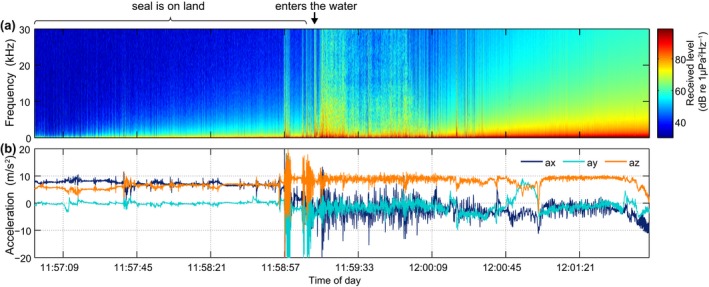
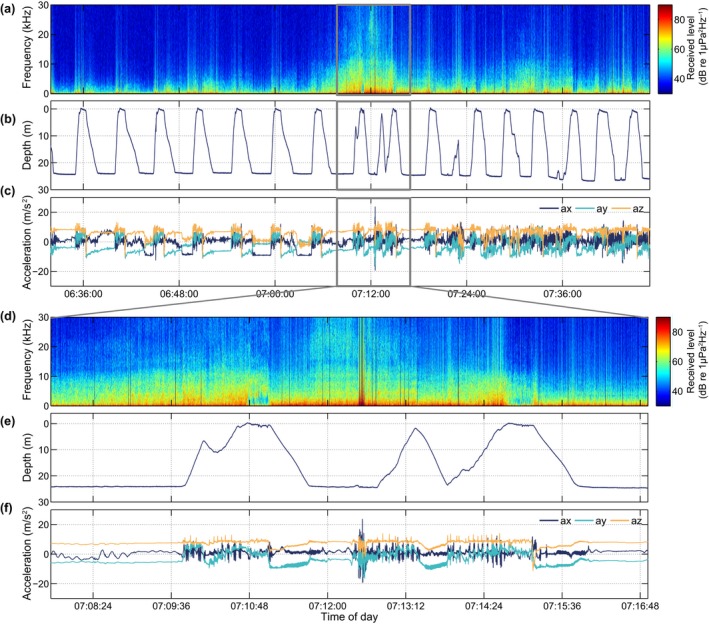
The impact of anthropogenic noise on marine fauna is of increasing conservation concern with vessel noise being one of the major contributors. Animals that rely on shallow coastal habitats may be especially vulnerable to this form of pollution.Very limited information is available on how much noise from ship traffic individual animals experience, and how they may react to it due to a lack of suitable methods. To address this, we developed long-duration audio and 3D-movement tags (DTAGs) and deployed them on three harbor seals and two gray seals in the North Sea during 2015-2016.These tags recorded sound, accelerometry, magnetometry, and pressure continuously for up to 21 days. GPS positions were also sampled for one seal continuously throughout the recording period. A separate tag, combining a camera and an accelerometer logger, was deployed on two harbor seals to visualize specific behaviors that helped interpret accelerometer signals in the DTAG data.Combining data from depth, accelerometer, and audio sensors, we found that animals spent 6.6%-42.3% of the time hauled out (either on land or partly submerged), and 5.3%-12.4% of their at-sea time resting at the sea bottom, while the remaining time was used for traveling, resting at surface, and foraging. Animals were exposed to audible vessel noise 2.2%-20.5% of their time when in water, and we demonstrate that interruption of functional behaviors (e.g., resting) in some cases coincides with high-level vessel noise. Two-thirds of the ship noise events were traceable by the AIS vessel tracking system, while one-third comprised vessels without AIS.This preliminary study demonstrates how concomitant long-term continuous broadband on-animal sound and movement recordings may be an important tool in future quantification of disturbance effects of anthropogenic activities at sea and assessment of long-term population impacts on pinnipeds.
人为噪声对海洋动物的影响日益受到保护关注,船舶噪声是主要贡献因素之一。依赖浅海沿岸栖息地的动物可能尤其容易受到这种污染形式的影响。由于缺乏合适的方法,关于单个动物在船舶交通中所经历的噪声量以及它们如何对此做出反应的信息非常有限。为了解决这个问题,我们开发了长时间音频和三维运动标签(DTAG),并于2015年至2016年在北海的三只港海豹和两只灰海豹身上进行了部署。这些标签连续记录声音、加速度测量、磁力测量和压力长达21天。在整个记录期间,还对一只海豹连续采样GPS位置。在两只港海豹身上部署了一个单独的标签,该标签结合了摄像头和加速度计记录器,以可视化有助于解释DTAG数据中加速度计信号的特定行为。结合深度、加速度计和音频传感器的数据,我们发现动物在拖出(在陆地或部分淹没)状态下花费的时间占6.6% - 42.3%,在海底休息的海上时间占5.3% - 12.4%,其余时间用于旅行、在水面休息和觅食。动物在水中时,有2.2% - 20.5%的时间暴露于可听见的船舶噪声中,并且我们证明在某些情况下,功能行为(如休息)的中断与高强度船舶噪声同时发生。三分之二的船舶噪声事件可通过AIS船舶跟踪系统追踪到,而三分之一的船舶没有AIS。这项初步研究表明,伴随的长期连续动物宽带声音和运动记录可能是未来量化海上人为活动干扰影响以及评估对鳍足类动物长期种群影响的重要工具。