
急性心力衰竭综合征住院患者心室传导障碍模式的预后意义
Prognostic Implication of Ventricular Conduction Disturbance Pattern in Hospitalized Patients with Acute Heart Failure Syndrome.
作者信息
Lee Ji Hyun, Park Jin Joo, Cho Youngjin, Oh Il Young, Yoo Byung Su, Kim Jae Joong, Kim Kye Hun, Kang Seok Min, Baek Sang Hong, Jeon Eun Seok, Cho Myeong Chan, Chae Shung Chull, Oh Byung Hee, Choi Dong Ju
机构信息
Department of Internal Medicine, Yonsei University Wonju College of Medicine, Wonju, Korea.
Department of Cardiology, Cardiovascular Center, Seoul National University Bundang Hospital, Seongnam, Korea.
出版信息
Korean Circ J. 2019 Jul;49(7):602-611. doi: 10.4070/kcj.2018.0290. Epub 2019 Feb 26.
BACKGROUND AND OBJECTIVES
Conflicting data exist regarding the prognostic implication of ventricular conduction disturbance pattern in patients with heart failure (HF). This study investigated the prognostic impact of ventricular conduction pattern in hospitalized patients with acute HF.
METHODS
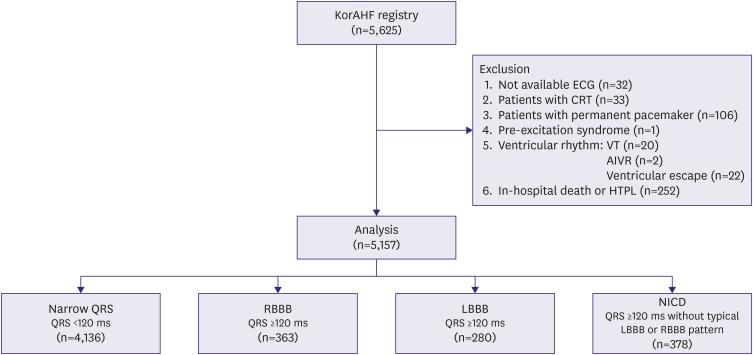
Data from the Korean Acute Heart Failure registry were used. Patients were categorized into four groups: narrow QRS (<120 ms), right bundle branch block (RBBB), left bundle branch block (LBBB), and nonspecific intraventricular conduction delay (NICD). The NICD was defined as prolonged QRS (≥120 ms) without typical features of LBBB or RBBB. The primary endpoint was the composite of all-cause mortality or rehospitalization for HF aggravation within 1 year after discharge.
RESULTS
This study included 5,157 patients. The primary endpoint occurred in 39.7% of study population. The LBBB group showed the highest incidence of primary endpoint followed by NICD, RBBB, and narrow QRS groups (52.5% vs. 49.7% vs. 44.4% vs. 37.5%, p<0.001). In a multivariable Cox-proportional hazards regression analysis, LBBB and NICD were associated with 39% and 28% increased risk for primary endpoint (LBBB hazard ratio [HR], 1.392; 95% confidence interval [CI], 1.152-1.681; NICD HR, 1.278; 95% CI, 1.074-1.520) compared with narrow QRS group. The HR of RBBB for the primary endpoint was 1.103 (95% CI, 0.915-1.329).
CONCLUSIONS
LBBB and NICD were independently associated with an increased risk of 1-year adverse event in hospitalized patients with HF, whereas the prognostic impacts of RBBB were limited.
TRIAL REGISTRATION
ClinicalTrials.gov Identifier: NCT01389843.
背景与目的
关于心力衰竭(HF)患者心室传导障碍模式的预后意义,存在相互矛盾的数据。本研究调查了急性HF住院患者心室传导模式的预后影响。
方法
使用韩国急性心力衰竭注册研究的数据。患者被分为四组:窄QRS波(<120毫秒)、右束支传导阻滞(RBBB)、左束支传导阻滞(LBBB)和非特异性室内传导延迟(NICD)。NICD定义为QRS波延长(≥120毫秒),且无LBBB或RBBB的典型特征。主要终点是出院后1年内全因死亡或因HF加重再次住院的复合终点。
结果
本研究纳入5157例患者。主要终点在39.7%的研究人群中出现。LBBB组主要终点发生率最高,其次是NICD组、RBBB组和窄QRS波组(52.5%对49.7%对44.4%对37.5%,p<0.001)。在多变量Cox比例风险回归分析中,与窄QRS波组相比,LBBB和NICD与主要终点风险分别增加39%和28%相关(LBBB风险比[HR],1.392;95%置信区间[CI],1.152 - 1.681;NICD HR,1.278;95% CI,1.074 - 1.520)。RBBB的主要终点HR为1.103(95% CI,0.915 - 1.329)。
结论
LBBB和NICD与HF住院患者1年不良事件风险增加独立相关,而RBBB的预后影响有限。
试验注册
ClinicalTrials.gov标识符:NCT01389843。


 Zotero 插件