Anindyajati Adhi, Boughton Philip, Ruys Andrew J
School of Aerospace, Mechanical and Mechatronic Engineering, University of Sydney, NSW 2006, Australia.
Materials (Basel). 2019 Mar 19;12(6):916. doi: 10.3390/ma12060916.
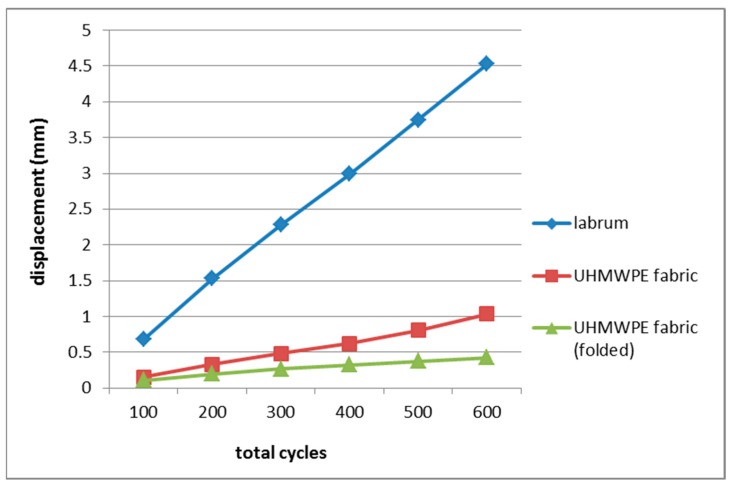
In this study, a fibrous composite was developed as synthetic graft for labral reconstruction treatment, comprised of ultra-high molecular weight polyethylene (UHMWPE) fabric, ultrafine fibre of polycaprolactone (PCL), and 45S5 Bioglass. This experiment aimed to examine the mechanical performance and cytocompatibility of the composite. Electrospinning and a slurry dipping technique were applied for composite fabrication. To assess the mechanical performance of UHMWPE, tensile cyclic loading test was carried out. Meanwhile, cytocompatibility of the composite on fibroblastic cells was examined through a viability assay, as well as SEM images to observe cell attachment and proliferation. The mechanical test showed that the UHMWPE fabric had a mean displacement of 1.038 mm after 600 cycles, approximately 4.5 times greater resistance compared to that of natural labrum, based on data obtained from literature. A viability assay demonstrated the predominant occupation of live cells on the material surface, suggesting that the composite was able to provide a viable environment for cell growth. Meanwhile, SEM images exhibited cell adhesion and the formation of cell colonies on the material surface. These results indicated that the UHMWPE/PCL/Bioglass composite could be a promising material for labrum implants.
在本研究中,开发了一种纤维复合材料作为用于盂唇重建治疗的合成移植物,其由超高分子量聚乙烯(UHMWPE)织物、聚己内酯(PCL)超细纤维和45S5生物玻璃组成。本实验旨在检测该复合材料的力学性能和细胞相容性。采用静电纺丝和浆料浸渍技术制备复合材料。为评估UHMWPE的力学性能,进行了拉伸循环加载试验。同时,通过活力测定以及扫描电子显微镜(SEM)图像来观察细胞附着和增殖情况,以此检测该复合材料对成纤维细胞的细胞相容性。力学测试表明,根据文献数据,UHMWPE织物在600次循环后平均位移为1.038毫米,与天然盂唇相比,其阻力大约大4.5倍。活力测定表明活细胞主要占据材料表面,这表明该复合材料能够为细胞生长提供适宜的环境。同时,SEM图像显示材料表面有细胞粘附和细胞集落形成。这些结果表明,UHMWPE/PCL/生物玻璃复合材料可能是一种有前景的盂唇植入材料。