Department of Biotechnology and Bioinformatics, School of Life Sciences, University of Hyderabad, Hyderabad, India.
Department of Computational Biology and Bioinformatics, University of Kerala, Thiruvanthapuram, India.
mSphere. 2019 Mar 20;4(2):e00082-19. doi: 10.1128/mSphere.00082-19.
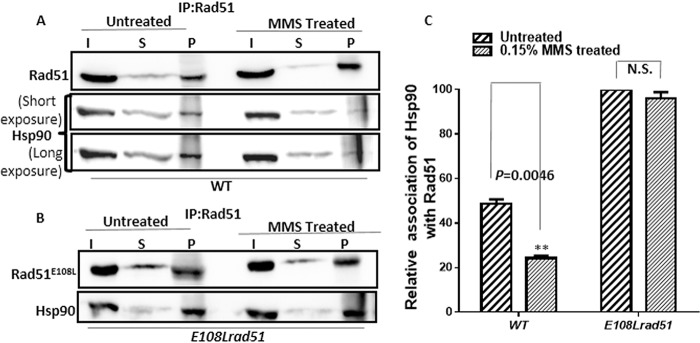
DNA damage-induced Rad51 focus formation is the hallmark of homologous recombination-mediated DNA repair. Earlier, we reported that Rad51 physically interacts with Hsp90, and under the condition of Hsp90 inhibition, it undergoes proteasomal degradation. Here, we show that the dynamic interaction between Rad51 and Hsp90 is crucial for the DNA damage-induced nuclear function of Rad51. Guided by a bioinformatics study, we generated a single mutant of Rad51, which resides at the N-terminal domain, outside the ATPase core domain. The mutant with an E to L change at residue 108 (Rad51) was predicted to bind more strongly with Hsp90 than the wild-type (Rad51). A coimmunoprecipitation study demonstrated that there exists a distinct difference between the associations of Rad51-Hsp90 and of Rad51-Hsp90. We found that upon DNA damage, the association between Rad51 and Hsp90 was significantly reduced compared to that in the undamaged condition. However, the mutant Rad51 remained tightly associated with Hsp90 even after DNA damage. Consequently, the recruitment of Rad51 to the double-stranded broken ends was reduced significantly. The - strain manifested severe sensitivity toward methyl methanesulfonate (MMS) and a complete loss of gene conversion efficiency, a phenotype similar to that of the strain. Previously, some of the N-terminal domain mutants of Rad51 were identified in a screen for a Rad51 interaction-deficient mutant; however, our study shows that Rad51 is not defective either in the self-interaction or its interaction with the members of the Rad52 epistatic group. Our study thus identifies a novel mutant of Rad51 which, owing to its greater association with Hsp90, exhibits a severe DNA repair defect. Rad51-mediated homologous recombination is the major mechanism for repairing DNA double-strand break (DSB) repair in cancer cells. Thus, regulating Rad51 activity could be an attractive target. The sequential assembly and disassembly of Rad51 to the broken DNA ends depend on reversible protein-protein interactions. Here, we discovered that a dynamic interaction with molecular chaperone Hsp90 is one such regulatory event that governs the recruitment of Rad51 onto the damaged DNA. We uncovered that Rad51 associates with Hsp90, and upon DNA damage, this complex dissociates to facilitate the loading of Rad51 onto broken DNA. In a mutant where such dissociation is incomplete, the occupancy of Rad51 at the broken DNA is partial, which results in inefficient DNA repair. Thus, it is reasonable to propose that any small molecule that may alter the dynamics of the Rad51-Hsp90 interaction is likely to impact DSB repair in cancer cells.
DNA 损伤诱导的 Rad51 焦点形成是同源重组介导的 DNA 修复的标志。我们之前报道过,Rad51 与 Hsp90 发生物理相互作用,并且在 Hsp90 抑制的条件下,它会经历蛋白酶体降解。在这里,我们表明 Rad51 与 Hsp90 之间的动态相互作用对于 Rad51 的核功能至关重要。在生物信息学研究的指导下,我们生成了一个位于 N 端结构域、ATP 酶核心结构域外的 Rad51 单突变体。残基 108 处由 E 突变为 L 的突变体(Rad51)被预测比野生型(Rad51)与 Hsp90 结合更强。免疫共沉淀研究表明,Rad51-Hsp90 和 Rad51-Hsp90 的结合存在明显差异。我们发现,与未受损条件相比,DNA 损伤后 Rad51 与 Hsp90 的结合显著减少。然而,突变体 Rad51 即使在 DNA 损伤后仍与 Hsp90 紧密结合。因此,Rad51 招募到双链断裂末端的能力显著降低。Δ菌株对甲基甲磺酸甲烷(MMS)表现出严重的敏感性,并且完全丧失了基因转换效率,表现出与Δ菌株相似的表型。先前,在筛选 Rad51 相互作用缺陷突变体的过程中发现了一些 Rad51 N 端结构域突变体;然而,我们的研究表明,Rad51 无论是在自身相互作用还是与 Rad52 上位群成员的相互作用中都没有缺陷。因此,我们的研究确定了一种新型 Rad51 突变体,由于与 Hsp90 的关联更大,因此表现出严重的 DNA 修复缺陷。Rad51 介导的同源重组是癌细胞中修复 DNA 双链断裂(DSB)的主要机制。因此,调节 Rad51 的活性可能是一个有吸引力的目标。Rad51 与断裂 DNA 末端的顺序组装和解组装取决于可逆的蛋白质-蛋白质相互作用。在这里,我们发现与分子伴侣 Hsp90 的动态相互作用是调节 Rad51 招募到受损 DNA 上的这样一个调节事件。我们发现 Rad51 与 Hsp90 结合,并且在 DNA 损伤后,这种复合物解离以促进 Rad51 加载到断裂的 DNA 上。在这种解离不完全的突变体中,Rad51 在断裂 DNA 上的占据是部分的,这导致 DNA 修复效率低下。因此,我们有理由提出,任何可能改变 Rad51-Hsp90 相互作用动态的小分子都可能影响癌细胞中的 DSB 修复。