• 文献检索
  • 文档翻译
  • 深度研究
  • 学术资讯
  • Suppr Zotero 插件Zotero 插件
  • 邀请有礼
  • 套餐&价格
  • 历史记录
应用&插件
Suppr Zotero 插件Zotero 插件浏览器插件Mac 客户端Windows 客户端微信小程序
定价
高级版会员购买积分包购买API积分包
服务
文献检索文档翻译深度研究API 文档MCP 服务
关于我们
关于 Suppr公司介绍联系我们用户协议隐私条款
关注我们

Suppr 超能文献

核心技术专利:CN118964589B侵权必究
粤ICP备2023148730 号-1Suppr @ 2026

文献检索

告别复杂PubMed语法,用中文像聊天一样搜索,搜遍4000万医学文献。AI智能推荐,让科研检索更轻松。

立即免费搜索

文件翻译

保留排版,准确专业,支持PDF/Word/PPT等文件格式,支持 12+语言互译。

免费翻译文档

深度研究

AI帮你快速写综述,25分钟生成高质量综述,智能提取关键信息,辅助科研写作。

立即免费体验

过去二十年全球珊瑚白化现象的分析。

A global analysis of coral bleaching over the past two decades.

机构信息

Institute for Global Ecology, Florida Institute of Technology, 150 West University Blvd., Melbourne, FL, 32901, USA.

Department of Ecology, Evolution, and Marine Biology, University of California, Santa Barbara, CA, 93106, USA.

出版信息

Nat Commun. 2019 Mar 20;10(1):1264. doi: 10.1038/s41467-019-09238-2.

DOI:10.1038/s41467-019-09238-2
PMID:30894534
原文链接:https://pmc.ncbi.nlm.nih.gov/articles/PMC6427037/
Abstract

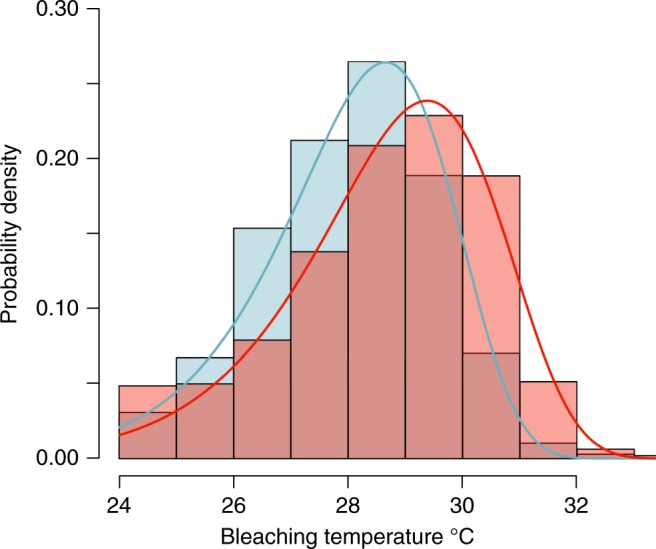
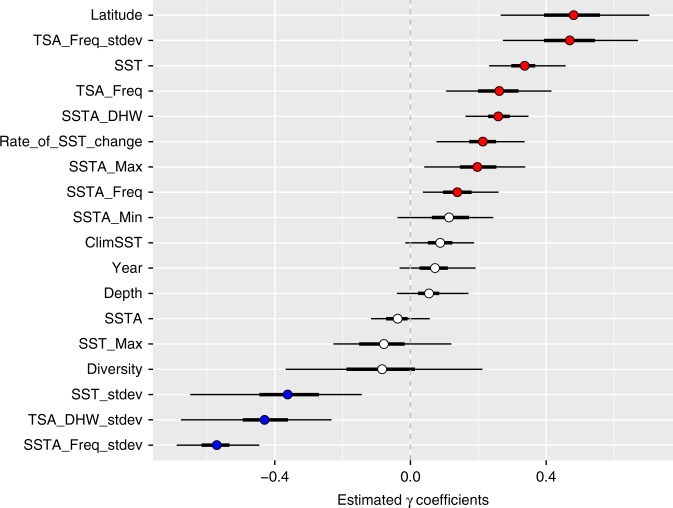
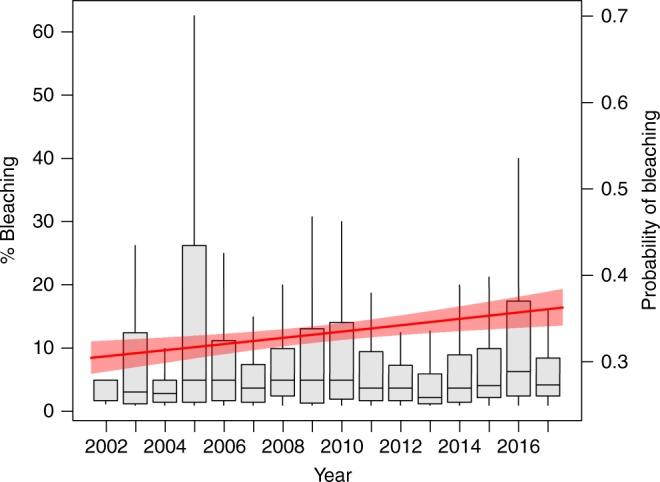
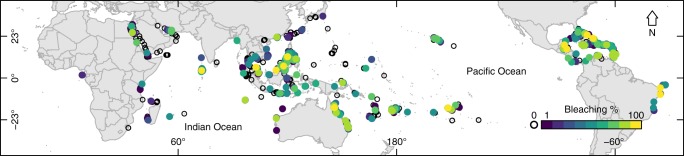
Thermal-stress events associated with climate change cause coral bleaching and mortality that threatens coral reefs globally. Yet coral bleaching patterns vary spatially and temporally. Here we synthesize field observations of coral bleaching at 3351 sites in 81 countries from 1998 to 2017 and use a suite of environmental covariates and temperature metrics to analyze bleaching patterns. Coral bleaching was most common in localities experiencing high intensity and high frequency thermal-stress anomalies. However, coral bleaching was significantly less common in localities with a high variance in sea-surface temperature (SST) anomalies. Geographically, the highest probability of coral bleaching occurred at tropical mid-latitude sites (15-20 degrees north and south of the Equator), despite similar thermal stress levels at equatorial sites. In the last decade, the onset of coral bleaching has occurred at significantly higher SSTs (∼0.5 °C) than in the previous decade, suggesting that thermally susceptible genotypes may have declined and/or adapted such that the remaining coral populations now have a higher thermal threshold for bleaching.

摘要

与气候变化相关的热应激事件导致珊瑚白化和死亡,从而威胁到全球的珊瑚礁。然而,珊瑚白化的模式在空间和时间上存在差异。在这里,我们综合了 1998 年至 2017 年间在 81 个国家的 3351 个地点进行的珊瑚白化实地观测,并使用一系列环境协变量和温度指标来分析白化模式。在经历高强度和高频率热应激异常的地方,珊瑚白化最为常见。然而,在海面温度(SST)异常方差较高的地方,珊瑚白化的情况明显较少。从地理上看,珊瑚白化的最高概率发生在热带中纬度地区(赤道南北 15-20 度),尽管赤道地区的热应力水平相似。在过去十年中,珊瑚白化的开始发生在比前十年更高的 SST(约 0.5°C),这表明易受热影响的基因型可能已经减少和/或适应,因此现在剩余的珊瑚种群对白化的热阈值更高。
https://cdn.ncbi.nlm.nih.gov/pmc/blobs/fdac/6427037/1edd38b9fc60/41467_2019_9238_Fig4_HTML.jpg
https://cdn.ncbi.nlm.nih.gov/pmc/blobs/fdac/6427037/49ed691de3fe/41467_2019_9238_Fig1_HTML.jpg
https://cdn.ncbi.nlm.nih.gov/pmc/blobs/fdac/6427037/8a0fadd6197d/41467_2019_9238_Fig2_HTML.jpg
https://cdn.ncbi.nlm.nih.gov/pmc/blobs/fdac/6427037/405c607d5bbf/41467_2019_9238_Fig3_HTML.jpg
https://cdn.ncbi.nlm.nih.gov/pmc/blobs/fdac/6427037/1edd38b9fc60/41467_2019_9238_Fig4_HTML.jpg
https://cdn.ncbi.nlm.nih.gov/pmc/blobs/fdac/6427037/49ed691de3fe/41467_2019_9238_Fig1_HTML.jpg
https://cdn.ncbi.nlm.nih.gov/pmc/blobs/fdac/6427037/8a0fadd6197d/41467_2019_9238_Fig2_HTML.jpg
https://cdn.ncbi.nlm.nih.gov/pmc/blobs/fdac/6427037/405c607d5bbf/41467_2019_9238_Fig3_HTML.jpg
https://cdn.ncbi.nlm.nih.gov/pmc/blobs/fdac/6427037/1edd38b9fc60/41467_2019_9238_Fig4_HTML.jpg

相似文献

1
A global analysis of coral bleaching over the past two decades.过去二十年全球珊瑚白化现象的分析。
Nat Commun. 2019 Mar 20;10(1):1264. doi: 10.1038/s41467-019-09238-2.
2
Oceanic differences in coral-bleaching responses to marine heatwaves.海洋热浪导致珊瑚白化反应的区域性差异。
Sci Total Environ. 2023 May 1;871:162113. doi: 10.1016/j.scitotenv.2023.162113. Epub 2023 Feb 9.
3
Turbid reefs moderate coral bleaching under climate-related temperature stress.浑浊的礁石在与气候相关的温度胁迫下减轻珊瑚白化。
Glob Chang Biol. 2020 Mar;26(3):1367-1373. doi: 10.1111/gcb.14948. Epub 2020 Jan 8.
4
Turning up the heat: increasing temperature and coral bleaching at the high latitude coral reefs of the Houtman Abrolhos Islands.升温:霍特曼阿布罗柳斯群岛高纬度珊瑚礁的温度升高和珊瑚白化。
PLoS One. 2012;7(8):e43878. doi: 10.1371/journal.pone.0043878. Epub 2012 Aug 29.
5
Thermal refugia against coral bleaching throughout the northern Red Sea.红海北部的珊瑚抗白化热避难所。
Glob Chang Biol. 2018 Feb;24(2):e474-e484. doi: 10.1111/gcb.13895. Epub 2017 Oct 17.
6
A coral reef refuge in the Red Sea.红海的珊瑚礁避难所。
Glob Chang Biol. 2013 Dec;19(12):3640-7. doi: 10.1111/gcb.12356. Epub 2013 Sep 23.
7
Local bleaching thresholds established by remote sensing techniques vary among reefs with deviating bleaching patterns during the 2012 event in the Arabian/Persian Gulf.通过遥感技术确定的局部白化阈值在2012年阿拉伯湾/波斯湾事件期间,因珊瑚礁的白化模式不同而有所差异。
Mar Pollut Bull. 2016 Apr 30;105(2):654-9. doi: 10.1016/j.marpolbul.2016.03.001. Epub 2016 Mar 10.
8
Tropical cyclone cooling combats region-wide coral bleaching.热带气旋降温可对抗大范围珊瑚白化。
Glob Chang Biol. 2014 May;20(5):1604-13. doi: 10.1111/gcb.12541. Epub 2014 Apr 8.
9
Marine heatwaves impair the thermal refugia potential of marginal reefs in the northern South China Sea.海洋热浪削弱了南海北部边缘珊瑚礁的热避难所潜力。
Sci Total Environ. 2022 Jun 15;825:154100. doi: 10.1016/j.scitotenv.2022.154100. Epub 2022 Feb 24.
10
Cloudiness reduces the bleaching response of coral reefs exposed to heat stress.云雾会降低暴露在热应激下的珊瑚礁的白化反应。
Glob Chang Biol. 2021 Aug;27(15):3474-3486. doi: 10.1111/gcb.15676. Epub 2021 May 24.

引用本文的文献

1
Species-specific retention vs. recovery of coral thermal tolerance following nursery propagation.珊瑚苗圃繁殖后特定物种的耐热性保留与恢复情况
Commun Biol. 2025 Aug 28;8(1):1294. doi: 10.1038/s42003-025-08657-w.
2
Regulation of coral assemblages: Spatial and temporal variation in the abundance of recruits, juveniles, and adults.珊瑚群落的调控:新招募个体、幼体和成体数量的时空变化。
PLoS One. 2025 Aug 21;20(8):e0329546. doi: 10.1371/journal.pone.0329546. eCollection 2025.
3
Global coral genomic vulnerability explains recent reef losses.

本文引用的文献

1
Global assessment of coral bleaching and required rates of adaptation under climate change.气候变化下珊瑚白化的全球评估及所需适应率
Glob Chang Biol. 2005 Dec;11(12):2251-2265. doi: 10.1111/j.1365-2486.2005.01073.x. Epub 2005 Nov 24.
2
Temperature-dependent hypoxia explains biogeography and severity of end-Permian marine mass extinction.温度相关缺氧解释了二叠纪末海洋大灭绝的生物地理学和严重程度。
Science. 2018 Dec 7;362(6419). doi: 10.1126/science.aat1327.
3
Evidence of acclimatization or adaptation in Hawaiian corals to higher ocean temperatures.
全球珊瑚基因组脆弱性解释了近期珊瑚礁的损失。
bioRxiv. 2025 Aug 11:2024.03.25.586253. doi: 10.1101/2024.03.25.586253.
4
Intergenerational metabolomic signatures of bleaching resistance in corals.珊瑚抗白化的代际代谢组学特征
Nat Commun. 2025 Jul 1;16(1):5971. doi: 10.1038/s41467-025-61102-8.
5
Environmental Drivers of Genetic Divergence in Two Corals From the Florida Keys.佛罗里达群岛两种珊瑚遗传分化的环境驱动因素
Evol Appl. 2025 Jun 29;18(7):e70126. doi: 10.1111/eva.70126. eCollection 2025 Jul.
6
Symbiotic Symbiodiniaceae mediate coral-associated bacterial communities along a natural thermal gradient.共生的虫黄藻沿着自然温度梯度介导与珊瑚相关的细菌群落。
Environ Microbiome. 2025 Jun 17;20(1):72. doi: 10.1186/s40793-025-00733-2.
7
Environmental acclimatization of the relatively high latitude scleractinian coral Pavona decussata: integrative perspectives on seasonal subaerial exposure and temperature fluctuations.相对高纬度石珊瑚类珊瑚十字牡丹珊瑚的环境适应性:关于季节性暴露于空气中和温度波动的综合观点
BMC Genomics. 2025 May 14;26(1):483. doi: 10.1186/s12864-025-11660-4.
8
Widespread coral bleaching and mass mortality during the 2023-2024 marine heatwave in Little Cayman.2023-2024年小开曼岛海洋热浪期间广泛的珊瑚白化和大规模死亡。
PLoS One. 2025 May 2;20(5):e0322636. doi: 10.1371/journal.pone.0322636. eCollection 2025.
9
Proteomic insights into the environmental adaptation of the subtropical brain coral host .对亚热带脑珊瑚宿主环境适应性的蛋白质组学见解。
iScience. 2025 Mar 25;28(4):112287. doi: 10.1016/j.isci.2025.112287. eCollection 2025 Apr 18.
10
Global warming drives a threefold increase in persistence and 1 C rise in intensity of marine heatwaves.全球变暖使海洋热浪的持续时间增加了两倍,强度上升了1摄氏度。
Proc Natl Acad Sci U S A. 2025 Apr 22;122(16):e2413505122. doi: 10.1073/pnas.2413505122. Epub 2025 Apr 14.
夏威夷珊瑚适应或适应更高海洋温度的证据。
PeerJ. 2018 Aug 7;6:e5347. doi: 10.7717/peerj.5347. eCollection 2018.
4
Ecosystem restructuring along the Great Barrier Reef following mass coral bleaching.大堡礁大规模珊瑚白化后的生态系统重构。
Nature. 2018 Aug;560(7716):92-96. doi: 10.1038/s41586-018-0359-9. Epub 2018 Jul 25.
5
High frequency temperature variability reduces the risk of coral bleaching.高频温度变化可降低珊瑚白化风险。
Nat Commun. 2018 Apr 26;9(1):1671. doi: 10.1038/s41467-018-04074-2.
6
Spatial and temporal patterns of mass bleaching of corals in the Anthropocene.人类世珊瑚大规模白化的时空模式。
Science. 2018 Jan 5;359(6371):80-83. doi: 10.1126/science.aan8048.
7
Global warming and recurrent mass bleaching of corals.全球变暖与珊瑚的反复大规模白化。
Nature. 2017 Mar 15;543(7645):373-377. doi: 10.1038/nature21707.
8
Reliability and utility of citizen science reef monitoring data collected by Reef Check Australia, 2002-2015.2002 - 2015年澳大利亚珊瑚礁检查组织收集的公民科学珊瑚礁监测数据的可靠性和实用性。
Mar Pollut Bull. 2017 Apr 15;117(1-2):148-155. doi: 10.1016/j.marpolbul.2017.01.054. Epub 2017 Feb 2.
9
Geographical limits to species-range shifts are suggested by climate velocity.气候速度限制了物种分布范围的变化。
Nature. 2014 Mar 27;507(7493):492-5. doi: 10.1038/nature12976. Epub 2014 Feb 9.
10
Marine taxa track local climate velocities.海洋生物类群能够追踪当地气候的变化速度。
Science. 2013 Sep 13;341(6151):1239-42. doi: 10.1126/science.1239352.