Calì Corrado, Tauffenberger Arnaud, Magistretti Pierre
Biological and Environmental Sciences and Engineering Division, King Abdullah University of Science and Technology, Thuwal, Saudi Arabia.
Front Cell Neurosci. 2019 Mar 6;13:82. doi: 10.3389/fncel.2019.00082. eCollection 2019.
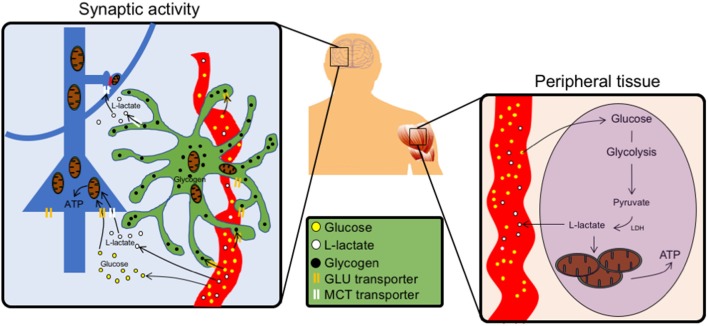
Brain energy metabolism has been the object of intense research in recent years. Pioneering work has identified the different cell types involved in energy production and use. Recent evidence has demonstrated a key role of L-Lactate in brain energy metabolism, producing a paradigm-shift in our understanding of the neuronal energy metabolism. At the center of this shift, is the identification of a central role of astrocytes in neuroenergetics. Thanks to their morphological characteristics, they are poised to take up glucose from the circulation and deliver energy substrates to neurons. Astrocyte neuron lactate shuttle (ANLS) model, has shown that the main energy substrate that astrocytes deliver to neurons is L-Lactate, to sustain neuronal oxidative metabolism. L-Lactate can also be produced from glycogen, the storage form of glucose, which is exclusively localized in astrocytes. Inhibition of glycogen metabolism and the ensuing inhibition of L-Lactate production leads to cognitive dysfunction. Experimental evidence indicates that the role of lactate in cognitive function relates not only to its role as a metabolic substrate for neurons but also as a signaling molecule for synaptic plasticity. Interestingly, a similar metabolic uncoupling appears to exist in peripheral tissues plasma, whereby glucose provides L-Lactate as the substrate for cellular oxidative metabolism. In this perspective article, we review the known information on the distribution of glycogen and lactate within brain cells, and how this distribution relates to the energy regime of glial vs. neuronal cells.
近年来,脑能量代谢一直是深入研究的对象。开创性的工作已经确定了参与能量产生和利用的不同细胞类型。最近的证据表明L-乳酸在脑能量代谢中起关键作用,这使我们对神经元能量代谢的理解发生了范式转变。这种转变的核心是确定星形胶质细胞在神经能量学中的核心作用。由于其形态特征,它们准备从循环中摄取葡萄糖并向神经元输送能量底物。星形胶质细胞-神经元乳酸穿梭(ANLS)模型表明,星形胶质细胞输送给神经元的主要能量底物是L-乳酸,以维持神经元的氧化代谢。L-乳酸也可以由糖原产生,糖原是葡萄糖的储存形式,仅存在于星形胶质细胞中。抑制糖原代谢以及随之而来的L-乳酸产生的抑制会导致认知功能障碍。实验证据表明,乳酸在认知功能中的作用不仅与其作为神经元代谢底物的作用有关,还与其作为突触可塑性信号分子的作用有关。有趣的是,外周组织血浆中似乎也存在类似的代谢解偶联,即葡萄糖提供L-乳酸作为细胞氧化代谢的底物。在这篇观点文章中,我们回顾了关于糖原和乳酸在脑细胞内分布的已知信息,以及这种分布与神经胶质细胞和神经元细胞能量状态的关系。