Pan Chin-Yun, Tseng Yu-Chuan, Lan Ting-Hsun, Chang Hong-Po
Department of Orthodontics, Dental Clinics, Kaohsiung Medical University Hospital, Kaohsiung, Taiwan.
School of Dentistry, College of Dental Medicine, Kaohsiung Medical University, Kaohsiung, Taiwan.
J Dent Sci. 2017 Dec;12(4):313-318. doi: 10.1016/j.jds.2017.07.002. Epub 2017 Oct 19.
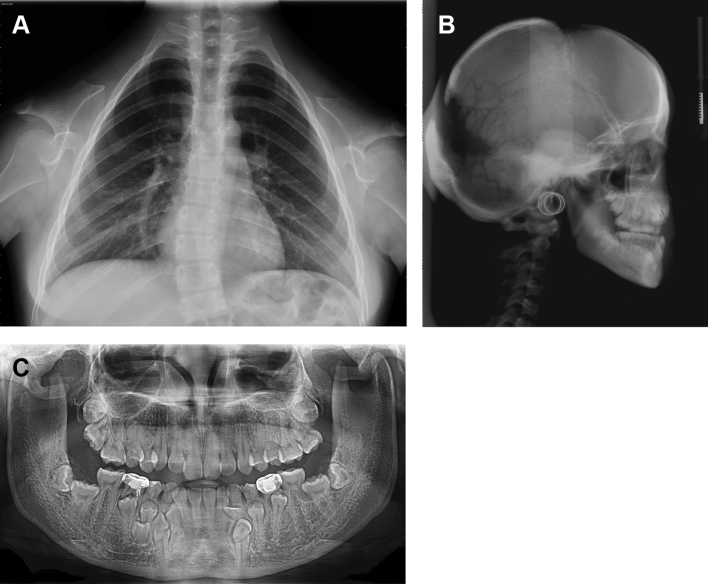
Cleidocranial dysplasia (CCD) is an autosomal-dominant malformation syndrome affecting bones and teeth. The most common skeletal and dental abnormalities in affected individuals are hypoplastic/aplastic clavicles, open fontanelles, short stature, retention of primary teeth, delayed eruption of permanent teeth, supernumerary teeth, and multiple impacted teeth. Treatment of CCD requires a multidisciplinary approach that may include dental corrections, orthognathic surgery and cranioplasty along with management of any complications of CCD. Early diagnosis of this condition enables application of the treatment strategy that provides the best quality of life to such patients. Notably, Runx2 gene mutations have been identified in CCD patients. Therefore, further elucidation of the molecular mechanism of supernumerary teeth formation related to Runx2 mutations may improve understanding of dental development in CCD. The insights into CCD pathogenesis may assist in the development of new treatments for CCD.
锁骨颅骨发育不全(CCD)是一种常染色体显性畸形综合征,会影响骨骼和牙齿。受影响个体最常见的骨骼和牙齿异常包括锁骨发育不全/发育不全、囟门未闭、身材矮小、乳牙滞留、恒牙萌出延迟、多生牙和多颗阻生牙。CCD的治疗需要多学科方法,可能包括牙齿矫正、正颌手术和颅骨成形术,以及对CCD任何并发症的管理。对这种疾病的早期诊断能够应用为这类患者提供最佳生活质量的治疗策略。值得注意的是,在CCD患者中已鉴定出Runx2基因突变。因此,进一步阐明与Runx2突变相关的多生牙形成的分子机制可能会增进对CCD中牙齿发育的理解。对CCD发病机制的深入了解可能有助于开发针对CCD的新治疗方法。