Oh Daniel J, Kanu Levi N, Chen Judy L, Aref Ahmad A, Mieler William F, MacIntosh Peter W
University of Illinois at Chicago, Department of Ophthalmology and Visual Sciences, Chicago, IL, USA.
J Ophthalmol. 2019 Feb 14;2019:7807391. doi: 10.1155/2019/7807391. eCollection 2019.
An ophthalmology consultation service is of significant benefit to patients in the hospital and is an instructive component of a residency education program. Ophthalmology consultations in a hospital present unique challenges to those seen in an outpatient clinic, for which the consulting ophthalmologist should be prepared. The purpose of this study was to profile the emergency room and inpatient ophthalmology consultations seen at an academic institution.
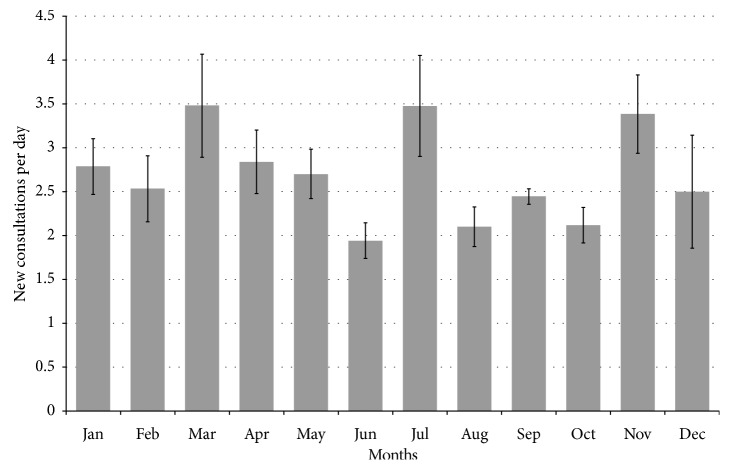
A prospective study of 581 patients was conducted on inpatient and emergency room ophthalmology consultations at the University of Illinois at Chicago over twelve months. Characteristics such as the consulting service, type of and reason for consultation, subspecialty staffing service, diagnosis, and suitability for in-hospital evaluation were recorded.
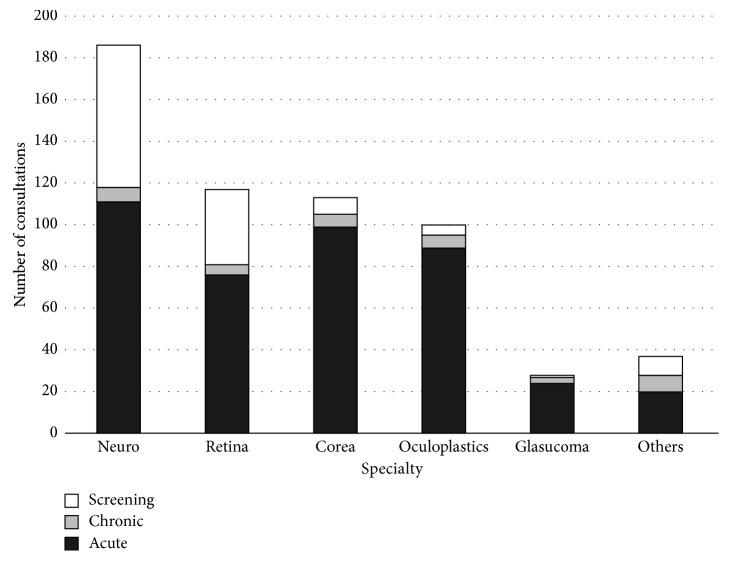
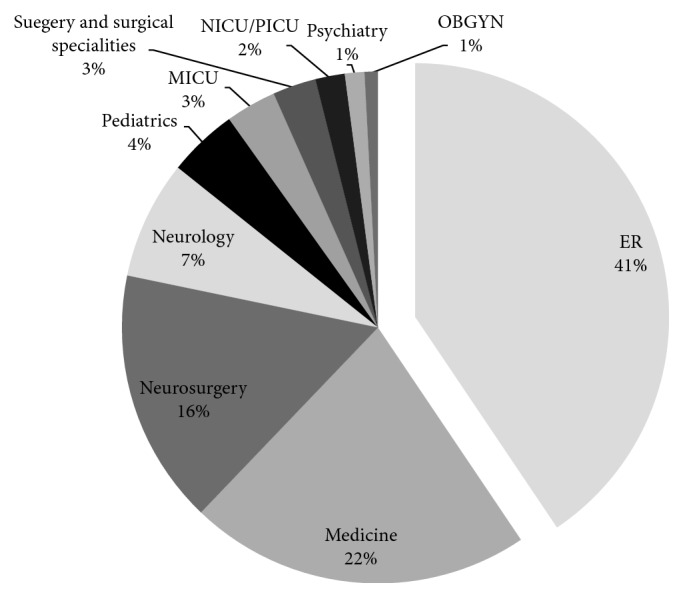
Consultations were received from either inpatient wards (59.4%) or the Emergency Department (40.6%). The most common inpatient consulting services were internal medicine (22%), followed by neurosurgery (16%) and neurology (7%). All the consultations were categorized as acute (72.3%), chronic (6.0%), or screening (21.7%). Consultations categorized as screening included papilledema (31.0%), fungemia (20.6%), syndromic evaluation (19.8%), visual field evaluation (17.5%), and miscellaneous evaluation (11.1%). We classified the ophthalmic diagnoses into 63 unique diagnoses. Amongst the ophthalmic subspecialties, neuro-ophthalmologic diagnoses were the most common (32.0%), followed by retina (20.1%) and cornea (19.4%). Neuro-ophthalmology had the highest proportion of screening consultations (36.6%), while glaucoma had the least overall number of consultations (10.1%), and the least proportion of screening consultations (3.6%). A significant proportion of nonacute consultations (19.0%) was deemed to be more suitable for outpatient evaluation.
Consultation databases can be useful in preparing trainees for in-hospital clinical care. A wide range of ocular pathologies may present to the ophthalmology consultant, from acute trauma to screening for systemic syndromes. Some consultations may be more suitable for outpatient evaluation which may help optimize patient care.
眼科会诊服务对医院患者大有裨益,且是住院医师培训项目的一个指导性组成部分。医院中的眼科会诊给门诊所见的会诊带来了独特的挑战,会诊眼科医生应为此做好准备。本研究的目的是剖析在一所学术机构进行的急诊室和住院患者眼科会诊情况。
对伊利诺伊大学芝加哥分校12个月内的住院患者和急诊室眼科会诊的581例患者进行了一项前瞻性研究。记录了诸如会诊科室、会诊类型和原因、亚专业人员配备服务、诊断以及院内评估的适用性等特征。
会诊来自住院病房(59.4%)或急诊科(40.6%)。最常见的住院会诊科室是内科(22%),其次是神经外科(16%)和神经内科(7%)。所有会诊分为急性(72.3%)、慢性(6.0%)或筛查(21.7%)。归类为筛查的会诊包括视乳头水肿(31.0%)、真菌血症(20.6%)、综合征评估(19.8%)、视野评估(17.5%)和其他评估(11.1%)。我们将眼科诊断分为63种独特的诊断。在眼科亚专业中,神经眼科诊断最为常见(32.0%),其次是视网膜(20.1%)和角膜(19.4%)。神经眼科的筛查会诊比例最高(36.6%),而青光眼的会诊总数最少(10.1%),筛查会诊比例最低(3.6%)。相当一部分非急性会诊(19.0%)被认为更适合门诊评估。
会诊数据库有助于培训学员进行院内临床护理。眼科会诊医生可能会遇到各种各样的眼部疾病,从急性创伤到全身性综合征的筛查。一些会诊可能更适合门诊评估,这有助于优化患者护理。