Rustamov Oybek, Wilkinson Jack, La Marca Antonio, Fitzgerald Cheryl, Roberts Stephen A
Department of Reproductive Medicine, St Mary's Hospital, Central Manchester University Hospital NHS Foundation Trust, Manchester Academic Health Science Centre (MAHSC), Manchester, England M13 0JH, UK.
Primary IVF, Primary Health Care Limited, Brisbane, QLD 4075, Australia.
Hum Reprod Open. 2017 Nov 13;2017(3):hox018. doi: 10.1093/hropen/hox018. eCollection 2017.
How much variation in oocyte yield after controlled ovarian stimulation (COS) can be accounted for by known patient and treatment characteristics?
There is substantial variation in the COS responses of similar women and in repeated COS episodes undertaken by the same woman, which cannot be accounted for at present.
The goal of individualized COS is to safely collect enough oocytes to maximize the chance of success in an ART cycle. Personalization of treatment rests on the ability to reduce variation in response through modifiable factors.
Multilevel modelling of a routine ART database covering the period 1 October 2008-8 August 2012 was employed to estimate the amount of variation in COS response and the extent to which this could be explained by immutable patient characteristics and by manipulable treatment variables. A total of 1851 treatment cycles undertaken by 1430 patients were included. The study was not subject to attrition, as cancelled cycles were included in the analysis.
PARTICIPANTS/MATERIALS SETTING METHODS: Women aged 21-43 years undergoing ovarian stimulation for IVF (possibly with ICSI) using their own eggs at a tertiary care centre.
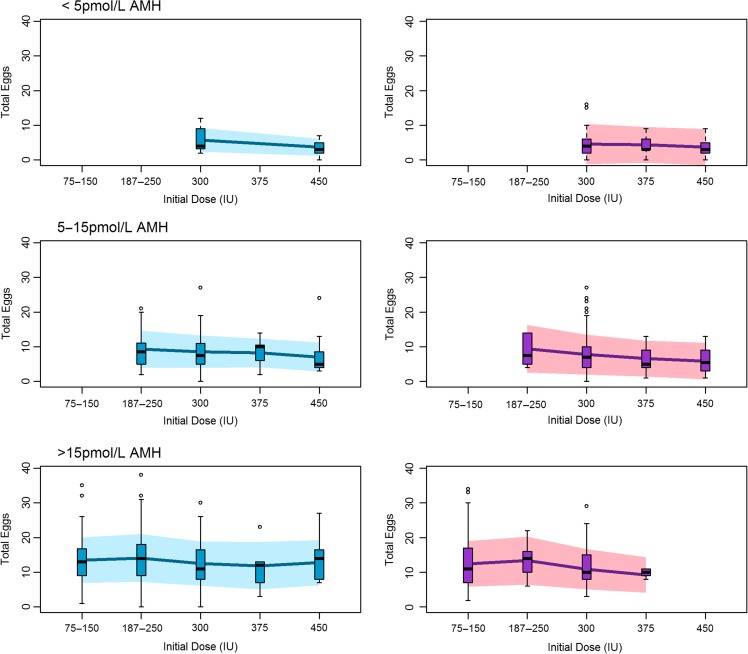
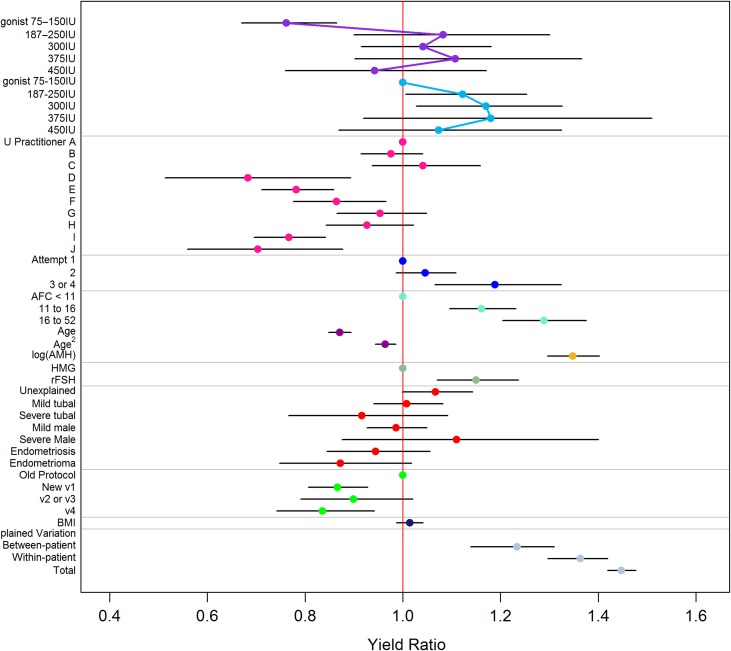
Substantial unexplained variation in COS response (oocyte yield): was observed (3.4-fold (95% CI: 3.12 to 3.61)). Only a relatively small amount of this variation (around 19%) can be explained by modifiable factors. A significant, previously undescribed predictor of response was the practitioner performing oocyte retrieval, with 1.5-fold variation between surgeons with the highest and lowest yields.
Although a large number of covariables were adjusted for in the analysis, including those that were used for dosing and determination of the stimulation regimen, this study is subject to confounding due to unmeasured variables and measurement error.
The present study suggests that there are limits to the extent that COS response can be predicted on the basis of known factors, or controlled by manipulation of treatment factors. Moreover, modifiable variation in response appears to be partially attributable to differences between surgeons performing oocyte retrieval. Consequently, consistent prevention of ineffective or unsafe responses to COS is not likely to be possible at present. Our results highlight the importance of blinding surgeons in RCTs. The data also suggest that there is likely to be limited scope for personalized treatment unless additional predictors of ovarian response can be identified.
STUDY FUNDING/COMPETING INTERESTS: J.W. is funded by a Doctoral Research Fellowship from the National Institute for Health Research (DRF-2014-07-050) supervised by S.A.R. The views expressed in this publication are those of the authors and not necessarily those of the NHS, the National Institute for Health Research or the Department of Health. J.W. is a statistical editor of the Cochrane Gynaecology and Fertility Group. S.A.R. is a statistical editor for Human Reproduction. J.W. also declares that publishing peer-reviewed articles benefits his career. A.L.M. has received consultation fees from MSD, Merck Serono, Ferring, TEVA, Roche, Beckman Coulter.
已知的患者和治疗特征能在多大程度上解释控制性卵巢刺激(COS)后卵母细胞产量的差异?
相似女性的COS反应以及同一女性多次进行COS时,都存在显著差异,目前这些差异无法得到解释。
个体化COS的目标是安全收集足够的卵母细胞,以最大化辅助生殖技术(ART)周期成功的几率。治疗的个性化取决于通过可调节因素减少反应差异的能力。
采用对2008年10月1日至2012年8月8日期间的常规ART数据库进行多层次建模,以估计COS反应的差异程度,以及这种差异能在多大程度上由不可改变的患者特征和可操控的治疗变量来解释。共纳入1430例患者的1851个治疗周期。由于取消的周期也纳入了分析,该研究不存在失访情况。
参与者/材料设置方法:在一家三级医疗中心,年龄21 - 43岁、使用自身卵子接受IVF(可能联合ICSI)卵巢刺激的女性。
观察到COS反应(卵母细胞产量)存在大量无法解释的差异(3.4倍(95%可信区间:3.12至3.61))。这种差异中只有相对较小的一部分(约19%)可由可调节因素解释。一个显著的、之前未描述过的反应预测因素是进行卵母细胞采集的医生,产量最高和最低的医生之间相差1.5倍。
尽管分析中调整了大量协变量,包括用于给药和确定刺激方案的变量,但由于存在未测量的变量和测量误差,本研究仍存在混杂因素。
本研究表明,基于已知因素预测COS反应或通过操控治疗因素进行控制的程度是有限的。此外,反应中可调节差异似乎部分归因于进行卵母细胞采集的医生之间的差异。因此,目前不太可能持续预防对COS无效或不安全的反应。我们的结果凸显了在随机对照试验中对医生进行盲法处理的重要性。数据还表明,除非能识别出更多卵巢反应的预测因素,个性化治疗的空间可能有限。
研究资金/竞争利益:J.W.由英国国家卫生研究院的博士研究奖学金资助(DRF - 2014 - 07 - 050),由S.A.R.指导。本出版物中表达的观点是作者的观点,不一定代表英国国家医疗服务体系、英国国家卫生研究院或卫生部的观点。J.W.是Cochrane妇科与生育组的统计编辑。S.A.R.是《人类生殖》的统计编辑。J.W.还声明发表同行评审文章对其职业发展有益。A.L.M.已从默克雪兰诺、辉凌、梯瓦、罗氏、贝克曼库尔特公司获得咨询费。