• 文献检索
  • 文档翻译
  • 深度研究
  • 学术资讯
  • Suppr Zotero 插件Zotero 插件
  • 邀请有礼
  • 套餐&价格
  • 历史记录
应用&插件
Suppr Zotero 插件Zotero 插件浏览器插件Mac 客户端Windows 客户端微信小程序
定价
高级版会员购买积分包购买API积分包
服务
文献检索文档翻译深度研究API 文档MCP 服务
关于我们
关于 Suppr公司介绍联系我们用户协议隐私条款
关注我们

Suppr 超能文献

核心技术专利:CN118964589B侵权必究
粤ICP备2023148730 号-1Suppr @ 2026

文献检索

告别复杂PubMed语法,用中文像聊天一样搜索,搜遍4000万医学文献。AI智能推荐,让科研检索更轻松。

立即免费搜索

文件翻译

保留排版,准确专业,支持PDF/Word/PPT等文件格式,支持 12+语言互译。

免费翻译文档

深度研究

AI帮你快速写综述,25分钟生成高质量综述,智能提取关键信息,辅助科研写作。

立即免费体验

促性腺激素起始剂量预测模型及其在控制性卵巢刺激中的临床应用。

Prediction model of gonadotropin starting dose and its clinical application in controlled ovarian stimulation.

机构信息

Department of Obstetrics and Gynecology, Renmin Hospital of Wuhan University, Wuhan, China.

Reproductive Medicine Center, Renmin Hospital of Wuhan University, Wuhan, China.

出版信息

BMC Pregnancy Childbirth. 2022 Nov 4;22(1):810. doi: 10.1186/s12884-022-05152-6.

DOI:10.1186/s12884-022-05152-6
PMID:36333671
原文链接:https://pmc.ncbi.nlm.nih.gov/articles/PMC9635211/
Abstract

BACKGROUND

Selecting an appropriate and personalized Gn starting dose (GSD) is an essential procedure for determining the quality and quantity of oocytes in the controlled ovarian stimulation (COS) process of the in-vitro fertilization (IVF) treatment cycle. The current approach for determining the GSD is mainly based on the experience of a clinician, lacking unified and scientific standards. This study aims to establish a prediction model of GSD, based on which good COS outcomes can be achieved with the influencing factors comprehensively evaluated quantitatively.

MATERIAL AND METHODS

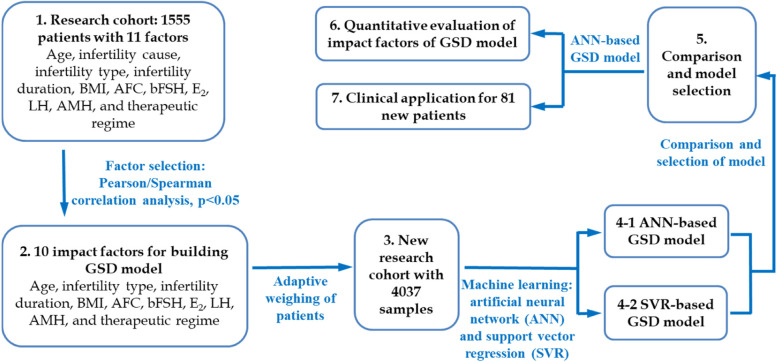
We collected a total of 1555 patients undergoing the first oocytes retrieving cycle and conducted correlation analysis to find the significant factors related to the GSD. Two GSD models are built based on two popular machine learning approaches, and the one with better model performance is selected as the final model. Finally, clinical application and validation were conducted to verify the effectiveness of the proposed model.

RESULTS

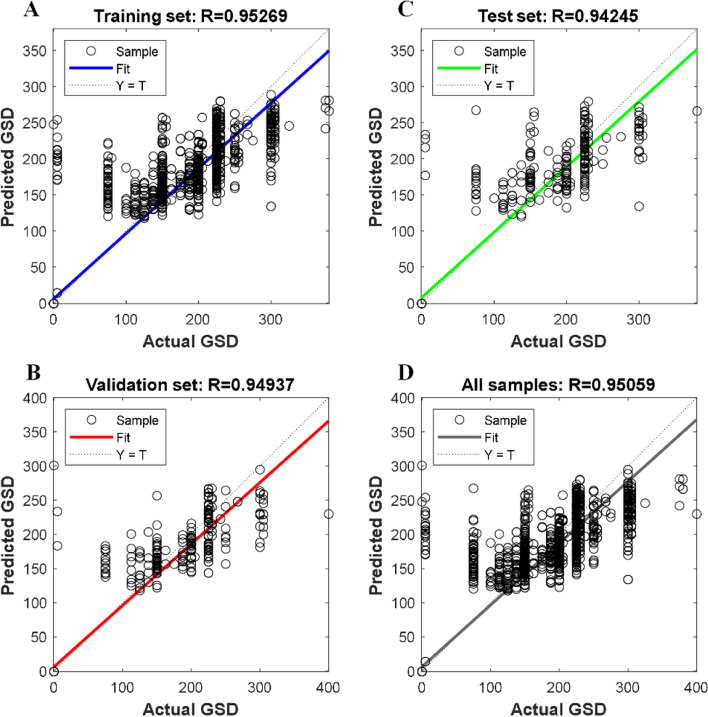
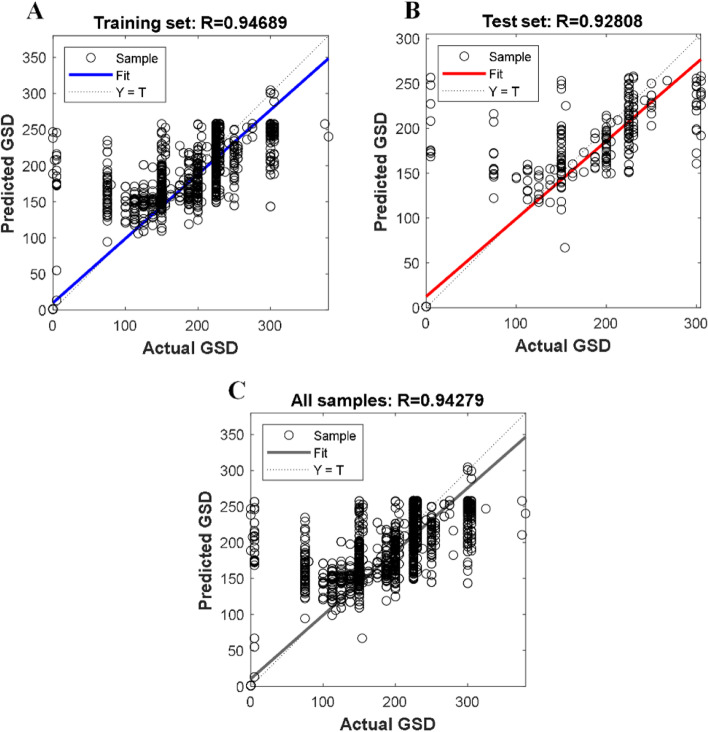
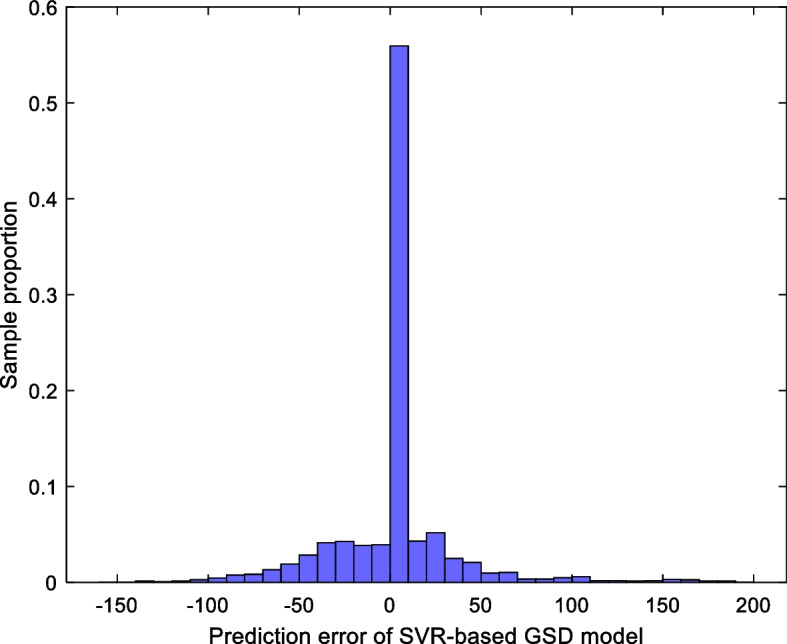
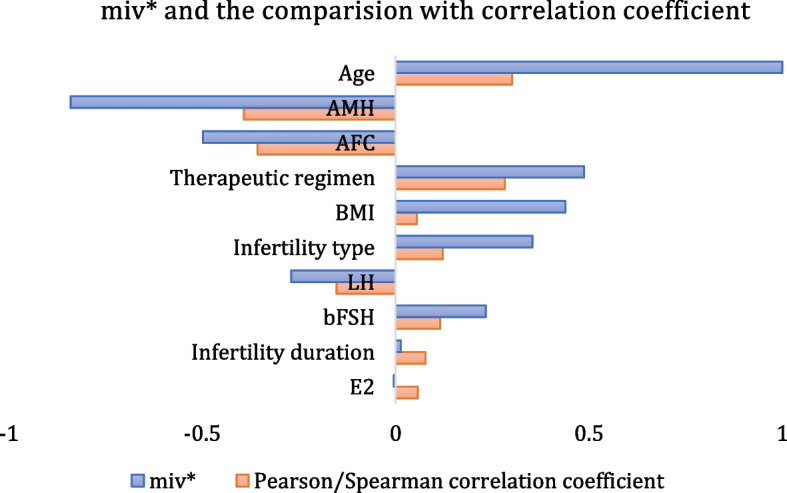
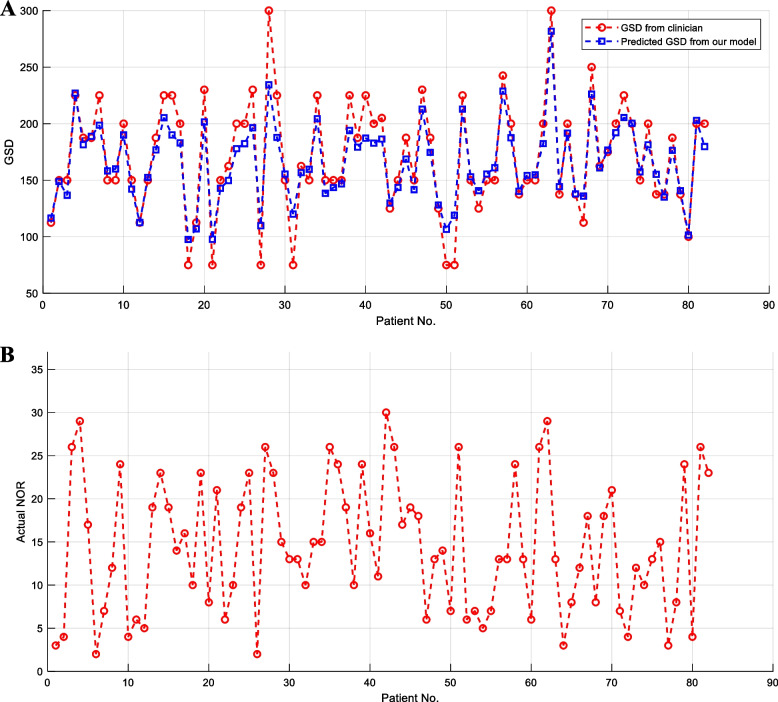
(1) Age, duration of infertility, type of infertility, body mass index (BMI), antral follicle count (AFC), basal follicle stimulating hormone (bFSH), estradiol (E), luteinizing hormone (LH), anti-Müllerian hormone (AMH) and COS treatment regimen were closely related to the GSD (P < 0.05). (2) The selected model has good modeling performance in terms of both root mean square error (RMSE) (29.87 ~ 34.21) and regression coefficient R (0.947 ~ 0.953). (3) A comprehensive evaluation of influencing factors for GSD is conducted and shows that the top four most significant factors are age, AMH, AFC, and BMI. (4) The proposed GSD can approximate the actual value well in the clinical application, with the mean absolute error of only 11.26 units, and the recommended results can prompt the number of oocytes retrieved (NOR) close to the optimal number.

CONCLUSION

Modeling the GSD value with machine learning approaches is feasible and effective, and the proposed model has good clinical application for determining the GSD in the IVF treatment cycle.

摘要

背景

选择合适的、个性化的 Gn 起始剂量(GSD)是体外受精(IVF)治疗周期控制性卵巢刺激(COS)过程中确定卵母细胞质量和数量的重要程序。目前,确定 GSD 的方法主要基于临床医生的经验,缺乏统一和科学的标准。本研究旨在建立 GSD 的预测模型,在此基础上,通过全面定量评估影响因素,可以获得良好的 COS 结局。

材料与方法

共收集 1555 例行第一次取卵周期的患者,进行相关性分析,寻找与 GSD 相关的显著因素。基于两种流行的机器学习方法建立两种 GSD 模型,选择性能更好的模型作为最终模型。最后,进行临床应用和验证,以验证所提出模型的有效性。

结果

(1)年龄、不孕持续时间、不孕类型、体重指数(BMI)、窦卵泡计数(AFC)、基础卵泡刺激素(bFSH)、雌二醇(E)、黄体生成素(LH)、抗苗勒管激素(AMH)和 COS 治疗方案与 GSD 密切相关(P<0.05)。(2)所选模型在均方根误差(RMSE)(29.8734.21)和回归系数 R(0.9470.953)方面均具有良好的建模性能。(3)对 GSD 的影响因素进行综合评估,结果显示,前四个最重要的因素是年龄、AMH、AFC 和 BMI。(4)在临床应用中,所提出的 GSD 能够很好地逼近实际值,平均绝对误差仅为 11.26 个单位,推荐结果可以提示接近最佳数量的可获取卵母细胞数(NOR)。

结论

使用机器学习方法对 GSD 值进行建模是可行且有效的,所提出的模型在确定 IVF 治疗周期中的 GSD 方面具有良好的临床应用价值。
https://cdn.ncbi.nlm.nih.gov/pmc/blobs/12f5/9635211/5d2d91a39847/12884_2022_5152_Fig11_HTML.jpg
https://cdn.ncbi.nlm.nih.gov/pmc/blobs/12f5/9635211/51995c720f86/12884_2022_5152_Fig1_HTML.jpg
https://cdn.ncbi.nlm.nih.gov/pmc/blobs/12f5/9635211/1e7e3827c5da/12884_2022_5152_Fig2_HTML.jpg
https://cdn.ncbi.nlm.nih.gov/pmc/blobs/12f5/9635211/ab5d1c5637e9/12884_2022_5152_Fig3_HTML.jpg
https://cdn.ncbi.nlm.nih.gov/pmc/blobs/12f5/9635211/191f376fa4f0/12884_2022_5152_Fig4_HTML.jpg
https://cdn.ncbi.nlm.nih.gov/pmc/blobs/12f5/9635211/4448642e9991/12884_2022_5152_Fig5_HTML.jpg
https://cdn.ncbi.nlm.nih.gov/pmc/blobs/12f5/9635211/a755d8584bf1/12884_2022_5152_Fig6_HTML.jpg
https://cdn.ncbi.nlm.nih.gov/pmc/blobs/12f5/9635211/49cd381e865c/12884_2022_5152_Fig7_HTML.jpg
https://cdn.ncbi.nlm.nih.gov/pmc/blobs/12f5/9635211/a2228f0f57be/12884_2022_5152_Fig8_HTML.jpg
https://cdn.ncbi.nlm.nih.gov/pmc/blobs/12f5/9635211/e57971799ad6/12884_2022_5152_Fig9_HTML.jpg
https://cdn.ncbi.nlm.nih.gov/pmc/blobs/12f5/9635211/ce1607c0a745/12884_2022_5152_Fig10_HTML.jpg
https://cdn.ncbi.nlm.nih.gov/pmc/blobs/12f5/9635211/5d2d91a39847/12884_2022_5152_Fig11_HTML.jpg
https://cdn.ncbi.nlm.nih.gov/pmc/blobs/12f5/9635211/51995c720f86/12884_2022_5152_Fig1_HTML.jpg
https://cdn.ncbi.nlm.nih.gov/pmc/blobs/12f5/9635211/1e7e3827c5da/12884_2022_5152_Fig2_HTML.jpg
https://cdn.ncbi.nlm.nih.gov/pmc/blobs/12f5/9635211/ab5d1c5637e9/12884_2022_5152_Fig3_HTML.jpg
https://cdn.ncbi.nlm.nih.gov/pmc/blobs/12f5/9635211/191f376fa4f0/12884_2022_5152_Fig4_HTML.jpg
https://cdn.ncbi.nlm.nih.gov/pmc/blobs/12f5/9635211/4448642e9991/12884_2022_5152_Fig5_HTML.jpg
https://cdn.ncbi.nlm.nih.gov/pmc/blobs/12f5/9635211/a755d8584bf1/12884_2022_5152_Fig6_HTML.jpg
https://cdn.ncbi.nlm.nih.gov/pmc/blobs/12f5/9635211/49cd381e865c/12884_2022_5152_Fig7_HTML.jpg
https://cdn.ncbi.nlm.nih.gov/pmc/blobs/12f5/9635211/a2228f0f57be/12884_2022_5152_Fig8_HTML.jpg
https://cdn.ncbi.nlm.nih.gov/pmc/blobs/12f5/9635211/e57971799ad6/12884_2022_5152_Fig9_HTML.jpg
https://cdn.ncbi.nlm.nih.gov/pmc/blobs/12f5/9635211/ce1607c0a745/12884_2022_5152_Fig10_HTML.jpg
https://cdn.ncbi.nlm.nih.gov/pmc/blobs/12f5/9635211/5d2d91a39847/12884_2022_5152_Fig11_HTML.jpg

相似文献

1
Prediction model of gonadotropin starting dose and its clinical application in controlled ovarian stimulation.促性腺激素起始剂量预测模型及其在控制性卵巢刺激中的临床应用。
BMC Pregnancy Childbirth. 2022 Nov 4;22(1):810. doi: 10.1186/s12884-022-05152-6.
2
Predictive value of anti-müllerian hormone, follicle-stimulating hormone and antral follicle count on the outcome of ovarian stimulation in women following GnRH-antagonist protocol for IVF/ET.抗苗勒管激素、促卵泡生成素及窦卵泡计数对接受 GnRH 拮抗剂方案进行体外受精/胚胎移植的女性卵巢刺激结局的预测价值。
Arch Gynecol Obstet. 2014 Dec;290(6):1249-53. doi: 10.1007/s00404-014-3332-3. Epub 2014 Jul 8.
3
The addition of anti-Müllerian hormone in an algorithm for individualized hormone dosage did not improve the prediction of ovarian response-a randomized, controlled trial.抗苗勒管激素在个体化激素剂量算法中的添加并未改善卵巢反应的预测-一项随机对照试验。
Hum Reprod. 2017 Apr 1;32(4):811-819. doi: 10.1093/humrep/dex012.
4
Anti-Müllerian hormone versus antral follicle count for defining the starting dose of FSH.抗苗勒管激素与窦卵泡计数用于定义 FSH 的起始剂量。
Reprod Biomed Online. 2013 Oct;27(4):390-9. doi: 10.1016/j.rbmo.2013.07.008. Epub 2013 Jul 23.
5
Relationship Between Anti-Müllerian Hormone and Fertilization-Embryo Transfer in Clinical Pregnancy.抗苗勒管激素与临床妊娠中受精-胚胎移植的关系。
Front Endocrinol (Lausanne). 2020 Dec 4;11:595448. doi: 10.3389/fendo.2020.595448. eCollection 2020.
6
Nomogram to predict FSH starting dose in poor ovarian response women in progestin primed ovarian stimulation protocol.预测孕激素预处理卵巢刺激方案中卵巢反应不良患者 FSH 起始剂量的列线图。
BMC Womens Health. 2023 Apr 28;23(1):202. doi: 10.1186/s12905-023-02327-x.
7
Comparison of antral follicle count and serum anti Müllerian hormone level for determination of gonadotropin dosing in in-vitro fertilization: randomized trial.比较窦卵泡计数和血清抗苗勒管激素水平在体外受精中确定促性腺激素剂量的应用:随机试验。
Ultrasound Obstet Gynecol. 2020 Mar;55(3):303-309. doi: 10.1002/uog.20402. Epub 2020 Feb 10.
8
A Novel Nomogram for Individualized Gonadotropin Starting Dose in GnRH Antagonist Protocol.基于 GnRH 拮抗剂方案的个体化促性腺激素起始剂量的新型列线图
Front Endocrinol (Lausanne). 2021 Sep 14;12:688654. doi: 10.3389/fendo.2021.688654. eCollection 2021.
9
[Value of anti-Müllerian hormone and age in predicting pregnancy outcomes of in vitro fertilization and embryo transfer treatment].抗苗勒管激素及年龄在预测体外受精-胚胎移植治疗妊娠结局中的价值
Zhonghua Fu Chan Ke Za Zhi. 2019 Apr 25;54(4):239-244. doi: 10.3760/cma.j.issn.0529-567x.2019.04.005.
10
Anti-Mullerian hormone is a better marker than inhibin B, follicle stimulating hormone, estradiol or antral follicle count in predicting the outcome of in vitro fertilization.抗苗勒管激素比抑制素 B、卵泡刺激素、雌二醇或窦卵泡计数在预测体外受精结局方面更有价值。
Arch Gynecol Obstet. 2011 Jun;283(6):1415-21. doi: 10.1007/s00404-011-1889-7. Epub 2011 Mar 29.

引用本文的文献

1
Artificial Intelligence in Assisted Reproductive Technology: A New Era in Fertility Treatment.辅助生殖技术中的人工智能:生育治疗的新时代。
Cureus. 2025 Apr 1;17(4):e81568. doi: 10.7759/cureus.81568. eCollection 2025 Apr.
2
Pharmacogenetic analysis using artificial intelligence (AI) to identify polymorphisms associated with sub-optimal ovarian response and hyper-response.利用人工智能进行药物遗传学分析,以识别与卵巢反应欠佳和过度反应相关的多态性。
J Assist Reprod Genet. 2025 Apr 2. doi: 10.1007/s10815-025-03471-z.
3
Clinical data-based modeling of IVF live birth outcome and its application.

本文引用的文献

1
Machine Learning-Based Modeling of Ovarian Response and the Quantitative Evaluation of Comprehensive Impact Features.基于机器学习的卵巢反应建模及综合影响特征的定量评估
Diagnostics (Basel). 2022 Feb 14;12(2):492. doi: 10.3390/diagnostics12020492.
2
Evaluation of Female Fertility-AMH and Ovarian Reserve Testing.女性生育力评估——抗苗勒管激素(AMH)和卵巢储备测试。
J Clin Endocrinol Metab. 2022 May 17;107(6):1510-1519. doi: 10.1210/clinem/dgac039.
3
Exploration of the value of progesterone and progesterone/estradiol ratio on the hCG trigger day in predicting pregnancy outcomes of PCOS patients undergoing IVF/ICSI: a retrospective cohort study.
基于临床数据的 IVF 活产结局建模及其应用。
Reprod Biol Endocrinol. 2024 Jul 8;22(1):76. doi: 10.1186/s12958-024-01253-3.
4
Harnessing Artificial Intelligence to Predict Ovarian Stimulation Outcomes in In Vitro Fertilization: Scoping Review.利用人工智能预测体外受精中卵巢刺激的结果:范围综述。
J Med Internet Res. 2024 Jul 5;26:e53396. doi: 10.2196/53396.
5
Analysis of controlled ovarian hyperstimulation protocols in women over 35 years old with poor ovarian response: a real-world study.对卵巢反应不良的 35 岁以上高龄妇女控制性卵巢过度刺激方案的分析:一项真实世界研究。
BMC Pregnancy Childbirth. 2023 Nov 23;23(1):813. doi: 10.1186/s12884-023-06112-4.
6
Letrozole cotreatment improves the follicular output rate in high-body-mass-index women with polycystic ovary syndrome undergoing IVF treatment.来曲唑联合治疗可提高 BMI 较高的多囊卵巢综合征患者行 IVF 治疗时的卵泡募集率。
Front Endocrinol (Lausanne). 2023 Mar 3;14:1072170. doi: 10.3389/fendo.2023.1072170. eCollection 2023.
探讨 hCG 扳机日孕激素及孕激素/雌二醇比值对预测多囊卵巢综合征患者行 IVF/ICSI 妊娠结局的价值:一项回顾性队列研究。
Reprod Biol Endocrinol. 2021 Dec 11;19(1):184. doi: 10.1186/s12958-021-00862-6.
4
Machine-intelligence for developing a potent signature to predict ovarian response to tailor assisted reproduction technology.开发一种有力的预测卵巢反应的标志物的机器智能,以定制辅助生殖技术。
Aging (Albany NY). 2021 May 17;13(13):17137-17154. doi: 10.18632/aging.203032.
5
Review of computer vision application in in vitro fertilization: the application of deep learning-based computer vision technology in the world of IVF.计算机视觉在体外受精中的应用综述:基于深度学习的计算机视觉技术在试管婴儿世界中的应用。
J Assist Reprod Genet. 2021 Jul;38(7):1627-1639. doi: 10.1007/s10815-021-02123-2. Epub 2021 Apr 3.
6
The Ovarian Sensitivity Index (OSI) Significantly Correlates with Ovarian Reserve Biomarkers, Is More Predictive of Clinical Pregnancy than the Total Number of Oocytes, and Is Consistent in Consecutive IVF Cycles.卵巢敏感性指数(OSI)与卵巢储备生物标志物显著相关,比卵母细胞总数更能预测临床妊娠,且在连续的体外受精周期中保持一致。
J Clin Med. 2020 Jun 18;9(6):1914. doi: 10.3390/jcm9061914.
7
Reduced oxygen concentration during human IVF culture improves embryo utilization and cumulative pregnancy rates per cycle.人类体外受精培养过程中降低氧气浓度可提高每个周期的胚胎利用率和累积妊娠率。
Hum Reprod Open. 2020 Jan 22;2020(1):hoz036. doi: 10.1093/hropen/hoz036. eCollection 2020.
8
An artificial neural network for the prediction of assisted reproduction outcome.人工神经网络在辅助生殖结局预测中的应用。
J Assist Reprod Genet. 2019 Jul;36(7):1441-1448. doi: 10.1007/s10815-019-01498-7. Epub 2019 Jun 19.
9
Do female age and body weight modify the effect of individualized FSH dosing in IVF/ICSI treatment? A secondary analysis of the OPTIMIST trial.女性年龄和体重是否会影响 IVF/ICSI 治疗中个体化 FSH 剂量的效果?对 OPTIMIST 试验的二次分析。
Acta Obstet Gynecol Scand. 2019 Oct;98(10):1332-1340. doi: 10.1111/aogs.13664. Epub 2019 Jun 21.
10
A predictive formula for selecting individual FSH starting dose based on ovarian reserve markers in IVF/ICSI cycles.基于卵巢储备标志物预测 IVF/ICSI 周期中 FSH 起始剂量的公式。
Arch Gynecol Obstet. 2019 Aug;300(2):441-446. doi: 10.1007/s00404-019-05156-2. Epub 2019 Apr 11.