Stanekova V, Woodman R J, Tremellen K
College of Medicine and Public Health, Flinders University, Sturt Road, Bedford Park, South Australia, Australia.
Flinders Centre for Epidemiology and Biostatistics, Sturt Road, Bedford Park, South Australia, Australia.
Hum Reprod Open. 2018 Jul 4;2018(3):hoy011. doi: 10.1093/hropen/hoy011. eCollection 2018.
Does the rate of miscarriage increase in the setting of adenomyosis independent of other known risk factors for miscarriage such as maternal age, BMI, embryo genetic status?
Adenomyosis and high BMI both significantly increase miscarriage risk independent of each other, maternal age and embryo health. This study is the first to suggest that ultra-long down regulation GnRH agonist treatment may reduce the rate of early pregnancy loss in adenomyosis patients.
The presence of adenomyosis is known to be associated with lower rates of successful implantation and increased risk of early pregnancy loss. However, it is presently unclear whether this reproductive impairment is directly mediated by adenomyosis itself, or indirectly caused by adenomyosis association with known risk factors for miscarriage such as obesity and advancing maternal age/foetal aneuploidy.
A retrospective cohort study was undertaken in a private infertility (IVF) clinic examining the outcome for women ( = 345) undergoing the transfer of a genetically screened frozen-thawed embryo between 2012 and 2015.
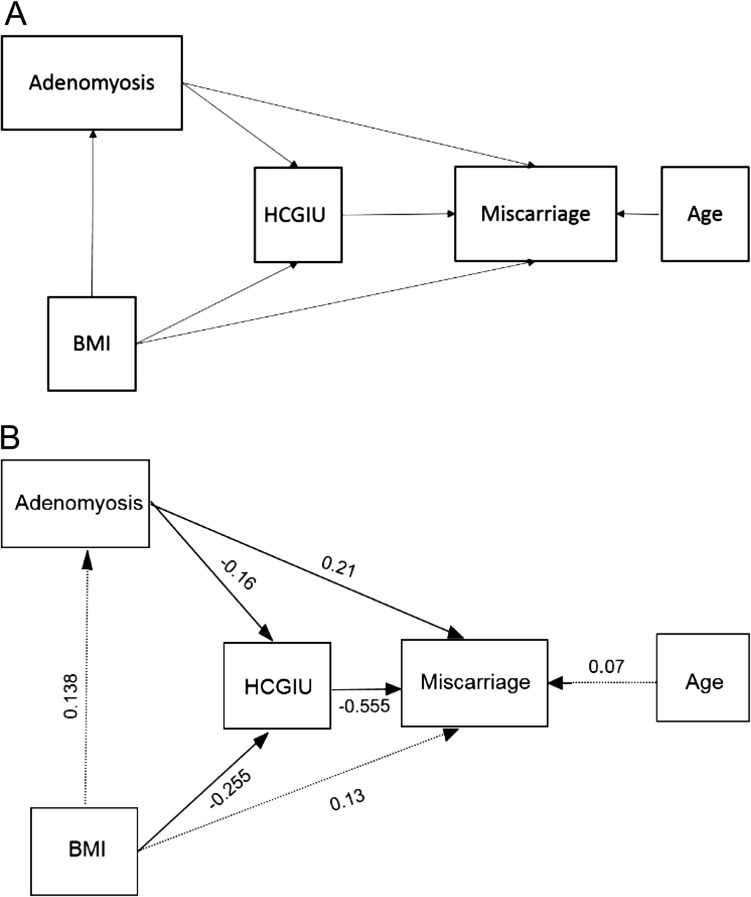
PARTICIPANTS/MATERIALS SETTING AND METHOD: A total of 171 women who successfully conceived (positive serum βhCG) following the transfer of a single euploid good morphology frozen-thawed embryo were included in analysis after meeting the inclusion criteria. Only the first conception cycle for each patient was included in the study. Patients with known pre-existing medical risk factors for miscarriage (e.g. thrombophilia, poorly controlled diabetes, coeliac disease, SLE, uterine septum, chromosomal abnormalities) and those women undergoing treatment using donated oocytes and surrogacy were excluded. Patients were then classified as having adenomyosis or not based on a high-quality pelvic ultrasound or MRI. The direct and indirect effects of adenomyosis and BMI on overall miscarriage rate by 12 weeks gestation was then assessed using multivariate logistic regression and mediation analysis. Furthermore, the data were also analysed to elucidate the influence of GnRH ultra-long down-regulation therapy on miscarriage rates.
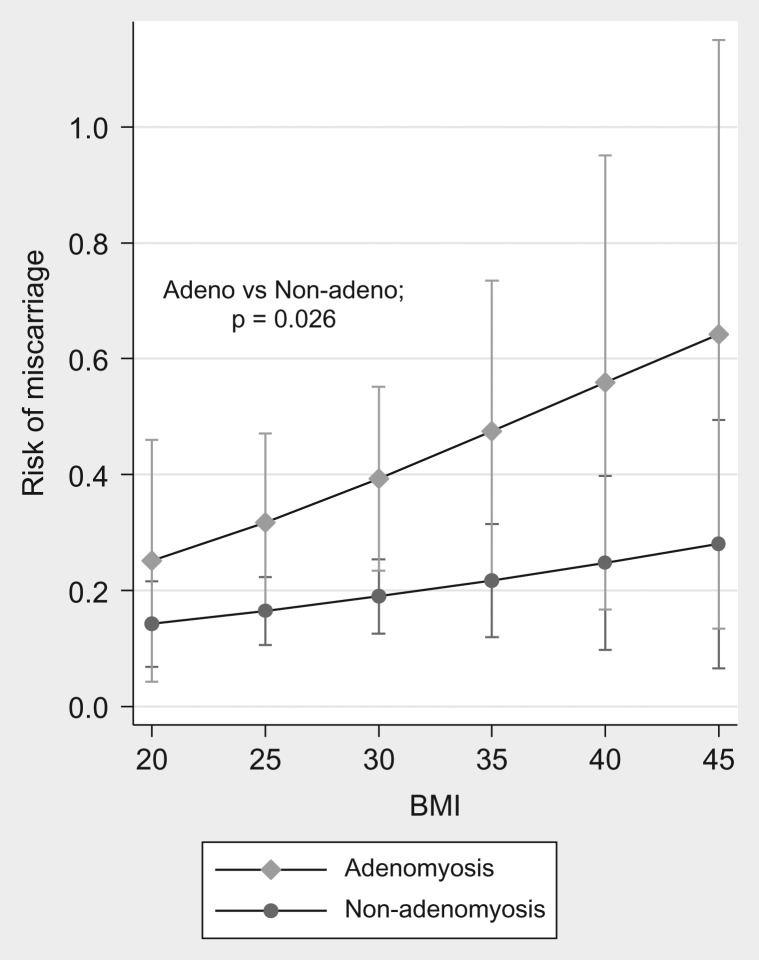
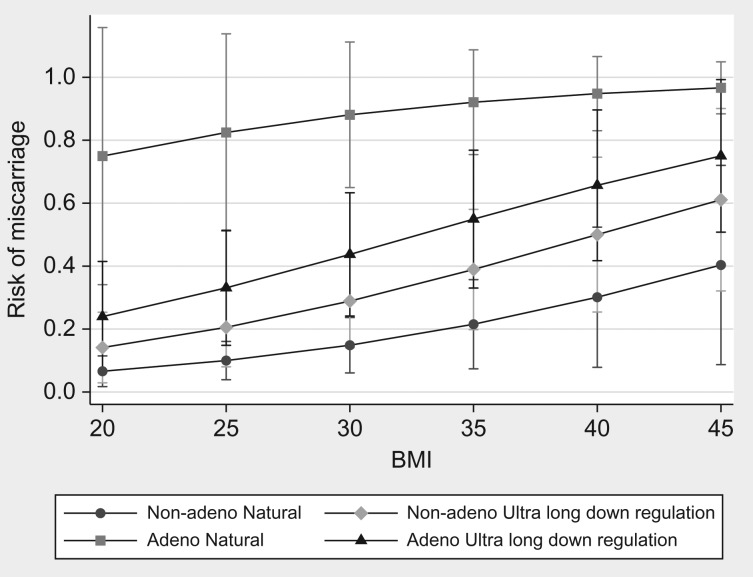
Overall, the adjusted rate of miscarriage was higher in those patients with adenomyosis compared to those without (44.1 vs 15.3%, < 0.0001), with most of these miscarriages occurring at the early biochemical stage. The rate of miscarriage was especially high in adenomyosis patients not receiving GnRH agonist pre-treatment (82.4%), compared to those patients who did receive GnRH pre-treatment (35.7%, = 0.0089).
The study is mainly limited by its small sample size and retrospective design which carries inherent potential for bias (i.e. misclassification and errors due to inadequate clinical notes). The small sample size precluded analysis to distinguish how the extent of adenomyosis disease may modify miscarriage risk (i.e. focal or diffuse disease). Furthermore, the relatively low number of adenomyosis patients not receiving GnRH agonist treatment, plus the non-randomized nature of the decision not to offer such treatment, precludes definitive conclusions on the benefit of GnRH agonist therapy to reduce miscarriage risk.
Considering the significant emotional and financial impact of miscarriage, we suggest screening of all women undergoing IVF treatment for the presence of adenomyosis, with consideration given to ultra-long down regulation GnRH agonist treatment in any woman identified as having adenomyosis. Furthermore, given the persistent and often progressive nature of the disease, adenomyosis should also be considered as a potential uterine cause of recurrent miscarriage. Finally, we hope our study highlights the need for high-quality prospective RCT to be undertaken to provide superior evidence for the potential benefit of GnRH agonist pre-treatment.
STUDY FUNDING/COMPETING INTERESTS: K.T. is a practicing IVF gynaecologist and holds a minority stake in the publicly listed company Monash IVF. The other authors declare that they have no conflict of interest. This study was financially supported by Flinders University Medical School.
在子宫腺肌病的情况下,流产率是否会增加,而不依赖于其他已知的流产风险因素,如产妇年龄、体重指数、胚胎遗传状态?
子宫腺肌病和高体重指数均显著增加流产风险,且相互独立,不受产妇年龄和胚胎健康状况影响。本研究首次表明,超长方案下调促性腺激素释放激素(GnRH)激动剂治疗可能降低子宫腺肌病患者的早期妊娠丢失率。
已知子宫腺肌病的存在与较低的成功着床率和较高的早期妊娠丢失风险相关。然而,目前尚不清楚这种生殖功能损害是由子宫腺肌病本身直接介导的,还是由子宫腺肌病与已知的流产风险因素(如肥胖和产妇年龄增长/胎儿非整倍体)的关联间接引起的。
研究设计、规模、持续时间:在一家私立不孕症(体外受精[IVF])诊所进行了一项回顾性队列研究,调查2012年至2015年间接受遗传筛查的冻融胚胎移植的女性(n = 345)的结局。
参与者/材料、环境与方法:共有171名女性在移植单个整倍体、形态良好的冻融胚胎后成功受孕(血清β人绒毛膜促性腺激素[β-hCG]呈阳性),符合纳入标准后纳入分析。每位患者仅纳入第一个受孕周期。排除已知存在流产的既往医学风险因素(如血栓形成倾向、控制不佳的糖尿病、乳糜泻、系统性红斑狼疮、子宫纵隔、染色体异常)的患者,以及使用捐赠卵子和代孕进行治疗的女性。然后根据高质量的盆腔超声或磁共振成像(MRI)将患者分为有子宫腺肌病或无子宫腺肌病。然后使用多变量逻辑回归和中介分析评估子宫腺肌病和体重指数对妊娠12周时总体流产率的直接和间接影响。此外,还对数据进行了分析,以阐明GnRH超长方案下调疗法对流产率的影响。
总体而言,与无子宫腺肌病的患者相比,有子宫腺肌病的患者经调整后的流产率更高(44.1%对15.3%,P < 0.0001),这些流产大多发生在早期生化阶段。未接受GnRH激动剂预处理的子宫腺肌病患者流产率尤其高(82.4%),而接受GnRH预处理的患者流产率为35.7%(P = 0.0089)。
局限性、谨慎的原因:本研究主要受样本量小和回顾性设计的限制,存在内在的偏倚可能性(即由于临床记录不充分导致的错误分类和误差)。样本量小使得无法进行分析以区分子宫腺肌病的程度如何改变流产风险(即局灶性或弥漫性疾病)。此外,未接受GnRH激动剂治疗的子宫腺肌病患者数量相对较少,加上不提供此类治疗的决定具有非随机性质,因此无法就GnRH激动剂疗法降低流产风险的益处得出明确结论。
考虑到流产对情绪和经济的重大影响,我们建议对所有接受IVF治疗的女性进行子宫腺肌病筛查,对于任何被确定患有子宫腺肌病的女性,考虑采用超长方案下调GnRH激动剂治疗。此外,鉴于该疾病的持续性和通常的进展性,子宫腺肌病也应被视为复发性流产潜在的子宫原因。最后,我们希望我们的研究强调需要进行高质量的前瞻性随机对照试验(RCT),以提供关于GnRH激动剂预处理潜在益处的更有力证据。
研究资金/利益冲突:K.T.是一名执业IVF妇科医生,在上市公司莫纳什IVF持有少数股份。其他作者声明他们没有利益冲突。本研究由弗林德斯大学医学院提供资金支持。