CIIMAR-Interdisciplinary Centre of Marine and Environmental Research, U. Porto-University of Porto, Porto, Portugal.
Department of Biology, Faculty of Sciences, U. Porto-University of Porto, Porto, Portugal.
Mol Biol Evol. 2019 Jun 1;36(6):1270-1280. doi: 10.1093/molbev/msz068.
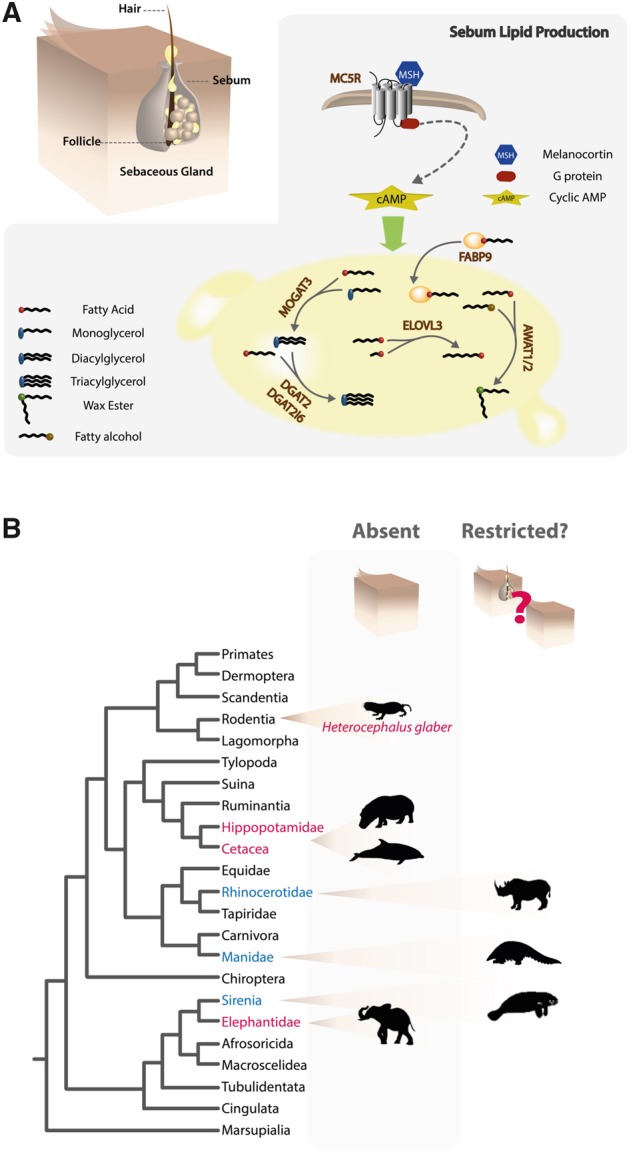
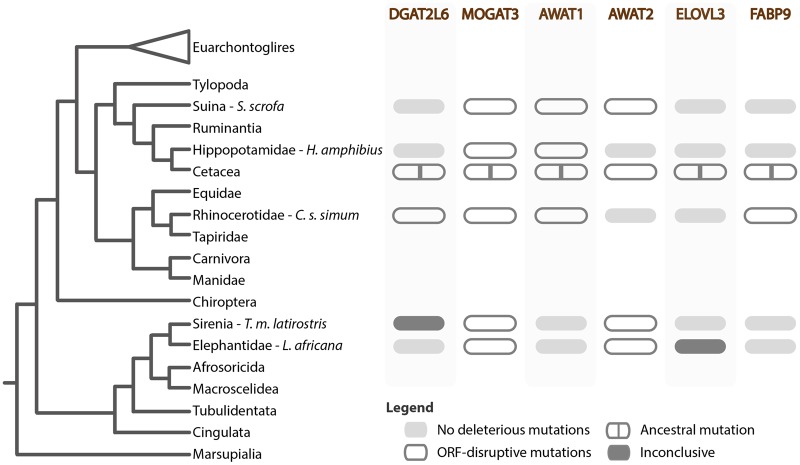
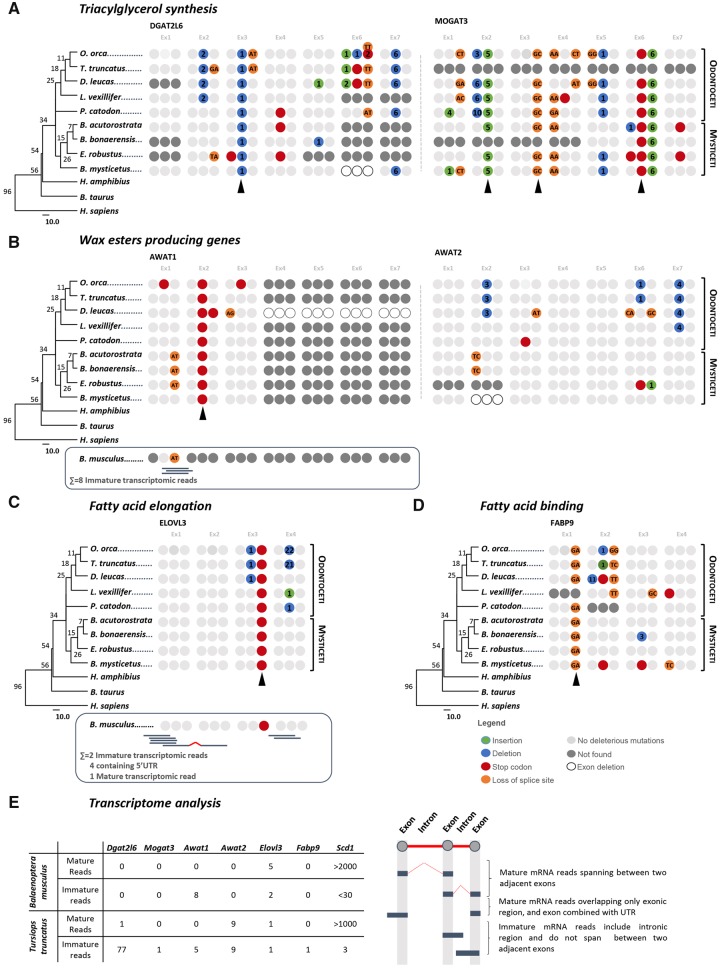
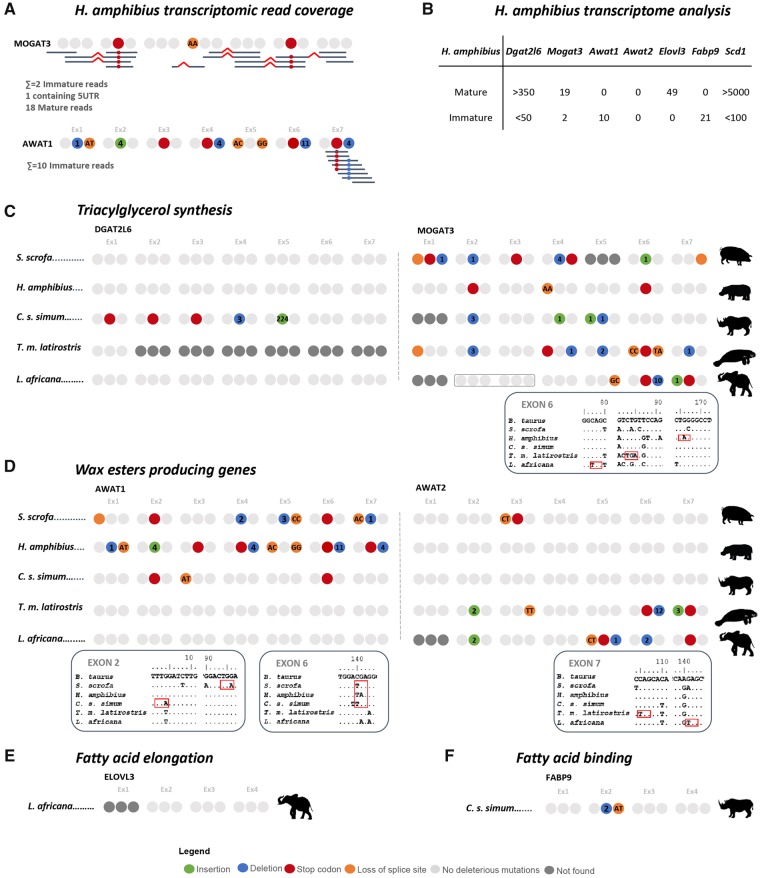
Genomes are dynamic biological units, with processes of gene duplication and loss triggering evolutionary novelty. The mammalian skin provides a remarkable case study on the occurrence of adaptive morphological innovations. Skin sebaceous glands (SGs), for instance, emerged in the ancestor of mammals serving pivotal roles, such as lubrication, waterproofing, immunity, and thermoregulation, through the secretion of sebum, a complex mixture of various neutral lipids such as triacylglycerol, free fatty acids, wax esters, cholesterol, and squalene. Remarkably, SGs are absent in a few mammalian lineages, including the iconic Cetacea. We investigated the evolution of the key molecular components responsible for skin sebum production: Dgat2l6, Awat1, Awat2, Elovl3, Mogat3, and Fabp9. We show that all analyzed genes have been rendered nonfunctional in Cetacea species (toothed and baleen whales). Transcriptomic analysis, including a novel skin transcriptome from blue whale, supports gene inactivation. The conserved mutational pattern found in most analyzed genes, indicates that pseudogenization events took place prior to the diversification of modern Cetacea lineages. Genome and skin transcriptome analysis of the common hippopotamus highlighted the convergent loss of a subset of sebum-producing genes, notably Awat1 and Mogat3. Partial loss profiles were also detected in non-Cetacea aquatic mammals, such as the Florida manatee, and in terrestrial mammals displaying specialized skin phenotypes such as the African elephant, white rhinoceros and pig. Our findings reveal a unique landscape of "gene vestiges" in the Cetacea sebum-producing compartment, with limited gene loss observed in other mammalian lineages: suggestive of specific adaptations or specializations of skin lipids.
基因组是动态的生物单位,基因复制和丢失的过程引发了进化的新颖性。哺乳动物的皮肤为适应性形态创新的发生提供了一个显著的案例研究。例如,皮肤皮脂腺(SGs)在哺乳动物的祖先中出现,通过分泌皮脂发挥关键作用,皮脂是各种中性脂质的复杂混合物,如三酰基甘油、游离脂肪酸、蜡酯、胆固醇和角鲨烯。值得注意的是,SGs 在一些哺乳动物谱系中缺失,包括标志性的鲸目动物。我们研究了负责皮肤皮脂产生的关键分子成分的进化:Dgat2l6、Awat1、Awat2、Elovl3、Mogat3 和 Fabp9。我们表明,所有分析的基因在鲸目动物物种(齿鲸和须鲸)中都失去了功能。包括蓝鲸新皮肤转录组在内的转录组分析支持基因失活。在大多数分析的基因中发现的保守突变模式表明,假基因化事件发生在现代鲸目动物谱系多样化之前。普通河马的基因组和皮肤转录组分析突出了一组皮脂产生基因的趋同缺失,特别是 Awat1 和 Mogat3。在非鲸目水生哺乳动物中,如佛罗里达海牛,以及在表现出特殊皮肤表型的陆地哺乳动物中,如非洲象、白犀牛和猪,也检测到了部分缺失谱。我们的研究结果揭示了鲸目动物皮脂产生区独特的“基因残余”景观,其他哺乳动物谱系中的基因丢失有限:表明皮肤脂质的特定适应或特化。