Institute of Cardiovascular Science (R.S.P., A.F.S., L.J.H., K.D., J.D., A.D.H., F.W.A), Faculty of Population Health Science, University College London, United Kingdom.
Bart's Heart Centre, St Bartholomew's Hospital, London (R.S.P., J.D., A. Timmis).
Circ Genom Precis Med. 2019 Apr;12(4):e002470. doi: 10.1161/CIRCGEN.119.002470. Epub 2019 Mar 21.
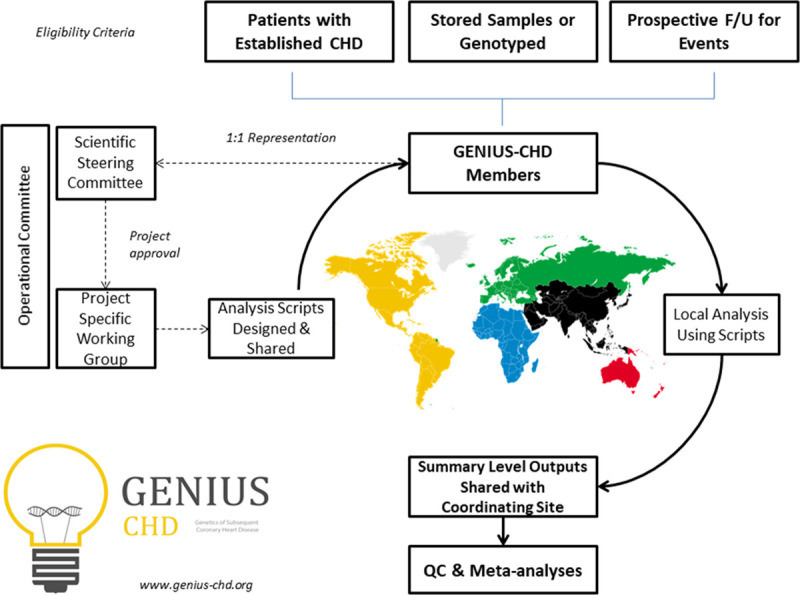
The Genetics of Subsequent Coronary Heart Disease (GENIUS-CHD) consortium was established to facilitate discovery and validation of genetic variants and biomarkers for risk of subsequent CHD events, in individuals with established CHD.
The consortium currently includes 57 studies from 18 countries, recruiting 185 614 participants with either acute coronary syndrome, stable CHD, or a mixture of both at baseline. All studies collected biological samples and followed-up study participants prospectively for subsequent events.
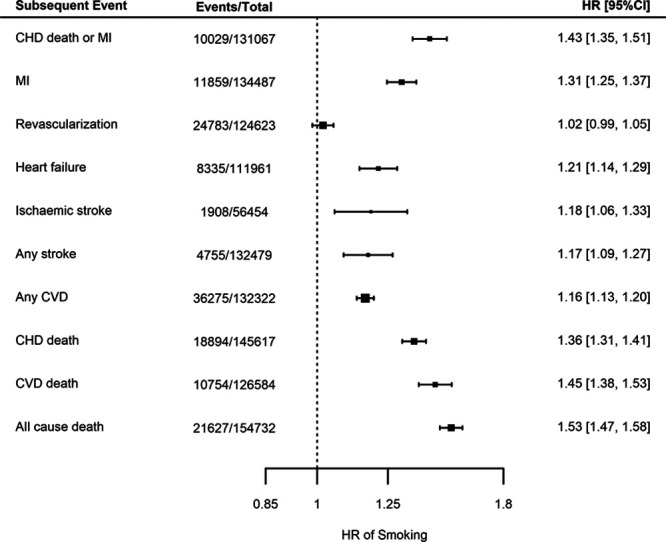
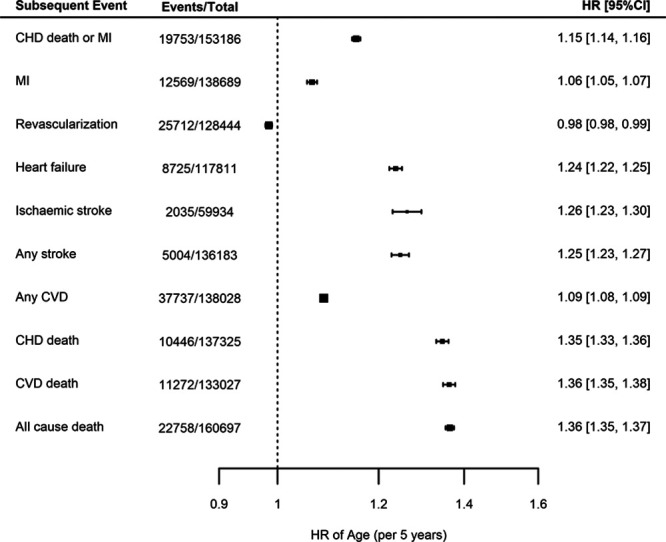
Enrollment into the individual studies took place between 1985 to present day with a duration of follow-up ranging from 9 months to 15 years. Within each study, participants with CHD are predominantly of self-reported European descent (38%-100%), mostly male (44%-91%) with mean ages at recruitment ranging from 40 to 75 years. Initial feasibility analyses, using a federated analysis approach, yielded expected associations between age (hazard ratio, 1.15; 95% CI, 1.14-1.16) per 5-year increase, male sex (hazard ratio, 1.17; 95% CI, 1.13-1.21) and smoking (hazard ratio, 1.43; 95% CI, 1.35-1.51) with risk of subsequent CHD death or myocardial infarction and differing associations with other individual and composite cardiovascular endpoints.
GENIUS-CHD is a global collaboration seeking to elucidate genetic and nongenetic determinants of subsequent event risk in individuals with established CHD, to improve residual risk prediction and identify novel drug targets for secondary prevention. Initial analyses demonstrate the feasibility and reliability of a federated analysis approach. The consortium now plans to initiate and test novel hypotheses as well as supporting replication and validation analyses for other investigators.
随后发生冠心病的遗传学(GENIUS-CHD)联合会的成立旨在促进已确诊冠心病患者的冠心病后续事件风险的遗传变异和生物标志物的发现和验证。
该联合会目前包括来自 18 个国家的 57 项研究,招募了 185614 名基线时患有急性冠状动脉综合征、稳定型冠心病或两者混合的参与者。所有研究均采集了生物样本,并前瞻性地对研究参与者进行了后续事件随访。
个别研究的入组时间为 1985 年至目前,随访时间从 9 个月到 15 年不等。在每项研究中,冠心病患者主要为自报的欧洲血统(38%-100%),大多数为男性(44%-91%),招募时的平均年龄为 40 至 75 岁。使用联邦分析方法进行的初步可行性分析得出了与年龄(危险比,1.15;95%置信区间,1.14-1.16)每增加 5 年、男性(危险比,1.17;95%置信区间,1.13-1.21)和吸烟(危险比,1.43;95%置信区间,1.35-1.51)与冠心病死亡或心肌梗死后续风险相关的预期关联,以及与其他个体和综合心血管终点不同的关联。
GENIUS-CHD 是一个全球性的合作组织,旨在阐明已确诊冠心病患者后续事件风险的遗传和非遗传决定因素,以改善残余风险预测并确定二级预防的新药物靶点。初步分析表明,联邦分析方法具有可行性和可靠性。该联合会现在计划为其他研究人员启动和测试新的假设,并支持复制和验证分析。