Institute of Animal Nutrition, Nutrition Diseases and Dietetics, Faculty of Veterinary Medicine, University of Leipzig, Leipzig, Germany.
Institute of Biochemistry, Faculty of Veterinary Medicine, University of Leipzig, Leipzig, Germany.
PLoS One. 2019 Mar 21;14(3):e0207568. doi: 10.1371/journal.pone.0207568. eCollection 2019.
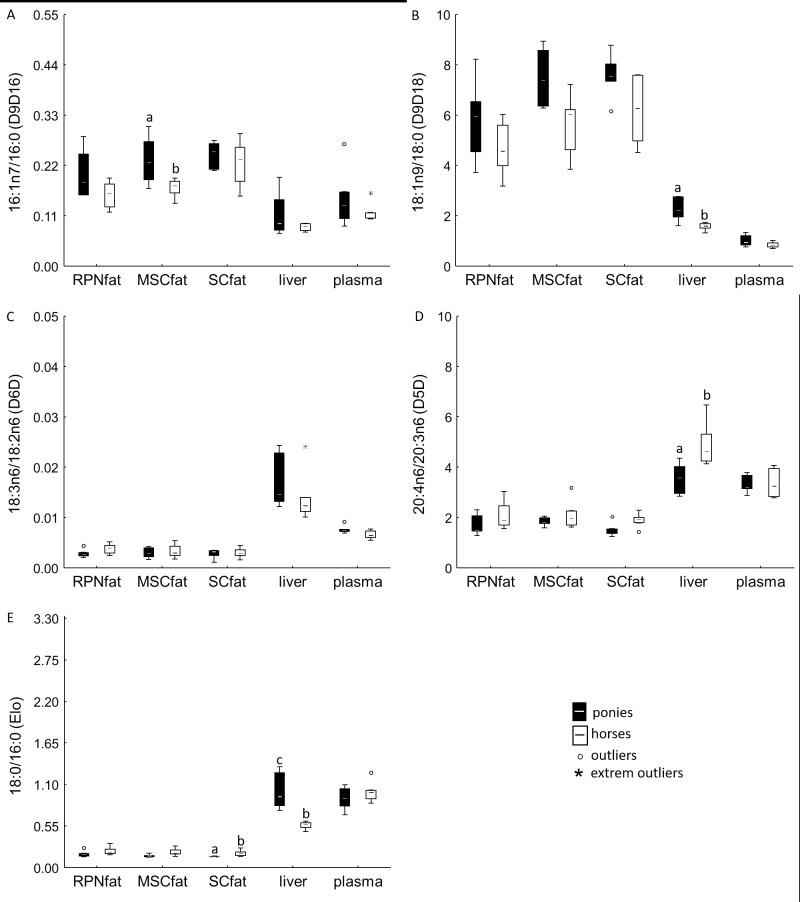
Fatty acids, as key components of cellular membranes and complex lipids, may play a central role in endocrine signalling and the function of adipose tissue and liver. Thus, the lipid fatty acid composition may play a role in health status in the equine. This study aimed to investigate the fatty acid composition of different tissues and liver lipid classes by comparing Warmblood horses and Shetland ponies under defined conditions. We hypothesized that ponies show different lipid patterns than horses in adipose tissue, liver and plasma. Six Warmblood horses and six Shetland ponies were housed and fed under identical conditions. Tissue and blood sampling were performed following a standardized protocol. A one-step lipid extraction, methylation and trans-esterification method with subsequent gas chromatography was used to analyse the total lipid content and fatty acid profile of retroperitoneal, mesocolon and subcutaneous adipose tissue, liver and plasma. Fatty acids were grouped according to their degree of saturation and their conjugated double bond into the respective lipid classes. In the adipose tissues, saturated fatty acids (SFAs) and n-9 monounsaturated fatty acids (n-9 MUFAs) were most present in ponies and horses. N-6 polyunsaturated fatty acids (n-6 PUFAs), followed by SFAs, were most frequently found in liver tissue and plasma in all animals. Horses, in comparison to ponies, had significantly higher n-6 PUFA levels in all tissues and plasma. In liver tissue, horses had significantly lower hepatic iso-branched-chain fatty acids (iso-BCFAs) than ponies. The hepatic fatty acid composition of selected lipid classes was different between horses and ponies. In the polar PL fraction, horses had low n-9 MUFA and n-3 PUFA contents but higher n-6 PUFA contents than ponies. Furthermore, iso-BCFAs are absent in several hepatic lipid fractions of horses but not ponies. The differences in fatty acid lipid classes between horses and ponies provide key information on the species- and location-specific regulation of FA metabolism, thus affecting health status such as inflammatory responses.
脂肪酸作为细胞膜和复合脂质的关键成分,可能在激素信号转导以及脂肪组织和肝脏的功能中发挥核心作用。因此,脂质脂肪酸组成可能在马的健康状况中起作用。本研究旨在通过比较温血马和设得兰矮种马在特定条件下,研究不同组织和肝脏脂质类别的脂肪酸组成。我们假设马和矮种马在脂肪组织、肝脏和血浆中的脂质模式不同。六匹温血马和六匹设得兰矮种马在相同的条件下饲养和喂养。按照标准化方案进行组织和血液取样。使用一步法脂质提取、甲基化和酯交换方法,随后进行气相色谱分析,分析腹膜后、结肠系膜和皮下脂肪组织、肝脏和血浆的总脂质含量和脂肪酸谱。脂肪酸根据其饱和度和共轭双键分为相应的脂质类。在脂肪组织中,饱和脂肪酸(SFAs)和 n-9 单不饱和脂肪酸(n-9 MUFA)在矮种马和马中最为丰富。所有动物的肝脏组织和血浆中,n-6 多不饱和脂肪酸(n-6 PUFA),其次是 SFAs,最为常见。与矮种马相比,马在所有组织和血浆中的 n-6 PUFA 水平显著更高。在肝脏组织中,马的肝异支链脂肪酸(iso-BCFA)显著低于矮种马。马和矮种马的一些脂质类别的肝脏脂肪酸组成不同。在极性 PL 部分中,马的 n-9 MUFA 和 n-3 PUFA 含量较低,但 n-6 PUFA 含量较高。此外,马的几个肝脂质部分中没有异支链脂肪酸,但矮种马有。马和矮种马之间脂肪酸脂质类别的差异提供了关于 FA 代谢的种特异性和位置特异性调节的关键信息,从而影响健康状况,如炎症反应。