Department of Hematology and Oncology, University Hospital Tübingen, 72076 Tübingen, Germany.
Institute for Cell Biology, Department of Immunology, University of Tübingen, 72076 Tübingen, Germany.
Int J Mol Sci. 2019 Mar 20;20(6):1397. doi: 10.3390/ijms20061397.
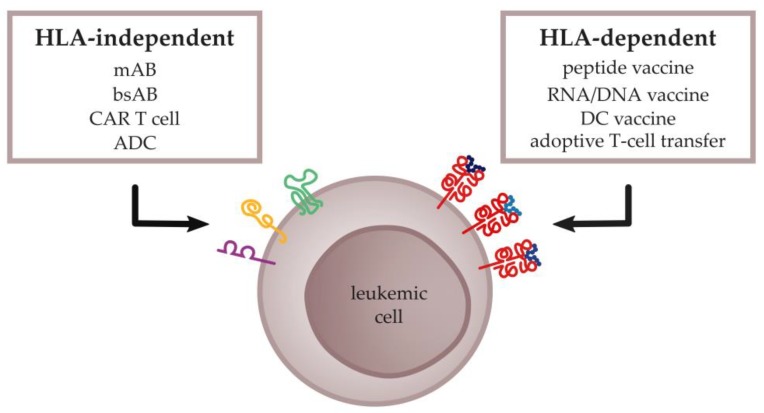
Immunotherapeutic approaches, including allogeneic stem cell transplantation and donor lymphocyte infusion, have significantly improved the prognosis of leukemia patients. Further efforts are now focusing on the development of immunotherapies that are able to target leukemic cells more specifically, comprising monoclonal antibodies, chimeric antigen receptor (CAR) T cells, and dendritic cell- or peptide-based vaccination strategies. One main prerequisite for such antigen-specific approaches is the selection of suitable target structures on leukemic cells. In general, the targets for anti-cancer immunotherapies can be divided into two groups: (1) T-cell epitopes relying on the presentation of peptides via human leukocyte antigen (HLA) molecules and (2) surface structures, which are HLA-independently expressed on cancer cells. This review discusses the most promising tumor antigens as well as the underlying discovery and selection strategies for the development of anti-leukemia immunotherapies.
免疫治疗方法,包括异基因干细胞移植和供者淋巴细胞输注,已显著改善了白血病患者的预后。目前,人们正致力于开发更能特异性靶向白血病细胞的免疫疗法,包括单克隆抗体、嵌合抗原受体 (CAR) T 细胞和基于树突状细胞或肽的疫苗接种策略。这种抗原特异性方法的一个主要前提是选择白血病细胞上合适的靶结构。一般来说,抗癌免疫疗法的靶标可以分为两类:(1)依赖于人类白细胞抗原 (HLA) 分子呈递肽的 T 细胞表位,和(2)在癌细胞上独立于 HLA 表达的表面结构。本文讨论了最有前途的肿瘤抗原,以及开发抗白血病免疫疗法的潜在发现和选择策略。