Institute of Physiology, University Medical Center Mainz, Johannes Gutenberg University, Duesbergweg 6, 55128 Mainz, Germany.
ICAR3R - Interdisciplinary Centre for 3Rs in Animal Research, Faculty of Medicine, Justus-Liebig-University, Rudolf-Buchheim-Str. 6, 35392 Giessen, Germany.
Int J Mol Sci. 2019 Mar 20;20(6):1416. doi: 10.3390/ijms20061416.
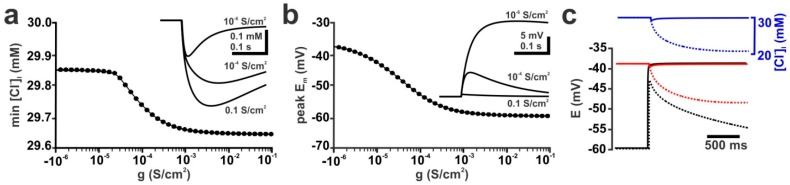
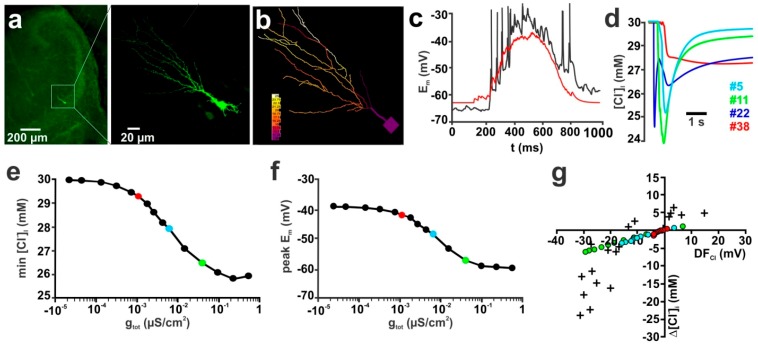
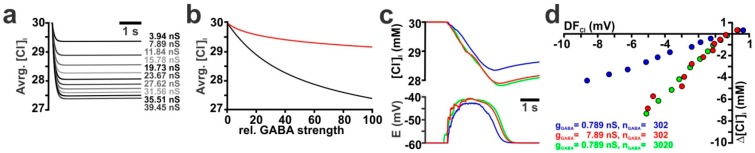
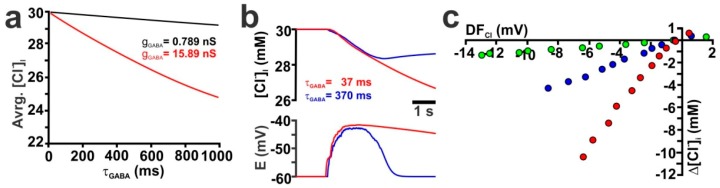
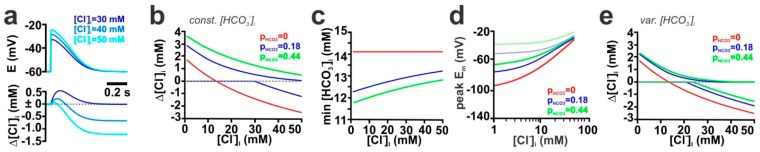
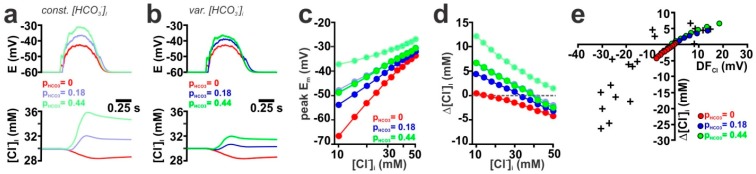
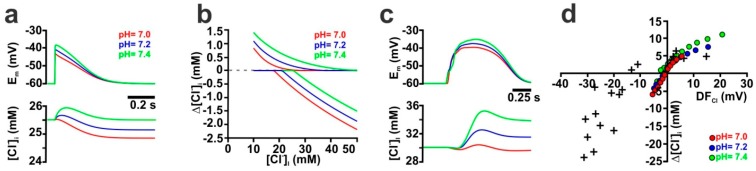
The effects of ionotropic γ-aminobutyric acid receptor (GABA-A, GABA) activation depends critically on the Cl-gradient across neuronal membranes. Previous studies demonstrated that the intracellular Cl-concentration ([Cl]) is not stable but shows a considerable amount of activity-dependent plasticity. To characterize how membrane properties and different molecules that are directly or indirectly involved in GABAergic synaptic transmission affect GABA-induced [Cl] changes, we performed compartmental modeling in the NEURON environment. These simulations demonstrate that GABA-induced [Cl] changes decrease at higher membrane resistance, revealing a sigmoidal dependency between both parameters. Increase in GABAergic conductivity enhances [Cl] with a logarithmic dependency, while increasing the decay time of GABA receptors leads to a nearly linear enhancement of the [Cl] changes. Implementing physiological levels of HCO₃-conductivity to GABA receptors enhances the [Cl] changes over a wide range of [Cl], but this effect depends on the stability of the HCO₃ gradient and the intracellular pH. Finally, these simulations show that pure diffusional Cl-elimination from dendrites is slow and that a high activity of Cl-transport is required to improve the spatiotemporal restriction of GABA-induced [Cl] changes. In summary, these simulations revealed a complex interplay between several key factors that influence GABA-induced [Cl] changes. The results suggest that some of these factors, including high resting [Cl], high input resistance, slow decay time of GABA receptors and dynamic HCO₃ gradient, are specifically adapted in early postnatal neurons to facilitate limited activity-dependent [Cl] decreases.
离子型γ-氨基丁酸受体 (GABA-A、GABA) 的激活作用取决于神经元膜两侧的氯离子梯度。先前的研究表明,细胞内氯离子浓度 ([Cl]) 并不稳定,而是表现出相当大的活动依赖性可塑性。为了描述膜特性和直接或间接参与 GABA 能突触传递的不同分子如何影响 GABA 诱导的 [Cl] 变化,我们在 NEURON 环境中进行了分区建模。这些模拟表明,随着膜电阻的增加,GABA 诱导的 [Cl] 变化减小,两者之间存在着显著的对数依赖关系。GABA 能电导的增加以对数依赖性增强 [Cl],而增加 GABA 受体的衰减时间则导致 [Cl] 变化几乎呈线性增强。在 GABA 受体中实现生理水平的 HCO₃ 电导增强了 [Cl] 在广泛 [Cl] 范围内的变化,但这种效应取决于 HCO₃ 梯度的稳定性和细胞内 pH 值。最后,这些模拟表明,从树突中扩散性地消除 Cl 是缓慢的,需要高的 Cl 转运活性来改善 GABA 诱导的 [Cl] 变化的时空限制。总之,这些模拟揭示了影响 GABA 诱导的 [Cl] 变化的几个关键因素之间的复杂相互作用。结果表明,其中一些因素,包括高静息 [Cl]、高输入电阻、GABA 受体的衰减时间慢和动态 HCO₃ 梯度,在出生后早期神经元中被特异性地适应,以促进有限的活动依赖性 [Cl] 减少。