Faculty of Engineering and Physical Sciences, University of Surrey, Guildford, Surrey, UK.
Medical Research Council Laboratory of Molecular Biology, Francis Crick Avenue, Cambridge, UK.
J Biol Rhythms. 2019 Apr;34(2):144-153. doi: 10.1177/0748730419836370. Epub 2019 Mar 21.
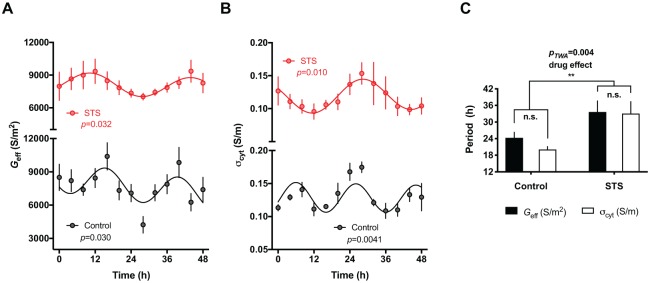
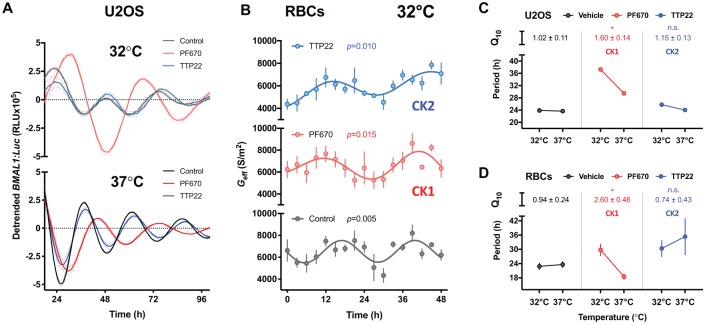
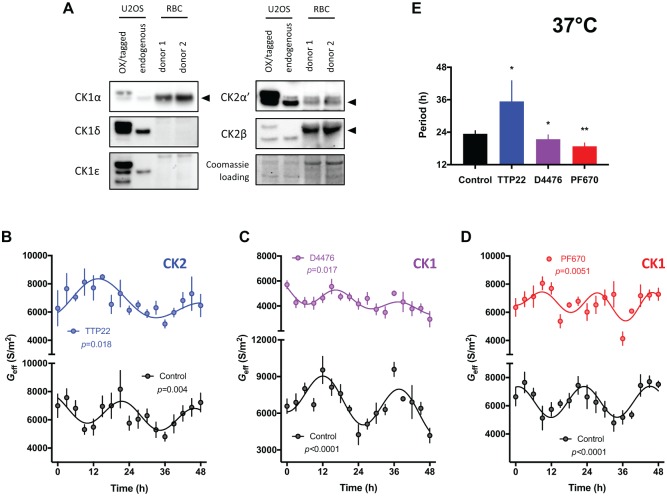
Temperature compensation and period determination by casein kinase 1 (CK1) are conserved features of eukaryotic circadian rhythms, whereas the clock gene transcription factors that facilitate daily gene expression rhythms differ between phylogenetic kingdoms. Human red blood cells (RBCs) exhibit temperature-compensated circadian rhythms, which, because RBCs lack nuclei, must occur in the absence of a circadian transcription-translation feedback loop. We tested whether period determination and temperature compensation are dependent on CKs in RBCs. As with nucleated cell types, broad-spectrum kinase inhibition with staurosporine lengthened the period of the RBC clock at 37°C, with more specific inhibition of CK1 and CK2 also eliciting robust changes in circadian period. Strikingly, inhibition of CK1 abolished temperature compensation and increased the Q for the period of oscillation in RBCs, similar to observations in nucleated cells. This indicates that CK1 activity is essential for circadian rhythms irrespective of the presence or absence of clock gene expression cycles.
在真核生物的生物钟中,酪蛋白激酶 1(CK1)的温度补偿和周期确定是保守特征,而有利于日常基因表达节律的时钟基因转录因子则在不同的进化王国之间存在差异。人类红细胞(RBC)表现出温度补偿的生物钟节律,由于 RBC 缺乏细胞核,因此必须在没有生物钟转录-翻译反馈回路的情况下发生。我们测试了 CK 在 RBC 中的周期确定和温度补偿是否依赖于 CK。与有核细胞类型一样,用星形孢菌素进行广谱激酶抑制会延长 RBC 时钟在 37°C 下的周期,而更特异性地抑制 CK1 和 CK2 也会引起生物钟周期的明显变化。引人注目的是,抑制 CK1 会消除温度补偿,并增加 RBC 中振荡周期的 Q 值,与有核细胞的观察结果相似。这表明,无论是否存在时钟基因表达周期,CK1 的活性对于生物钟节律都是必不可少的。