Wong David Cs, O'Neill John S
MRC Laboratory of Molecular Biology, Francis Crick Avenue, Cambridge, CB2 0QH, UK.
Curr Opin Physiol. 2018 Oct;5:117-132. doi: 10.1016/j.cophys.2018.10.003.
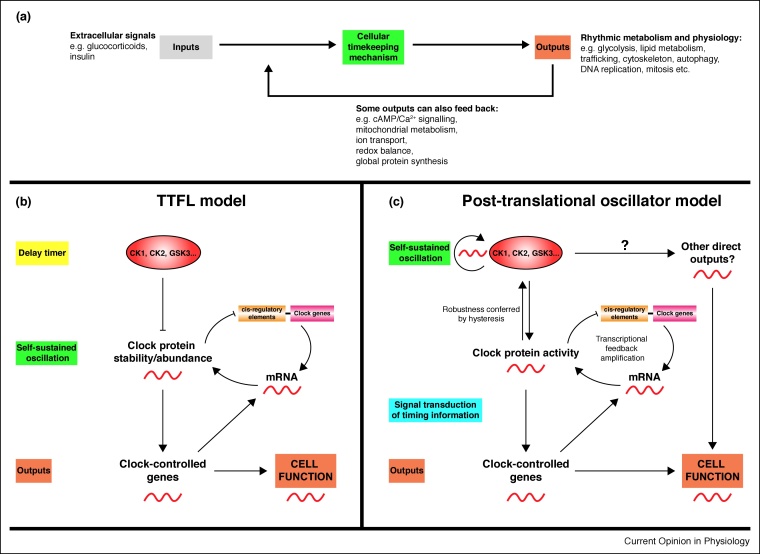
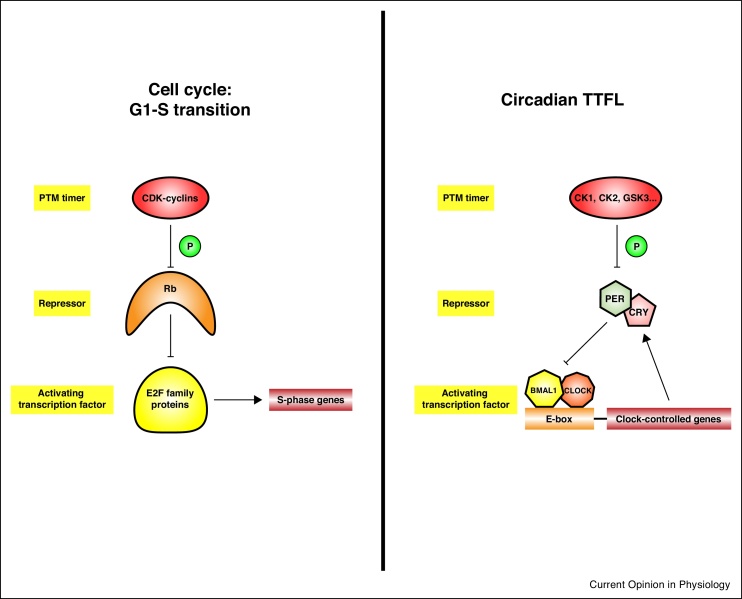
'Biological clocks' orchestrate mammalian biology to a daily rhythm. Whilst 'clock gene' transcriptional circuits impart rhythmic regulation to myriad cellular systems, our picture of the biochemical mechanisms that determine their circadian (∼24 hour) period is incomplete. Here we consider the evidence supporting different models for circadian rhythm generation in mammalian cells in light of evolutionary factors. We find it plausible that the circadian timekeeping mechanism in mammalian cells is primarily protein-based, signalling biological timing information to the nucleus by the post-translational regulation of transcription factor activity, with transcriptional feedback imparting robustness to the oscillation via hysteresis. We conclude by suggesting experiments that might distinguish this model from competing paradigms.
“生物钟”将哺乳动物的生理活动编排成每日的节律。虽然“时钟基因”转录回路对无数细胞系统进行节律性调控,但我们对于决定其昼夜节律(约24小时)周期的生化机制的了解并不完整。在此,我们根据进化因素来考量支持哺乳动物细胞中昼夜节律产生的不同模型的证据。我们发现,哺乳动物细胞中的昼夜计时机制主要基于蛋白质,通过转录因子活性的翻译后调控将生物定时信息传递至细胞核,而转录反馈则通过滞后作用赋予振荡以稳健性,这似乎是合理的。我们最后提出了一些实验建议,这些实验可能会将该模型与其他竞争范式区分开来。