Policarpo Verónica, Romano Sónia, António João H C, Correia Tânia Sofia, Costa Suzete
Instituto de Ciências Sociais, Universidade de Lisboa, Av. Prof. Aníbal de Bettencourt, 9, 1600-189, Lisbon, Portugal.
Centre for Health Evaluation & Research (CEFAR), Associação Nacional das Farmácias (ANF), Rua Marechal Saldanha 1, 1249-069, Lisbon, Portugal.
BMC Health Serv Res. 2019 Mar 21;19(1):186. doi: 10.1186/s12913-019-3987-3.
Worldwide community pharmacies are shifting their role in the healthcare system from simple medication dispensers to health care providers. High levels of satisfaction with pharmacy services were found in previous studies. This study has two main goals. The primary goal is to describe the levels of satisfaction and knowledge regarding pharmacy services in Portugal. The secondary goal is to explore the perceptions and the utilisation of pharmacy services by the Portuguese. This statement includes exploring the impact of a set of variables on both perceptions and uses of pharmacies in regard to services that are currently offered as well as to new services that may be provided in the future.
A face-to-face survey of closed-ended questions was applied to a nationwide representative sample of the Portuguese population in September 2015. The sample was weighted based on population distribution across regions, habitat, age and gender. Data analysis comprises descriptive statistics and Multiple Correspondence Analysis to explore different typologies of respondent's orientation toward community pharmacy.
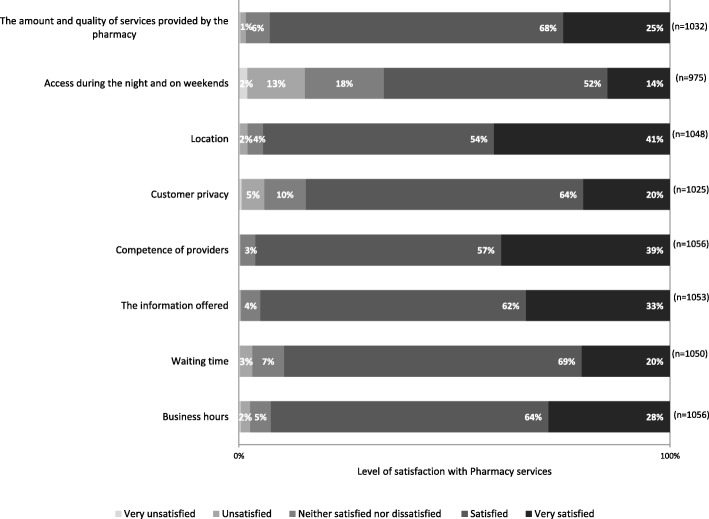
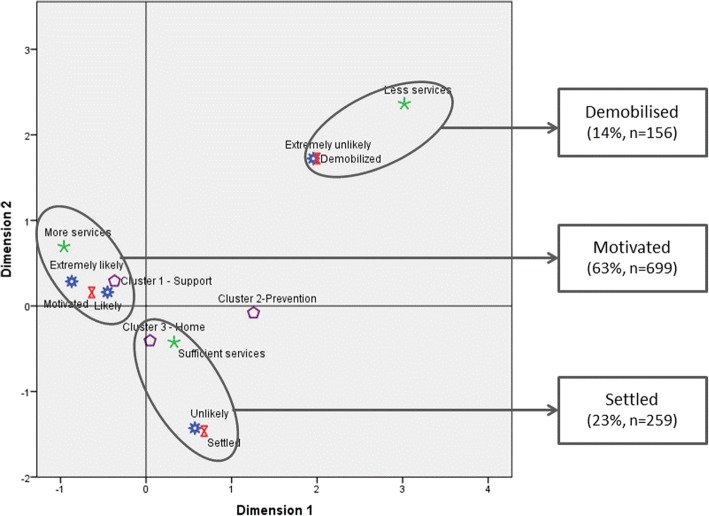
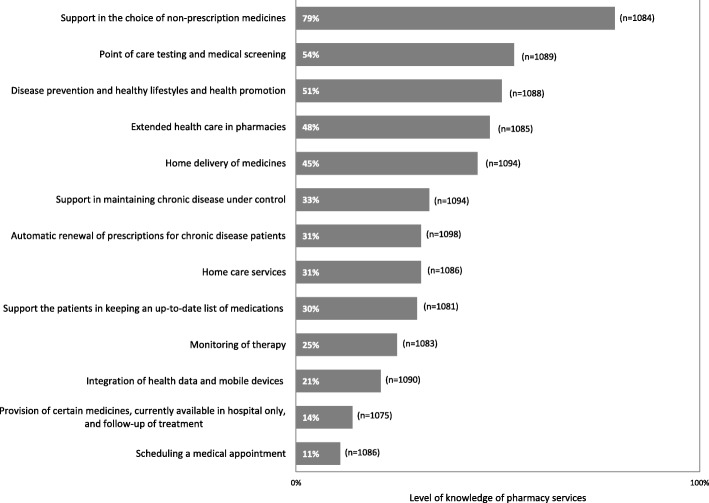
A total of 1114 interviews comprised the study. Of the respondents, 36% used the pharmacy as a first resource when seeking to treat a minor ailment, and 54% reported that they use the pharmacy as a first resource when seeking answers about medicines. Of those who visited their pharmacy at least once in the previous year, 94% were either globally satisfied or very satisfied. The level of acknowledgement of pharmacy services' was also high among the Portuguese. Of the participants, 29% considered there could be more services available in pharmacies that are currently provided by other health care facilities. The construction of a typology of orientations towards community pharmacy practice resulted in three outcome groups: "Motivated" (63%), those with a connection to a pharmacy; "Settled" (23%), mainly those who had a pharmacy nearby; and "Demobilised" (14%), those who are weakly tied to a pharmacy.
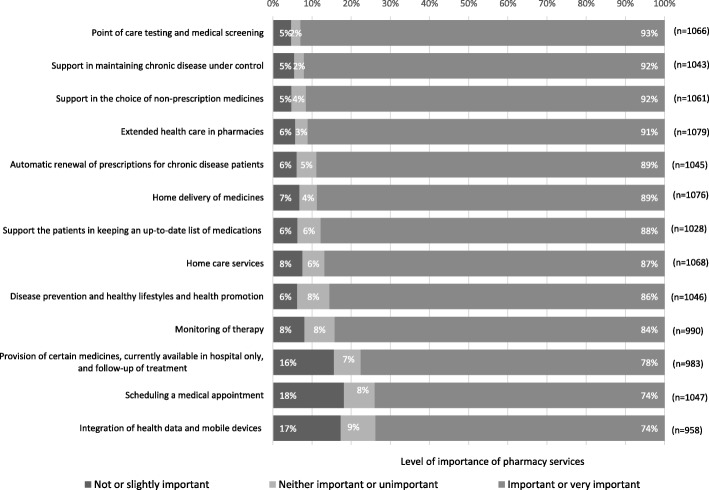
The vast majority of the Portuguese population has a strong positive attitude towards their community pharmacy, as expressed by the high levels of satisfaction with, and positive evaluation of, the pharmacy's services.
在全球范围内,社区药房在医疗保健系统中的角色正从单纯的药品分发者转变为医疗服务提供者。先前的研究发现,人们对药房服务的满意度很高。本研究有两个主要目标。首要目标是描述葡萄牙对药房服务的满意度和了解程度。次要目标是探究葡萄牙人对药房服务的看法和使用情况。这一表述包括探究一系列变量对当前所提供服务以及未来可能提供的新服务的药房认知和使用的影响。
2015年9月,对葡萄牙全国具有代表性的人群样本进行了一项封闭式问题的面对面调查。样本根据各地区、居住环境、年龄和性别的人口分布进行加权。数据分析包括描述性统计和多重对应分析,以探究受访者对社区药房的不同类型倾向。
该研究共进行了1114次访谈。在受访者中,36%的人在寻求治疗小病时将药房作为首选资源,54%的人表示在寻求药品相关答案时会将药房作为首选资源。在前一年至少去过一次药房的人中,94%的人总体满意或非常满意。葡萄牙人对药房服务的认知程度也很高。在参与者中,29%的人认为药房目前提供的服务可以比其他医疗保健机构提供的更多。构建社区药房实践倾向类型学产生了三个结果组:“积极型”(63%),与药房有联系的人;“稳定型”(23%),主要是附近有药房的人;“消极型”(14%),与药房联系薄弱的人。
绝大多数葡萄牙人对他们的社区药房持强烈的积极态度,这体现在对药房服务的高度满意和积极评价上。