Department of Experimental and Clinical Medicine, Magna Graecia University, Salvatore Venuta University Campus, Viale Europa, 88100, Catanzaro, Italy.
Medical and Translational Oncology Units, AOU Mater Domini, Catanzaro, Italy.
J Hematol Oncol. 2019 Mar 21;12(1):32. doi: 10.1186/s13045-019-0714-9.
Genomic instability is a feature of multiple myeloma (MM), and impairment in DNA damaging response (DDR) has an established role in disease pathobiology. Indeed, a deregulation of DNA repair pathways may contribute to genomic instability, to the establishment of drug resistance to genotoxic agents, and to the escape from immune surveillance. On these bases, we evaluated the role of different DDR pathways in MM and investigated, for the first time, the direct and immune-mediated anti-MM activity of the nucleotide excision repair (NER)-dependent agent trabectedin.
Gene-expression profiling (GEP) was carried out with HTA2.0 Affymetrix array. Evaluation of apoptosis, cell cycle, and changes in cytokine production and release have been performed in 2D and 3D Matrigel-spheroid models through flow cytometry on MM cell lines and patients-derived primary MM cells exposed to increasing nanomolar concentrations of trabectedin. DNA-damage response has been evaluated through Western blot, immunofluorescence, and DNA fragmentation assay. Trabectedin-induced activation of NK has been assessed by CD107a degranulation. miRNAs quantification has been done through RT-PCR.
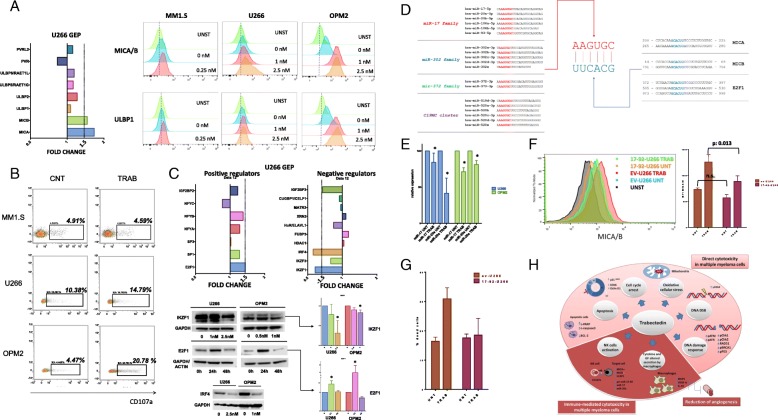
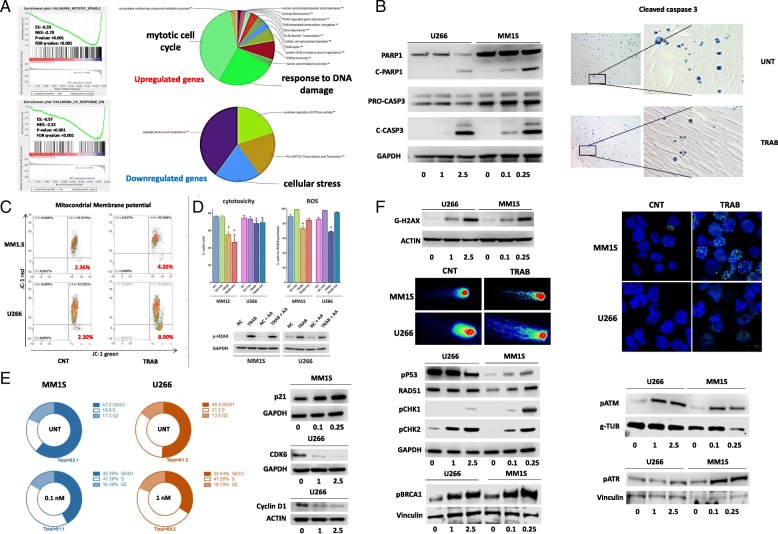
By comparing GEP meta-analysis of normal and MM plasma cells (PCs), we observed an enrichment in DNA NER genes in poor prognosis MM. Trabectedin triggered apoptosis in primary MM cells and MM cell lines in both 2D and 3D in vitro assays. Moreover, trabectedin induced DDR activation, cellular stress with ROS production, and cell cycle arrest. Additionally, a significant reduction of MCP1 cytokine and VEGF-A in U266-monocytes co-cultures was observed, confirming the impairment of MM-promoting milieu. Drug-induced cell stress in MM cells led to upregulation of NK activating receptors ligands (i.e., NKG2D), which translated into increased NK activation and degranulation. Mechanistically, this effect was linked to trabectedin-induced inhibition of NKG2D-ligands negative regulators IRF4 and IKZF1, as well as to miR-17 family downregulation in MM cells.
Taken together, our findings indicate a pleiotropic activity of NER-targeting agent trabectedin, which appears a promising candidate for novel anti-MM therapeutic strategies.
基因组不稳定性是多发性骨髓瘤(MM)的一个特征,而 DNA 损伤反应(DDR)的损伤在疾病发病机制中具有既定作用。事实上,DNA 修复途径的失调可能导致基因组不稳定性,导致对遗传毒性药物的耐药性的建立,并逃避免疫监视。基于这些基础,我们评估了不同 DDR 途径在 MM 中的作用,并首次研究了核苷酸切除修复(NER)依赖性药物 trabectedin 的直接和免疫介导的抗 MM 活性。
使用 HTA2.0 Affymetrix 阵列进行基因表达谱(GEP)分析。通过流式细胞术在 2D 和 3D Matrigel 球体模型中评估细胞凋亡、细胞周期以及细胞因子产生和释放的变化,用 trabectedin 处理 MM 细胞系和患者来源的原发性 MM 细胞,使其暴露于递增的纳摩尔浓度下。通过 Western blot、免疫荧光和 DNA 片段化测定评估 DNA 损伤反应。通过 CD107a 脱颗粒评估 trabectedin 诱导的 NK 激活。通过 RT-PCR 进行 miRNA 定量。
通过比较正常和 MM 浆细胞(PC)的 GEP 荟萃分析,我们观察到 DNA NER 基因在预后不良的 MM 中富集。在 2D 和 3D 体外试验中,trabectedin 均能诱导原发性 MM 细胞和 MM 细胞系的凋亡。此外,trabectedin 还诱导 DDR 激活、细胞应激导致 ROS 产生和细胞周期停滞。此外,在 U266-单核细胞共培养物中观察到 MCP1 细胞因子和 VEGF-A 的显著减少,证实了 MM 促进环境的受损。在 MM 细胞中,药物诱导的细胞应激导致 NK 激活受体配体(即 NKG2D)的上调,这转化为 NK 的激活和脱颗粒增加。从机制上讲,这种效应与 trabectedin 诱导的 NKG2D 配体负调节剂 IRF4 和 IKZF1 的抑制以及 MM 细胞中 miR-17 家族的下调有关。
总之,我们的研究结果表明,靶向 NER 的药物 trabectedin 具有多种活性,是一种很有前途的新型抗 MM 治疗策略的候选药物。