Department of Regional Health Research, University of Southern Denmark, Odense, Denmark.
Research department, Sygehus Sønderjylland, Aabenraa and King Christian X's Hospital for Rheumatic Diseases, Graasten, Denmark.
BMJ Open. 2019 Mar 20;9(3):e024338. doi: 10.1136/bmjopen-2018-024338.
To identify, appraise and synthesise qualitative studies on the experience of living with rheumatoid arthritis (RA)-related fatigue.
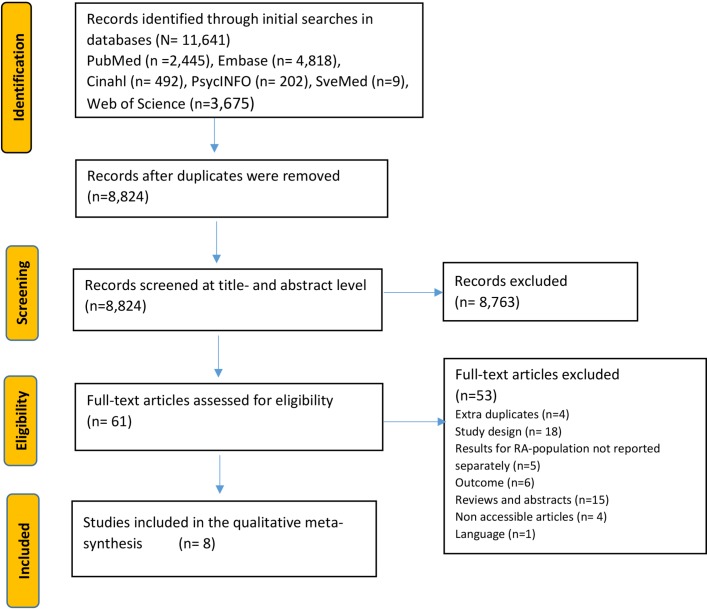
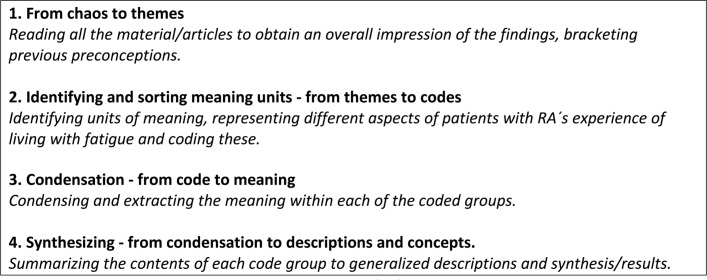
We conducted a qualitative metasynthesis encompassing a systematic literature search in February 2017, for studies published in the past 15 years, in PubMed, Cumulative Index to Nursing and Allied Health Literature (CINAHL), Embase, SveMed, PsychINFO and Web of Science. To be included, the studies had to report the experience of living with fatigue among adults with RA. The analysis and synthesis followed Malterud's systematic text condensation.
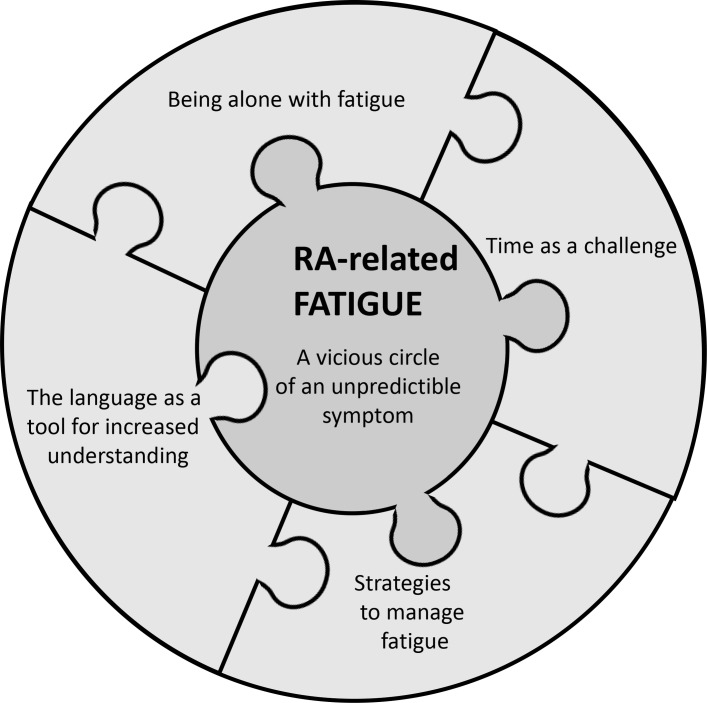
Eight qualitative articles were included, based on 212 people with RA (69% women) and aged between 20 and 83 years old. The synthesis resulted in the overall theme 'A vicious circle of an unpredictable symptom'. In addition, the synthesis derived four subthemes: 'being alone with fatigue'; 'time as a challenge'; 'language as a tool for increased understanding' and 'strategies to manage fatigue'. Fatigue affects all areas of everyday life for people with RA. They strive to plan and prioritise, pace, relax and rest. Furthermore, they try to make use of a variety of words and metaphors to explain to other people that they experience that RA-related fatigue is different from normal tiredness. Despite this, people with RA-related fatigue experience feeling alone with their symptom and they develop their own strategies to manage fatigue in their everyday life.
The unpredictability of RA-related fatigue is dominant, pervasive and is experienced as a vicious circle, which can be described in relation to its physical, cognitive, emotional and social impact. It is important for health professionals to acknowledge and address the impact of fatigue on the patients' everyday lives. Support from health professionals to manage fatigue and develop strategies to increase physical activity and maintain work is important for people with RA-related fatigue.
识别、评价并综合分析类风湿关节炎相关疲劳患者的生活体验相关的定性研究。
我们开展了一项定性整合研究,于 2017 年 2 月进行了系统的文献检索,检索范围包括过去 15 年发表的文献,检索数据库包括 PubMed、Cumulative Index to Nursing and Allied Health Literature(CINAHL)、Embase、SveMed、PsychINFO 和 Web of Science。纳入标准为报告成年类风湿关节炎患者疲劳生活体验的研究。分析和综合采用了 Malterud 的系统文本压缩法。
共纳入 8 篇定性研究,涉及 212 名类风湿关节炎患者(69%为女性),年龄 20 至 83 岁。综合分析得到的主题为“一个不可预测症状的恶性循环”。此外,综合分析还得到了四个亚主题:“独自面对疲劳”、“时间是一个挑战”、“语言是增加理解的工具”和“管理疲劳的策略”。疲劳会影响类风湿关节炎患者日常生活的各个方面,他们努力规划和优先安排、控制节奏、放松和休息。此外,他们试图使用各种词语和隐喻来向他人解释,让他人了解他们所经历的类风湿关节炎相关疲劳与正常疲劳不同。尽管如此,类风湿关节炎相关疲劳患者仍感到孤独无助,他们会在日常生活中制定自己的管理策略。
类风湿关节炎相关疲劳的不可预测性是主要的、普遍存在的,被体验为一个恶性循环,可以根据其对身体、认知、情感和社会的影响来描述。卫生专业人员承认并解决疲劳对患者日常生活的影响非常重要。卫生专业人员提供管理疲劳的支持,并制定增加身体活动和维持工作的策略,对类风湿关节炎相关疲劳患者很重要。