Olds Margie K, Ellis Richard, Parmar Priya, Kersten Paula
Flawless Motion, Auckland, New Zealand.
Health and Rehabilitation Research Institute, Auckland University of Technology, Auckland, New Zealand.
BMJ Open Sport Exerc Med. 2019 Mar 7;5(1):e000447. doi: 10.1136/bmjsem-2018-000447. eCollection 2019.
To develop a multivariate tool that would predict recurrent instability after a first-time traumatic anterior shoulder dislocation.
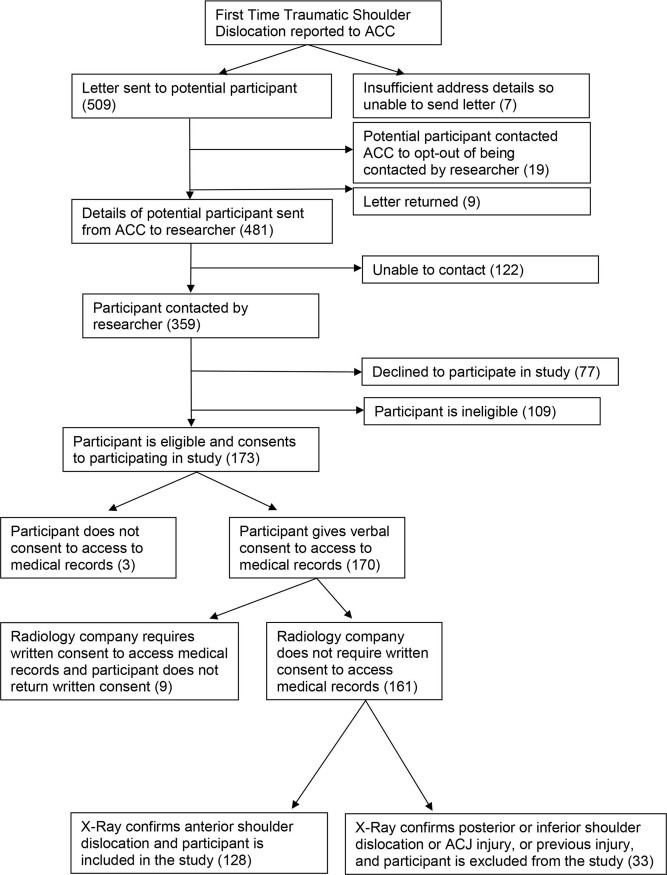
Participants (aged 16-40 years) were recruited across New Zealand into a prospective cohort study. Baseline data were collected during a telephone interview and through examination of radiology records. Variables associated with recurrent instability were selected for the multivariate logistic regression model using backwards selection (p<0.10). Coefficients for those variables retained in the model were used to develop the predictive tool.
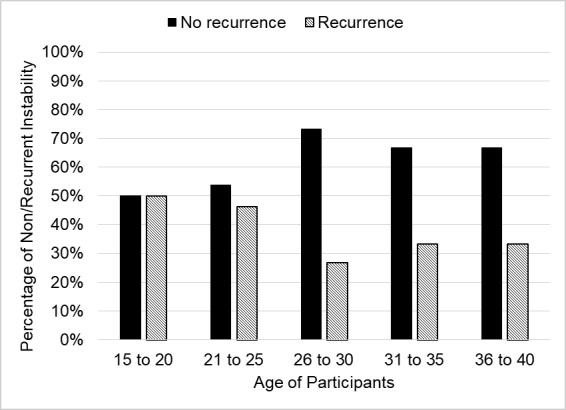
Among the 128 participants, 36% had redislocated at least once in the first 12 months. Univariate analysis showed an increased likelihood of recurrent dislocation with bony Bankart lesions (OR=3.65, 95% CI 1.05 to 12.70, p=0.04) and participants who had: not been immobilised in a sling (OR = 0.38, 95% CI 0.15 to 0.98, p=0.05), higher levels of shoulder activity (OR=1.13, 95% CI 1.01 to 1.27, p=0.03), higher levels of pain and disability (OR=1.03, 95% CI 1.01 to 1.06, p=0.02), higher levels of fear of reinjury (OR=1.12, 95% CI 1.01 to 1.26, p=0.04) and decreased quality of life (OR=1.01, 95% CI 1.00 to 1.02, p=0.05). There was no significant difference in those with non-dominant compared with dominant shoulder dislocations (p=0.10) or in those aged 16-25 years compared with 26-40 years (p=0.07).
Six of seven physical and psychosocial factors can be used to predict recurrent shoulder instability following a first-time traumatic anterior shoulder dislocation.
开发一种多变量工具,用于预测首次创伤性前肩脱位后的复发性不稳定。
在新西兰招募了年龄在16至40岁之间的参与者,进行一项前瞻性队列研究。通过电话访谈和检查放射学记录收集基线数据。使用向后选择法(p<0.10)为多变量逻辑回归模型选择与复发性不稳定相关的变量。模型中保留的那些变量的系数用于开发预测工具。
在128名参与者中,36%在最初12个月内至少再次脱位一次。单变量分析显示,伴有骨性Bankart损伤(OR=3.65,95%CI 1.05至12.70,p=0.04)以及具有以下情况的参与者复发性脱位的可能性增加:未用吊带固定(OR = 0.38,95%CI 0.15至0.98,p=0.05)、肩部活动水平较高(OR=1.13,95%CI 1.01至1.27,p=0.03)、疼痛和残疾水平较高(OR=1.03,95%CI 1.01至1.06,p=0.02)、再次受伤恐惧水平较高(OR=1.12,95%CI 1.01至1.26,p=0.04)以及生活质量下降(OR=1.01,95%CI 1.00至1.02,p=0.05)。非优势肩脱位与优势肩脱位的参与者之间(p=0.10)以及16至25岁与26至40岁的参与者之间(p=0.07)没有显著差异。
七个身体和心理社会因素中的六个可用于预测首次创伤性前肩脱位后的复发性肩部不稳定。