Loyer Xavier, Dubroca Caroline, Branchereau Maxime, Griffith Graziellia, Garcia Luis, Heymes Christophe
INSERM UMR-S 970, Paris Cardiovascular Research Center, France.
Université Paris Descartes, Sorbonne Paris Cité, France.
Biochem Biophys Rep. 2019 Mar 11;18:100620. doi: 10.1016/j.bbrep.2019.100620. eCollection 2019 Jul.
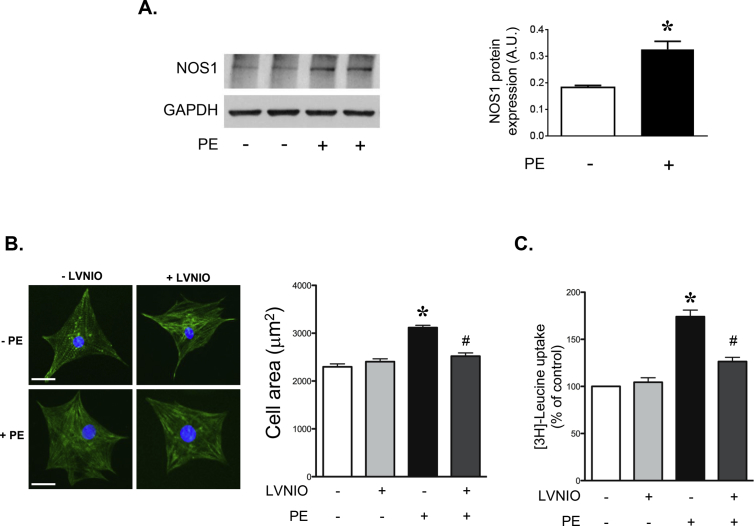
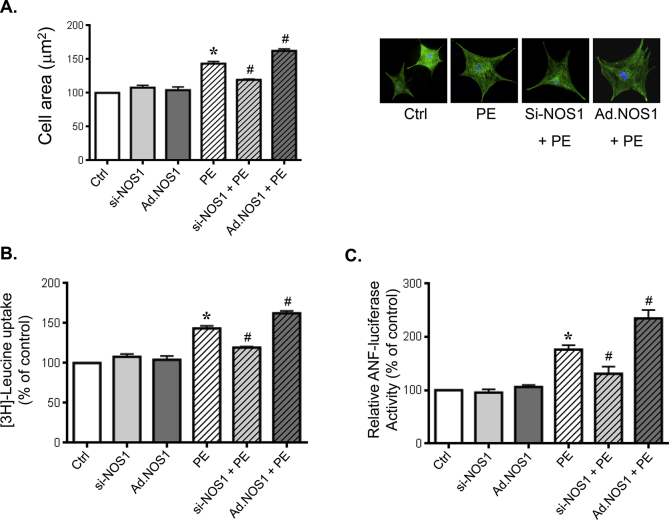
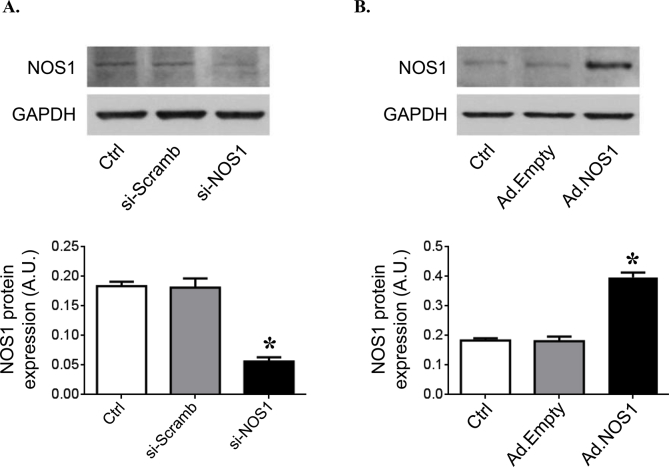
Neuronal nitric oxide synthase (NOS1) has been consistently shown to be the predominant isoform of NOS and/or NOS-derived NO that may be involved in the myocardial remodeling including cardiac hypertrophy. However, the direct functional contribution of NOS1 in this process remains to be elucidated. Therefore, in the present study, we attempted to use silent RNA and adenovirus mediated silencing or overexpression to investigate the role of NOS1 and the associated molecular signaling mechanisms during OKphenylephrine (PE)-induced cardiac hypertrophy growth in neonatal rat ventricular cardiomyocytes (NRVMs). We found that the expression of NOS1 was enhanced in PE-induced hypertrophic cardiomyocytes. Moreover, LVNIO treatment, a selective NOS1 inhibitor, significantly decreased PE-induced NRVMs hypertrophy and [H]-leucine incorporation. We demonstrated that NOS1 gene silencing attenuated both the increased size and the transcriptional activity of the hypertrophic marker atrial natriuretic factor (ANF) induced by PE stimulation. Further investigation suggested that deficiency of NOS1-induced diminished NRVMS hypertrophy resulted in decreased calcineurin protein expression and activity (assessed by measuring the transcriptional activity of NFAT) and, an increased activity of the anti-hypertrophic pathway, GSK-3β (estimated by its augmented phosphorylated level). In contrast, exposing the NOS1 overexpressed NRVMs to PE-treatment further increased the hypertrophic growth, ANF transcriptional activity and calcineurin activity. Together, the results of the present study suggest that NOS1 is directly involved in controlling the development of cardiomyocyte hypertrophy.
神经元型一氧化氮合酶(NOS1)一直被证明是一氧化氮合酶(NOS)和/或源自NOS的一氧化氮(NO)的主要亚型,可能参与包括心肌肥大在内的心肌重塑过程。然而,NOS1在此过程中的直接功能作用仍有待阐明。因此,在本研究中,我们试图利用小干扰RNA以及腺病毒介导的沉默或过表达,来研究在苯肾上腺素(PE)诱导的新生大鼠心室心肌细胞(NRVMs)肥大生长过程中,NOS1的作用以及相关的分子信号机制。我们发现,在PE诱导的肥大心肌细胞中,NOS1的表达增强。此外,LVNIO(一种选择性NOS1抑制剂)处理显著降低了PE诱导的NRVMs肥大以及[H]-亮氨酸掺入。我们证明,NOS1基因沉默减弱了PE刺激诱导的肥大标志物心房钠尿肽(ANF)的大小增加和转录活性。进一步研究表明,NOS1缺乏导致NRVMS肥大减轻,这使得钙调神经磷酸酶蛋白表达和活性降低(通过测量NFAT的转录活性来评估),以及抗肥大途径GSK-3β的活性增加(通过其增强的磷酸化水平来估计)。相反,将过表达NOS1的NRVMs暴露于PE处理下,会进一步增加肥大生长、ANF转录活性和钙调神经磷酸酶活性。总之,本研究结果表明,NOS1直接参与控制心肌细胞肥大发育。