Mercy Health Osteoporosis and Bone Health Services, Cincinnati, OH, USA.
Radius Health, Inc., Waltham, MA, USA.
Osteoporos Int. 2019 Jun;30(6):1187-1194. doi: 10.1007/s00198-019-04890-2. Epub 2019 Mar 21.
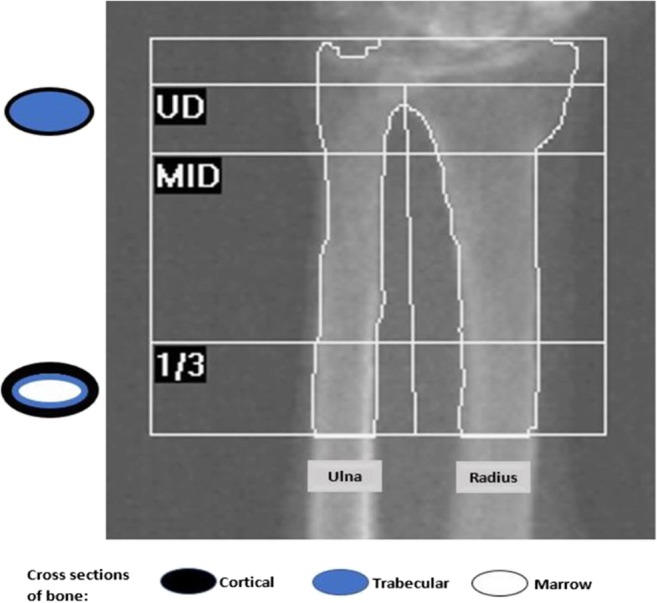
Wrist fractures are common, contribute significantly to morbidity in women with postmenopausal osteoporosis, and occur predominantly at the ultradistal radius, a site rich in trabecular bone. This exploratory analysis of the phase 3 ACTIVE study evaluated effects of abaloparatide versus placebo and teriparatide on forearm bone mineral density (BMD) and risk of wrist fracture.
Forearm BMD was measured by dual energy X-ray absorptiometry in a subset of 982 women from ACTIVE, evenly distributed across the three treatment groups. Wrist fractures were ascertained in the total cohort (N = 2463).
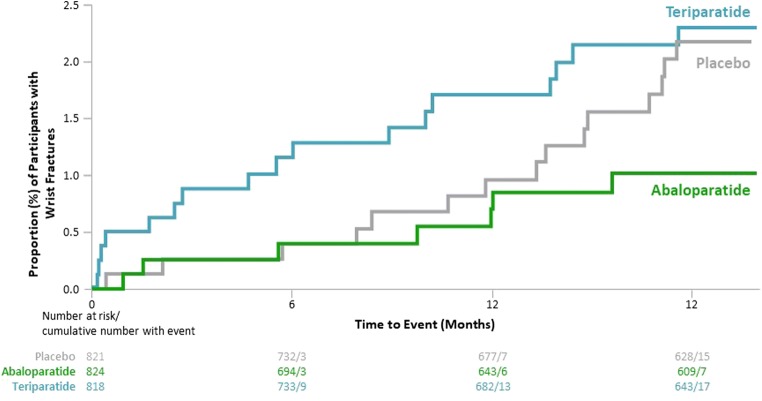
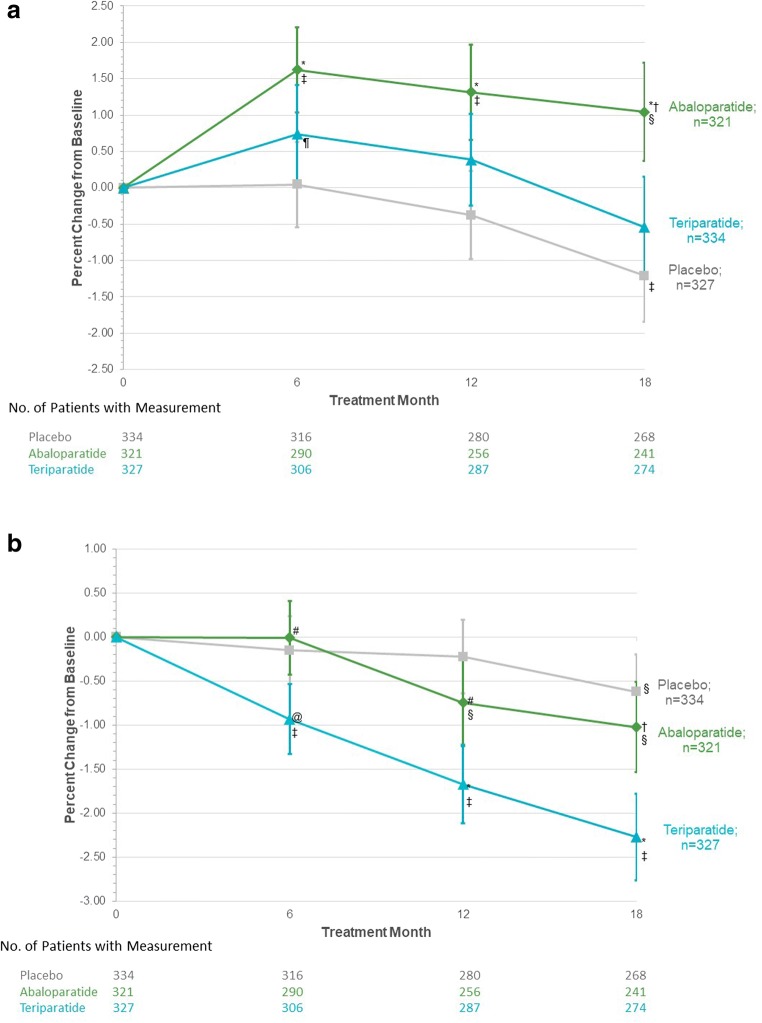
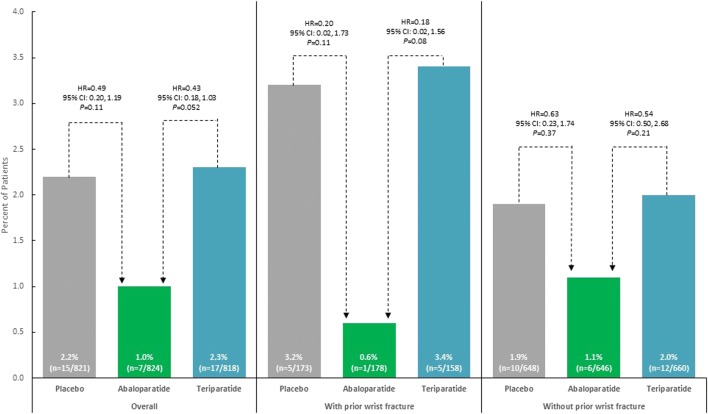
After 18 months, ultradistal radius BMD changes from baseline were 2.25 percentage points greater for abaloparatide compared with placebo (95% confidence interval (CI) 1.38, 3.12, p < 0.001) and 1.54 percentage points greater for abaloparatide compared with teriparatide (95% CI 0.64, 2.45, p < 0.001). At 18 months, 1/3 radius BMD losses (versus baseline) were similar for abaloparatide compared with placebo (-0.42; 95% CI -1.03, 0.20; p = 0.19) but losses with teriparatide exceeded those of placebo (-1.66%; 95% CI -2.27, -1.06; p < 0.001). The decline with abaloparatide was less than that seen with teriparatide (group difference 1.22%; 95% CI 0.57, 1.87; p < 0.001). The radius BMD findings, at both ultradistal and 1/3 sites, are consistent with the numerically lower incidence of wrist fractures observed in women treated with abaloparatide compared with teriparatide (HR = 0.43; 95% CI 0.18, 1.03; p = 0.052) and placebo (HR = 0.49, 95% CI 0.20, 1.19, p = 0.11).
Compared with teriparatide, abaloparatide increased BMD at the ultradistal radius (primarily trabecular bone) and decreased BMD to a lesser extent at the 1/3 radius (primarily cortical bone), likely contributing to the numerically lower wrist fracture incidence observed with abaloparatide.
腕骨骨折很常见,会显著增加绝经后骨质疏松女性的发病率,而且主要发生在超远端桡骨,这个部位富含小梁骨。这项对 3 期 ACTIVE 研究的探索性分析评估了abaloparatide 与安慰剂和特立帕肽对前臂骨密度(BMD)和腕骨骨折风险的影响。
ACTIVE 研究中的 982 名女性被随机分为三组,每组女性数量相等,通过双能 X 射线吸收法测量前臂 BMD。总队列(n=2463)中确定了腕骨骨折情况。
18 个月后,与安慰剂相比,abaloparatide 使超远端桡骨的骨密度从基线增加了 2.25 个百分点(95%置信区间(CI)1.38,3.12,p<0.001),与特立帕肽相比增加了 1.54 个百分点(95%CI 0.64,2.45,p<0.001)。18 个月时,与基线相比,abaloparatide 组的 1/3 桡骨 BMD 损失与安慰剂相似(-0.42;95%CI -1.03,0.20;p=0.19),但特立帕肽组的损失大于安慰剂组(-1.66%;95%CI -2.27,-1.06;p<0.001)。与特立帕肽相比,abaloparatide 引起的 BMD 下降幅度较小(组间差异 1.22%;95%CI 0.57,1.87;p<0.001)。超远端和 1/3 部位的桡骨 BMD 结果与 abaloparatide 治疗组腕骨骨折发生率低于特立帕肽(HR=0.43;95%CI 0.18,1.03;p=0.052)和安慰剂(HR=0.49,95%CI 0.20,1.19,p=0.11)的数值一致。
与特立帕肽相比,abaloparatide 增加了超远端桡骨(主要是小梁骨)的骨密度,并且在 1/3 桡骨(主要是皮质骨)的骨密度下降幅度较小,这可能是 abaloparatide 观察到的腕骨骨折发生率较低的原因。