Institut de Recherche Pour le Développement-Centre Population et Développement, Institut National de la Santé et de la Recherche Médicale, Université Paris Descartes, Paris, France.
JAMA Netw Open. 2019 Mar 1;2(3):e190526. doi: 10.1001/jamanetworkopen.2019.0526.
The World Health Organization recommends that rates of cesarean delivery range from 10% to 15%. India has the largest annual number of births in the world and needs updates of existing estimates.
To provide a new set of estimates of the rates of cesarean delivery and to map regional and socioeconomic disparities within these rates in India.
DESIGN, SETTING, AND PARTICIPANTS: Cross-sectional study primarily based on cross-sectional figures drawn from the fourth round of the National Family and Health Survey conducted from January 20, 2015, through December 4, 2016, by the Indian Institute for Population Sciences in Mumbai. The survey interviewed 699 686 girls and women aged 15 to 49 years and collected information on their last 3 pregnancies since January 2010 (259 627 births). The study population was statistically representative of India's 36 states and Union territories and its 640 districts. The survey also included information on the socioeconomic status of households. The research is based on data tabulations and mapping and on spatial and regression analyses of microdata. Socioeconomic inequalities in access to cesarean deliveries were assessed using the Gini coefficient. Data were analyzed from August to October 2018.
Rate of cesarean deliveries by regional and socioeconomic characteristics.
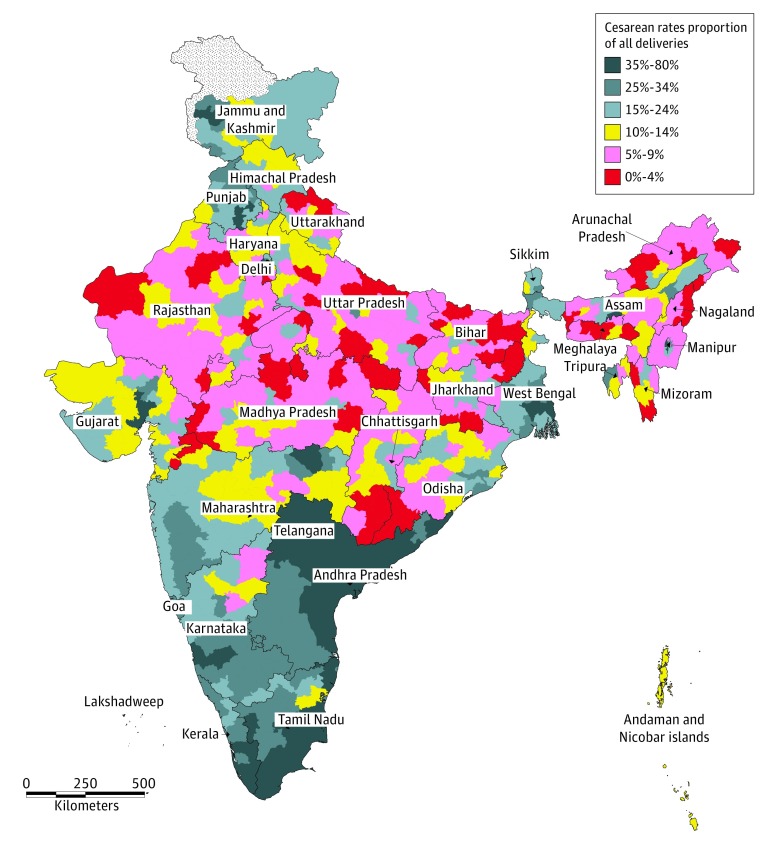
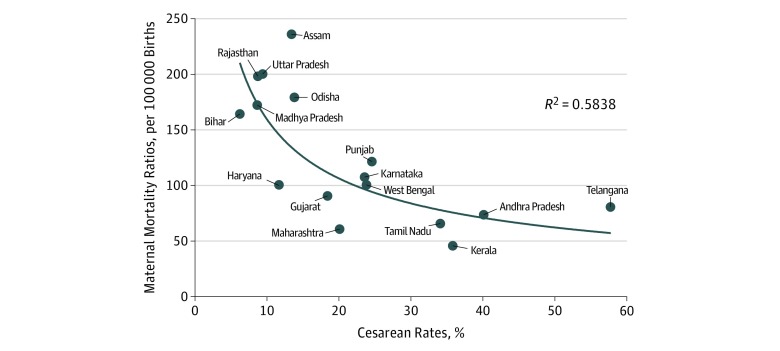
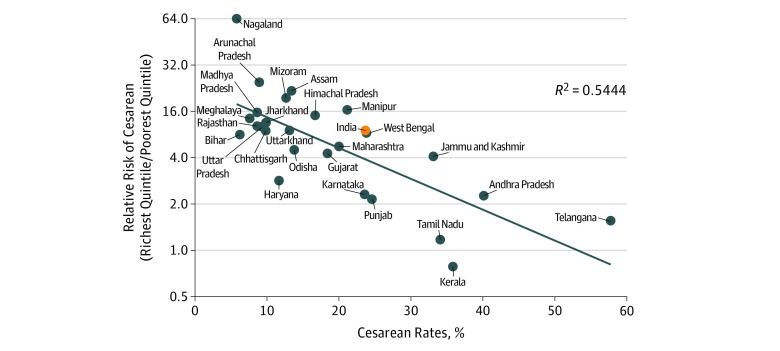
The cesarean birth rate computed for 699 686 Indian girls and women aged 15 to 49 years (mean [SD] age, 26.8 [5.0] years) was 17.2% (95% CI, 17.1%-17.3%) in 2010 to 2016, which corresponds to an estimated 4.38 million cesarean deliveries per year during the period (95% CI, 4.34-4.41 million) in India. Cesarean birth rates vary widely within the country, with a range of 5.8% (95% CI, 5.1%-6.5%) to 40.1% (95% CI, 38.4%-41.8%) across states and 4.4% (95% CI, 4.3%-4.6%) to 35.9% (35.4%-36.4%) across socioeconomic quintiles. The rate significantly increased from 9.2% (95% CI, 9.1%-9.3%) in 2004 to 2008. According to the recommended 10% to 15% benchmark of cesarean birth rates by the WHO, the estimated deficit of cesarean births in India is 0.5 million per year, whereas the estimated excess of cesarean births is 1.8 million. The overall Gini coefficient of inequality in access to cesarean deliveries is 46.4.
The rate of cesarean births is increasing in India and has already crossed the World Health Organization threshold of 15%. More research is needed to understand the factors behind the rapid rise of cesarean deliveries among affluent groups and in more developed regions.
世界卫生组织建议剖宫产率应在 10%至 15%之间。印度每年的分娩量居世界首位,需要更新现有的估计数据。
提供一组新的剖宫产率估计值,并绘制印度国内剖宫产率的区域和社会经济差异图。
设计、地点和参与者:本横断面研究主要基于 2015 年 1 月 20 日至 2016 年 12 月 4 日期间由印度人口科学研究所进行的第四次全国家庭与健康调查的横断面数据。该调查采访了 699686 名年龄在 15 至 49 岁的女孩和妇女,并收集了自 2010 年 1 月以来的最近 3 次妊娠信息(259627 例分娩)。研究人群在统计学上代表了印度的 36 个邦和联邦属地以及 640 个县。该调查还包括了有关家庭社会经济状况的信息。本研究基于数据制表和制图以及微观数据的空间和回归分析。利用基尼系数评估获得剖宫产的社会经济不平等情况。数据分析于 2018 年 8 月至 10 月进行。
按区域和社会经济特征划分的剖宫产率。
对 699686 名年龄在 15 至 49 岁的印度女孩和妇女(平均[标准差]年龄为 26.8[5.0]岁)的剖宫产分娩率进行计算,在 2010 年至 2016 年期间,剖宫产率为 17.2%(95%置信区间,17.1%-17.3%),这相当于同期印度每年估计有 438 万例剖宫产(95%置信区间,434 万-441 万)。印度国内剖宫产率差异很大,各州之间的范围为 5.8%(95%置信区间,5.1%-6.5%)至 40.1%(95%置信区间,38.4%-41.8%),社会经济五分位数之间的范围为 4.4%(95%置信区间,4.3%-4.6%)至 35.9%(35.4%-36.4%)。该比率从 2004 年至 2008 年的 9.2%(95%置信区间,9.1%-9.3%)显著增加。根据世界卫生组织建议的 10%至 15%剖宫产率基准,印度每年估计有 0.5 万例剖宫产不足,而估计有 180 万例剖宫产过多。剖宫产获取机会不平等的总体基尼系数为 46.4。
印度的剖宫产率正在上升,已经超过了世界卫生组织 15%的阈值。需要进一步研究以了解富裕群体和较发达地区剖宫产率迅速上升的背后因素。