Senior Scientist Group Nutrition, Immunity and Metabolism, Department of Nutrition and Gerontology, German Institute of Human Nutrition Potsdam-Rehbrücke (DIfE), Nuthetal, Germany.
German Centre for Cardiovascular Research (DZHK), Berlin, Germany.
JAMA Netw Open. 2019 Mar 1;2(3):e190896. doi: 10.1001/jamanetworkopen.2019.0896.
Inflammatory processes have been suggested to have an important role in colorectal cancer (CRC) etiology. Chemerin is a recently discovered inflammatory biomarker thought to exert chemotactic, adipogenic, and angiogenic functions. However, its potential link with CRC has not been sufficiently explored.
To evaluate the prospective association of circulating plasma chemerin concentrations with incident CRC.
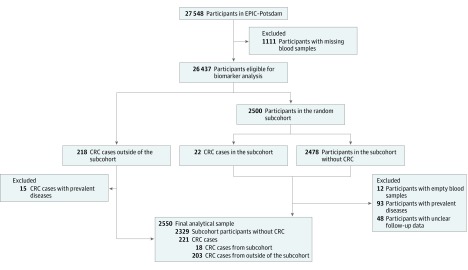
DESIGN, SETTING, AND PARTICIPANTS: Prospective case-cohort study based on 27 548 initially healthy participants from the European Prospective Investigation Into Cancer and Nutrition (EPIC)-Potsdam cohort who were followed for up to 16 years. Baseline study information and samples were collected between August 23, 1994, and September 25, 1998. Recruitment was according to random registry sampling from the geographical area of Potsdam, Germany, and surrounding municipalities. The last date of study follow-up was May 10, 2010. Statistical analysis was conducted in 2018.
Incident CRC, colon cancer, and rectal cancer. Baseline chemerin plasma concentrations were measured by enzyme-linked immunosorbent assay.
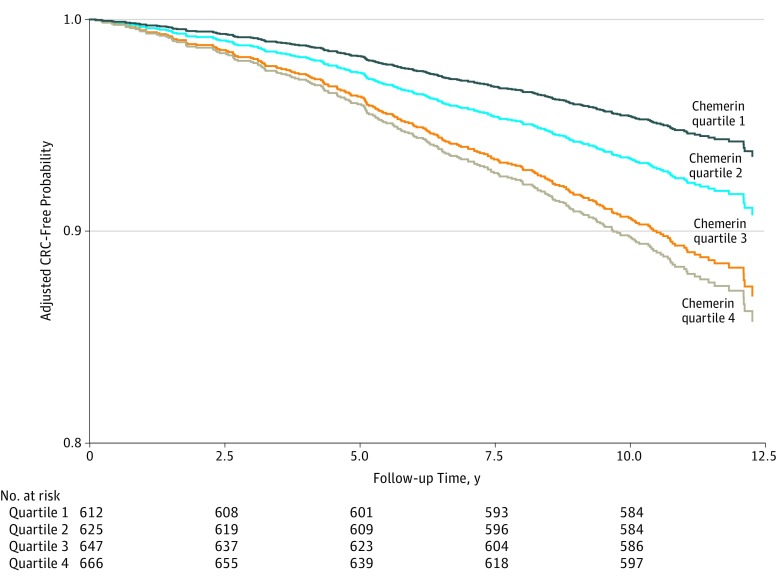
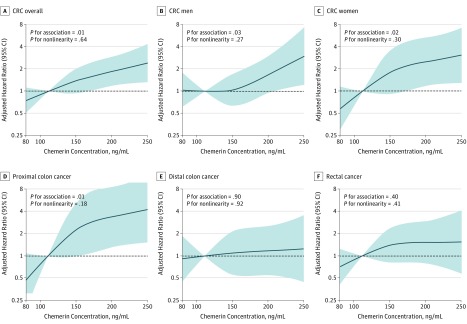
A random subcohort of 221 incident CRC cases and 2329 participants free of CRC with available blood sample measurements were included in the analysis. The participants' mean (SD) age was 50 (9) years, 62.1% were female, and 16.5% had a body mass index greater than 30. In multivariable-adjusted Cox proportional hazards regression models taking into account established CRC risk factors, higher chemerin concentrations were associated with a greater risk of CRC, with a hazard ratio (HR) of 1.81 (95% CI, 1.08-3.05; P for trend = .007) for the highest chemerin quartile vs the lowest. Analyses by cancer subsite indicated a stronger association with colon cancer (HR, 2.27; 95% CI, 1.18-4.34 for the highest quartile vs the lowest; P for trend = .005) compared with rectal cancer (HR, 1.27; 95% CI, 0.57-2.85; P for trend = .35). The association was particularly strong for proximal colon cancer (HR, 3.97; 95% CI, 1.51-10.50; P for trend = .001).
This study found that the association between chemerin concentration and the risk of incident CRC was linear and independent of established CRC risk factors. Further studies are warranted to evaluate chemerin as a novel immune-inflammatory agent in colorectal carcinogenesis.
炎症过程被认为在结直肠癌(CRC)发病机制中起着重要作用。Chemerin 是一种最近发现的炎症生物标志物,被认为具有趋化、脂肪生成和血管生成功能。然而,其与 CRC 的潜在联系尚未得到充分探索。
评估循环血浆 chemerin 浓度与 CRC 发病风险的前瞻性关联。
设计、地点和参与者:这是一项基于欧洲癌症前瞻性调查和营养(EPIC)-波茨坦队列的 27548 名最初健康参与者的前瞻性病例-队列研究,随访时间长达 16 年。基线研究信息和样本于 1994 年 8 月 23 日至 1998 年 9 月 25 日之间收集。招募是根据德国波茨坦地区及其周边市镇的地理区域的随机登记抽样进行的。研究随访的最后日期是 2010 年 5 月 10 日。统计分析于 2018 年进行。
CRC 发病、结肠癌和直肠癌。通过酶联免疫吸附试验测量基线 chemerin 血浆浓度。
纳入了 221 例 CRC 病例和 2329 例无 CRC 且可获得血液样本测量的参与者的随机亚队列进行分析。参与者的平均(SD)年龄为 50(9)岁,62.1%为女性,16.5%的体重指数大于 30。在多变量调整的 Cox 比例风险回归模型中,考虑到已确立的 CRC 风险因素,较高的 chemerin 浓度与更高的 CRC 风险相关,最高 quartile 的 HR 为 1.81(95%CI,1.08-3.05;P 趋势=0.007)。按癌症部位分析表明,与直肠癌(HR,1.27;95%CI,0.57-2.85;P 趋势=0.35)相比,与结肠癌(HR,2.27;95%CI,1.18-4.34;P 趋势=0.005)的相关性更强。对于近端结肠癌(HR,3.97;95%CI,1.51-10.50;P 趋势=0.001),这种相关性尤其强烈。
本研究发现,chemerin 浓度与 CRC 发病风险之间的关联呈线性,且独立于已确立的 CRC 风险因素。需要进一步的研究来评估 chemerin 作为结直肠癌变中一种新的免疫炎症因子的作用。