Institute of Health and Biomedical Innovation, School of Exercise and Nutrition Sciences, Queensland University of Technology, Brisbane, Australia.
Department of Sport and Exercise Science, University of Portsmouth, Portsmouth, United Kingdom.
PLoS One. 2019 Mar 22;14(3):e0214223. doi: 10.1371/journal.pone.0214223. eCollection 2019.
Passive heating (PH) has begun to gain research attention as an alternative therapy for cardio-metabolic diseases. Whether PH improves glycaemic control in diabetic and non-diabetic individuals is unknown. This study aims to review and conduct a meta-analysis of published literature relating to PH and glycaemic control.
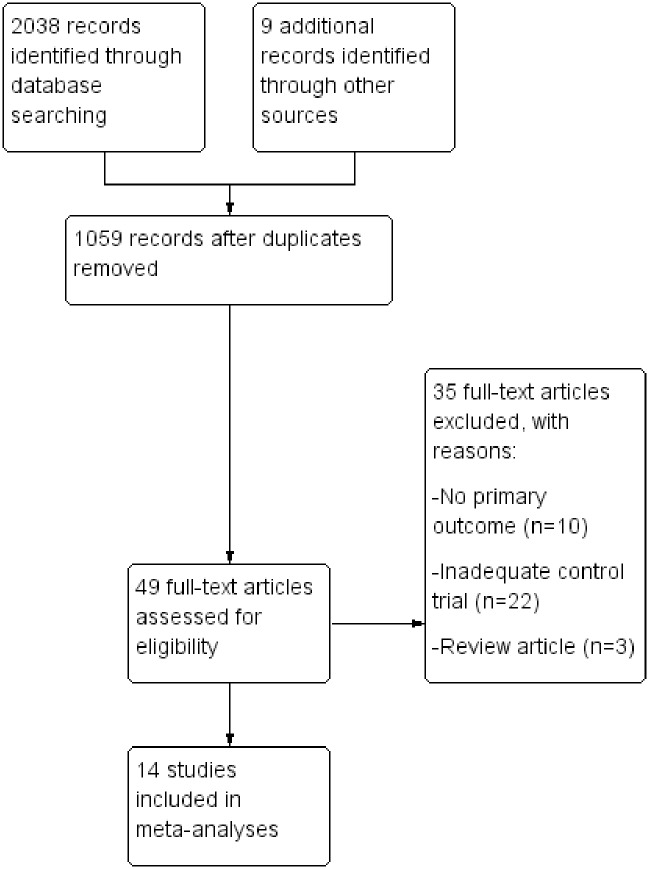
Electronic data sources, PubMed, Embase and Web of Science from inception to July 2018 were searched for randomised controlled trials (RCT) studying the effect of PH on glycaemic control in diabetic or non-diabetic individuals. To measure the treatment effect, standardised mean differences (SMD) with 95% confidence intervals (CI) were calculated.
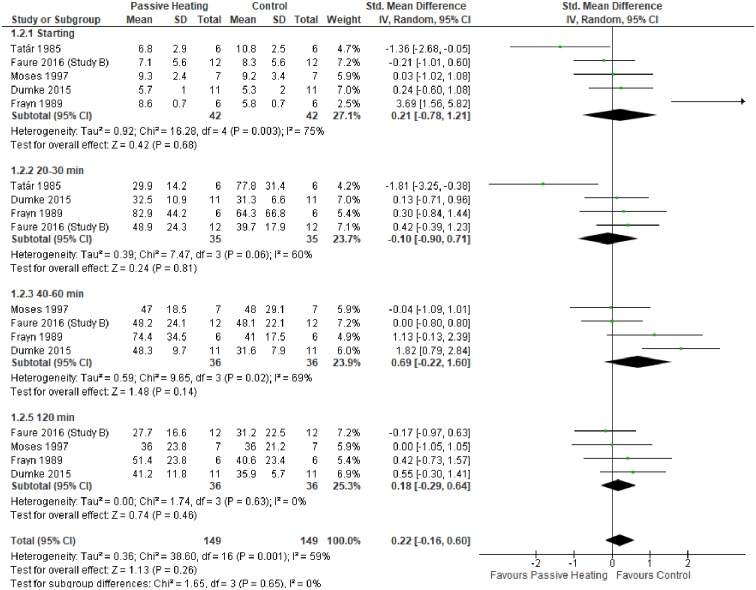
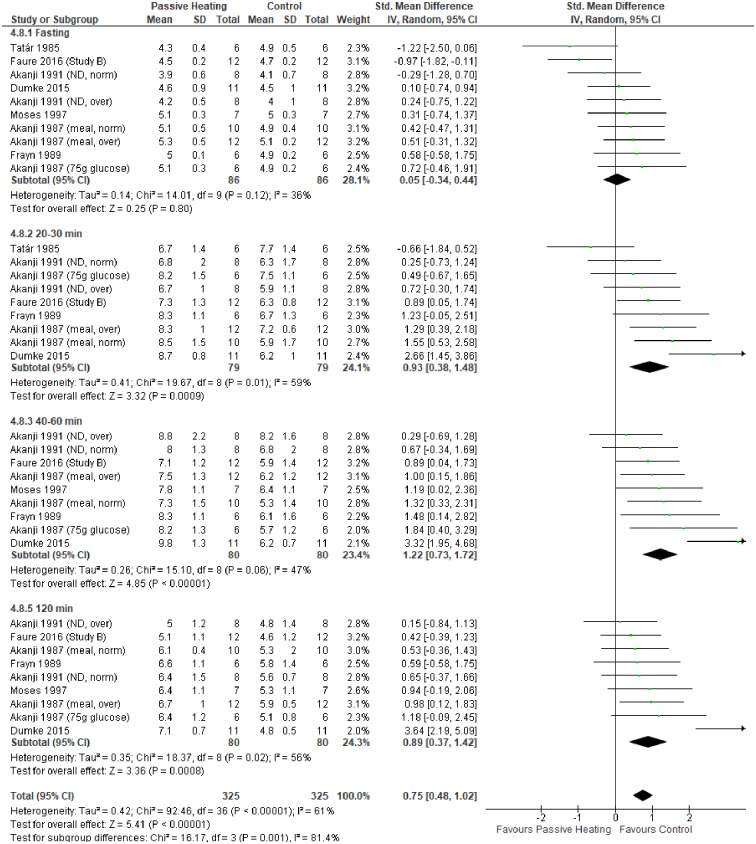
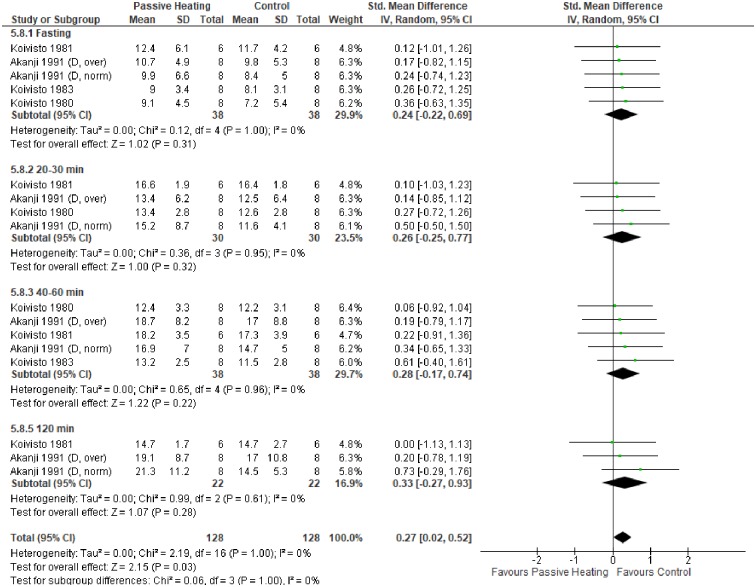
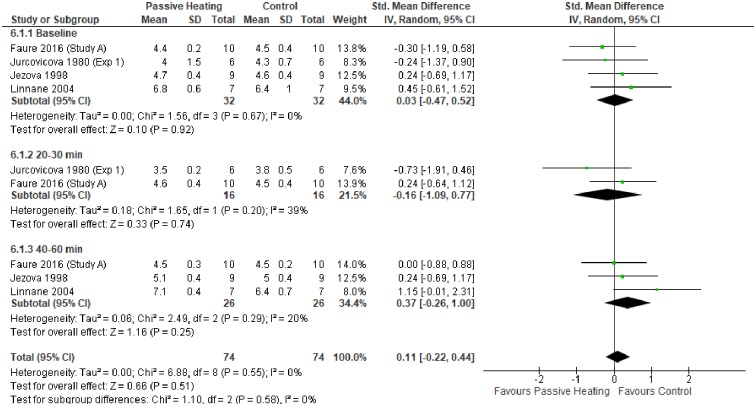
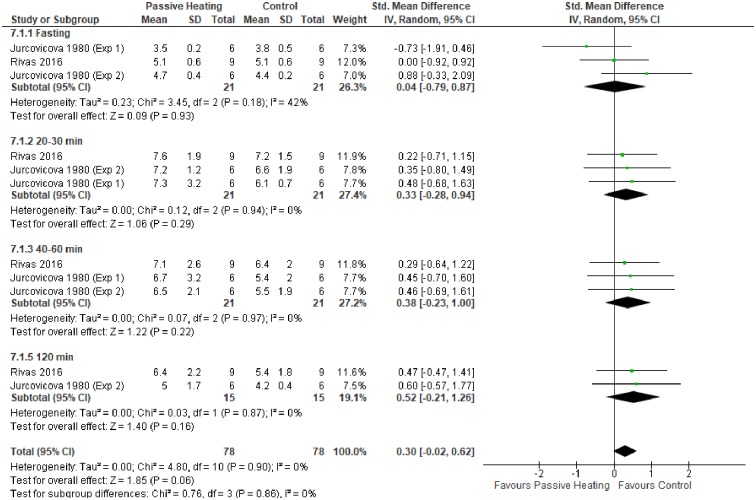
Fourteen articles were included in the meta-analysis. Following a glucose load, glucose concentration was greater during PH in non-diabetic (SMD 0.75, 95% CI 1.02 to 0.48, P < 0.001) and diabetic individuals (SMD 0.27, 95% CI 0.52 to 0.02, P = 0.030). In non-diabetic individuals, glycaemic control did not differ between PH and control only (SMD 0.11, 95% CI 0.44 to -0.22, P > 0.050) and a glucose challenge given within 24 hours post-heating (SMD 0.30, 95% CI 0.62 to -0.02, P > 0.050).
PH preceded by a glucose load results in acute glucose intolerance in non-diabetic and diabetic individuals. However, heating a non-diabetic individual without a glucose load appears not to affect glycaemic control. Likewise, a glucose challenge given within 24 hours of a single-bout of heating does not affect glucose tolerance in non-diabetic individuals. Despite the promise PH may hold, no short-term benefit to glucose tolerance is observed in non-diabetic individuals. More research is needed to elucidate whether this alternative therapy benefits diabetic individuals.
被动加热(PH)作为一种治疗心血管代谢疾病的替代疗法,开始引起研究关注。目前尚不清楚 PH 是否能改善糖尿病和非糖尿病个体的血糖控制。本研究旨在综述和荟萃分析已发表的关于 PH 与血糖控制相关的文献。
从建库到 2018 年 7 月,检索了电子数据库 PubMed、Embase 和 Web of Science 中关于 PH 对糖尿病或非糖尿病个体血糖控制影响的随机对照试验(RCT)。为了衡量治疗效果,计算了标准化均数差值(SMD)及其 95%置信区间(CI)。
共有 14 篇文章纳入荟萃分析。在给予葡萄糖负荷后,非糖尿病者在 PH 期间血糖浓度更高(SMD 0.75,95%CI 1.02 至 0.48,P < 0.001)和糖尿病者(SMD 0.27,95%CI 0.52 至 0.02,P = 0.030)。在非糖尿病者中,PH 与对照组之间的血糖控制无差异(SMD 0.11,95%CI 0.44 至 -0.22,P > 0.050),且在加热后 24 小时内给予葡萄糖刺激(SMD 0.30,95%CI 0.62 至 -0.02,P > 0.050)。
给予葡萄糖负荷前进行 PH 会导致非糖尿病者和糖尿病者出现急性葡萄糖不耐受。然而,对非糖尿病者进行无葡萄糖负荷的加热似乎不会影响血糖控制。同样,在单次加热后 24 小时内给予葡萄糖刺激不会影响非糖尿病者的葡萄糖耐量。尽管 PH 可能具有一定的前景,但在非糖尿病者中并未观察到对葡萄糖耐量的短期益处。需要进一步研究阐明这种替代疗法是否对糖尿病患者有益。